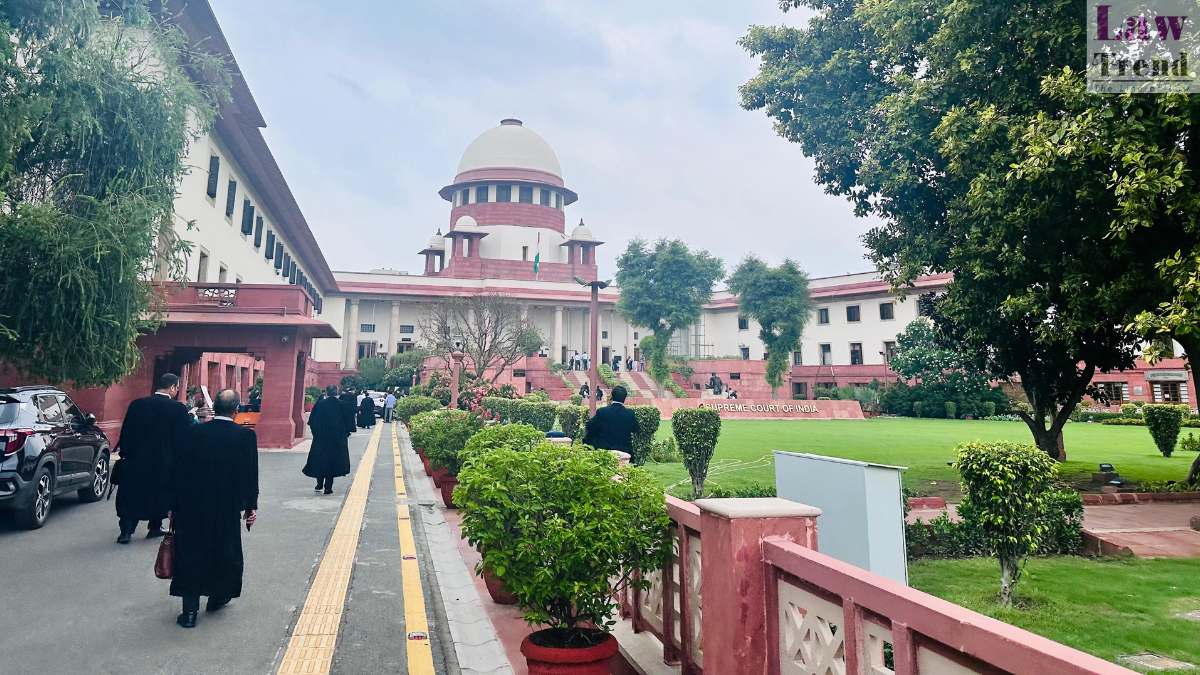
The Supreme Court of India has ruled that a High Court cannot revisit or disturb the finality of an order passed by the Apex Court in favor of a litigant. The Court also clarified the legal avenues available to individuals who are not parties to a proceeding but are adversely affected by a judgment in rem, particularly in service jurisprudence.
A bench comprising Justice Dipankar Datta and Justice Aravind Kumar delivered the judgment while adjudicating appeals arising out of a protracted dispute regarding the qualification and promotion of technical education teachers in Kerala.
Background of the Case
The dispute stems from Rule 6A of the Kerala Technical Education Service (Amendment) Rules, 2004, which granted exemption and a seven-year relaxation period for acquiring a Ph.D. degree for promotions to the posts of Assistant Professor (later re-designated as Associate Professor) and Professor. This was in response to All India Council of Technical Education (AICTE) notifications prescribing a Ph.D. as a minimum qualification.
The Kerala High Court initially struck down Rule 6A. However, the Supreme Court, in its 2016 judgment in Christy James Jose v. State of Kerala, set aside the High Court’s decision and upheld the appointments made under the rule. Following this, the appellants in the present case (Dr. Jiji K.S. & Ors.) secured a similar relief from the Supreme Court in Civil Appeal No. 4502 of 2016. In compliance, the State Government promoted them to the cadre of Associate Professor with retrospective effect via a Government Order (GO) in March 2019.
Subsequently, a fresh round of litigation erupted when Original Applications were filed before the Kerala Administrative Tribunal (KAT) challenging various other GOs related to promotions and reversions. The KAT quashed those GOs. When the matter reached the Kerala High Court, the Court, via its judgment dated December 3, 2020, laid down sweeping directives stating that AICTE Regulations override State Rules and that a Ph.D. was mandatory for promotions post-March 5, 2010.
The appellants, who were not parties to the proceedings before the KAT or the High Court, approached the Supreme Court, contending that the High Court’s generalized directives effectively undid the benefits granted to them by the Supreme Court’s 2016 orders.
Arguments of the Parties
Senior Counsel Mr. Jaideep Gupta, representing the appellants, argued that the High Court had essentially revisited the Supreme Court’s finalized order qua the appellants. He contended that since the Supreme Court had already settled the appellants’ rights and granted an order in their favor, the High Court could not disturb that finality.
In a connected matter (SLP (Civil) No. 18961/2022), the petitioner’s counsel, Smt. Vaheeda Babu, submitted that her client was prejudicially affected as his date of promotion as a Professor was reassigned to his disadvantage due to the High Court’s judgment, even though he was not a party to those proceedings.
Court’s Analysis and Observations
The Supreme Court agreed with the appellants’ contention regarding the finality of Apex Court orders. Noting that the appellants were promoted in compliance with the Court’s 2016 directions, the bench observed:
“This Court, having granted an order in favour of the appellants, there could arise no occasion for the High Court to disturb the finality attached to the same.”
However, the Court pointed out that had the appellants been impleaded before the High Court and the prior Supreme Court order placed on record, the current situation might not have arisen.
Addressing the broader legal issue of non-parties being affected by judgments in service matters, the Court relied on established precedents to outline the available remedies:
- Review Petitions for Non-Parties: Citing the decision in K. Ajit Babu v. Union of India (1997), the Court noted that judgments in service matters often act as “judgments in rem.” Consequently, a “right of review is available to the aggrieved persons on restricted ground mentioned in Order 47 of the Code of Civil Procedure if filed within the period of limitation.”
- Fresh Applications before Tribunals: Relying on Rama Rao v. M.G. Maheshwara Rao (2007), the Court observed that individuals not impleaded in a prior proceeding have an avenue to ventilate their grievances by moving an application under Section 19 of the Administrative Tribunals Act.
- Locus Standi to Seek Review: The bench also referred to Union of India v. Nareshkumar Badrikumar Jagad (2019), which held that even a non-party who “perceives to be in the position of a person aggrieved and satisfies the court as such, can seek review of an order passed therein.”
The Decision
The Supreme Court allowed the appeal filed by Dr. Jiji K.S. & Ors., strictly limiting the relief to their specific claims. The bench directed that “nothing said in the impugned order of the High Court will affect their career prospects in view of the special facts noticed above.”
Regarding the intervenors and the petitioner in the connected Special Leave Petition who were aggrieved by the High Court’s order but were not parties to it, the Supreme Court declined to enter into individual factual findings. Instead, the Court disposed of their applications and petitions, granting them the liberty to “pursue an appropriate remedy before the appropriate forum” in accordance with the law and the cited precedents.
- Case Title: Dr. Jiji K.S. & Ors. v. Shibu K & Ors. (with Dr. Bindu Kumar K v. Dr. V. Venu IAS)
- Case Number: Civil Appeal No. of 2026 (Arising out of SLP (Civil) No. 8737 of 2021) & SLP (Civil) No. 18961/2022