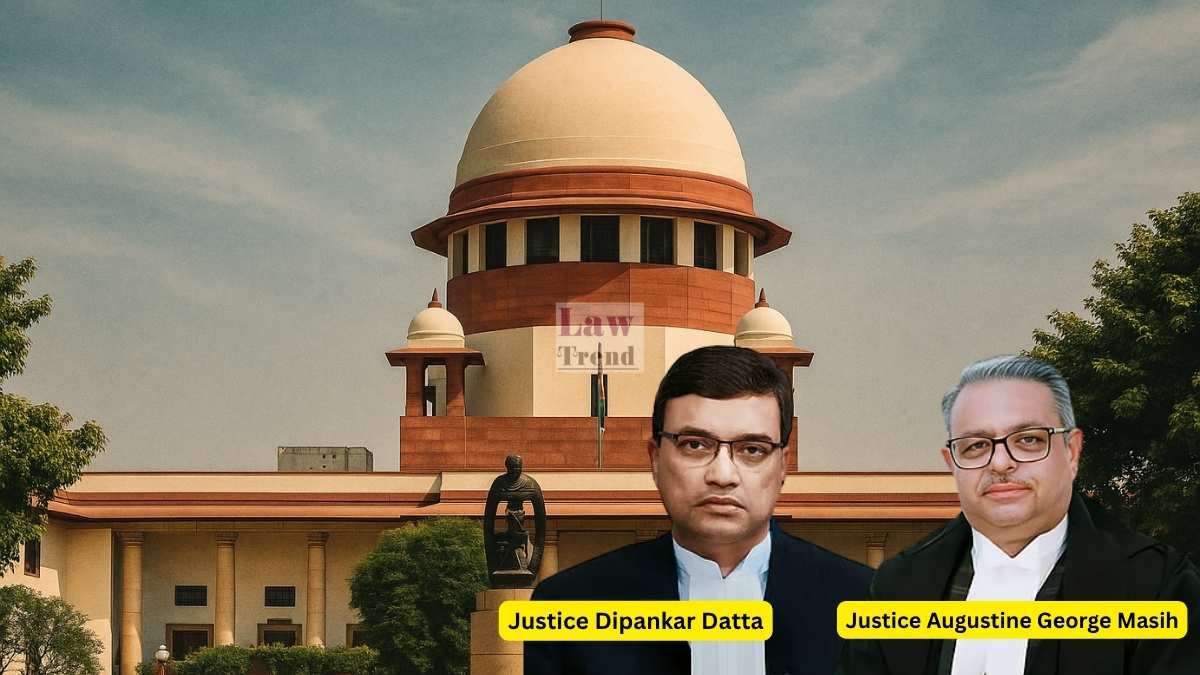
The Supreme Court of India has ruled that simultaneous proceedings for the Corporate Insolvency Resolution Process (CIRP) under the Insolvency and Bankruptcy Code, 2016 (IBC) can be maintained against both the principal debtor and its corporate guarantor. A bench comprising Justice Dipankar Datta and Justice Augustine George Masih held that a creditor is not required to elect its claims and that the statutory framework of the IBC, coupled with the co-extensive liability of a guarantor, permits concurrent or separate proceedings.
Background of the Case
The judgment was delivered in a batch of civil appeals, with the lead case being ICICI Bank Limited vs. Era Infrastructure (India) Limited. The common question of law across these appeals was whether simultaneous CIRP proceedings under the IBC against the principal debtor and its corporate guarantor (or vice-versa) are maintainable.
In several of the impugned orders, the National Company Law Tribunal (NCLT) and the National Company Law Appellate Tribunal (NCLAT) had rejected applications for the initiation of CIRP against a corporate debtor or guarantor if a claim for the same debt had already been admitted against the other entity. The tribunals had heavily relied on the NCLAT’s earlier decision in Vishnu Kumar Agarwal v. M/s Piramal Enterprises Ltd., which held that a second application by the same financial creditor for the same set of claims and default could not be admitted against a co-guarantor or principal borrower once an application was already admitted against one.
Arguments of the Parties
Submissions Opposing Simultaneous Proceedings
Counsel opposing concurrent proceedings argued that the IBC is meant for the resolution and maximization of the value of assets, not mere recovery. They contended that a financial creditor must exercise the “doctrine of election” and choose whether to pursue the debtor or the surety. Allowing simultaneous proceedings, they argued, would lead to inequitable consequences, granting the creditor a disproportionate voting share in multiple Committees of Creditors (CoCs) and potentially leading to unjust enrichment if the creditor recovers more than its entitlement. They also sought guidelines from the Court to mandate the disclosure of parallel claims.
Submissions in Support of Simultaneous Proceedings
Counsel supporting simultaneous proceedings argued that the issue was already settled by the Supreme Court in BRS Ventures Investments Ltd. v. SREI Infrastructure Finance Ltd. Furthermore, under Section 128 of the Indian Contract Act, 1872, the liability of the surety is co-extensive with that of the principal debtor. They argued that forcing a creditor to elect a claim would violate the “clean slate” principle under the IBC; if a creditor failed to file its entire claim in a CIRP, the unfiled portion would be extinguished forever. They also asserted that the doctrine of election does not apply as there is no inconsistency between the remedies.
Court’s Analysis
The Supreme Court analyzed the statutory scheme of the IBC, the history of insolvency laws, and the arguments presented.
First, the Court noted that the issue at hand is an already settled point of law, citing its previous ruling in BRS Ventures Investments Ltd.:
“…the IBC permits separate or simultaneous proceedings to be initiated under Section 7 by a financial creditor against the corporate debtor and the corporate guarantor.”
Addressing the argument that the IBC is not a recovery proceeding, the Court observed:
“A financial creditor, vested with rights under the Code, must be able to exercise it. Equally so, the adjudicating authority has the obligation to examine the application independently, on its own merits.”
The Court firmly rejected the application of the doctrine of election, stating:
“Since a guarantor’s liability is co-extensive, forcing the creditor to elect would essentially make it sacrifice part of its claim. This is not how a guarantee works, particularly when the Code does not provide for such election. The conspicuous absence of any such provision in the IBC implies that no such restriction can be imposed on the creditor.”
On the issue of double enrichment, the Court acknowledged the concern but noted that sufficient safeguards exist as on date to prevent such double enrichment. The Court pointed to Regulation 12A and Regulation 14 of the Insolvency and Bankruptcy Board of India (Insolvency Resolution Process for Corporate Persons) Regulations, 2016, which mandate creditors and resolution professionals to continuously update claims as and when they are satisfied from any source. Quoting its earlier decision in Maitreya Doshi v. Anand Rathi Global Finance Ltd., the Court observed:
“…once the claim of the Financial Creditor is discharged, there can be no question of recovery of the claim twice over.”
Finally, the Court declined the request to frame new guidelines or modalities for “group insolvency” or simultaneous proceedings, observing:
“To venture into unchartered territories, wearing the legislative hat, would be nothing short of judicial exploration, which we do not propose to do. We leave it to the wisdom of the legislature and the IBBI to frame appropriate policy framework and guidelines with an inclusive consultative process of all the stakeholders, if so required.”
Decision
Applying the law to the batch of appeals, the Supreme Court allowed Civil Appeal Nos. 6093 of 2019, 6094 of 2019, 2715 of 2020, and SLP (C) No. 21778 of 2019, setting aside the tribunal orders that had barred simultaneous proceedings.
Conversely, the Court dismissed Civil Appeal Nos. 827-828 of 2021, 4018 of 2023, and 7231 of 2024, thereby upholding the lower authorities’ decisions that had correctly permitted the initiation of simultaneous CIRP. Civil Appeal No. 40 of 2020 was also dismissed based on the specific facts regarding the withdrawal of a petition following a settlement.
- Case Title: ICICI Bank Limited vs. Era Infrastructure (India) Limited (and connected appeals)
- Case No.: Civil Appeal No. 6094 of 2019 (Lead Case)