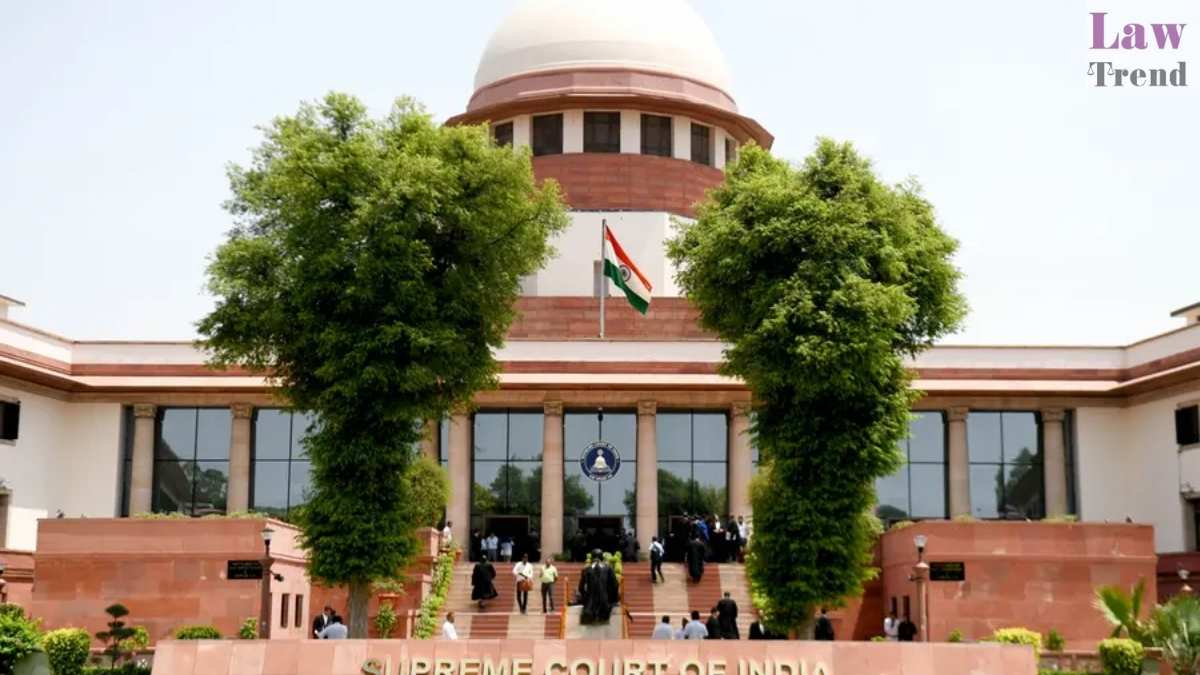
The Supreme Court of India has set aside a judgment of the Allahabad High Court and quashed a First Information Report (FIR) lodged against Vandana Jain and others, observing that a purely civil dispute arising from a Joint Venture Agreement (JVA) was given the “cloak of a criminal offence.”
A Bench comprising Justice Pamidighantam Sri Narasimha and Justice Manoj Misra held that the dispute between the parties was essentially of a civil nature and that the allegations did not disclose the commission of offences such as cheating, criminal breach of trust, or forgery.
Background of the Case
The matter originated from a Joint Venture Agreement (JVA) dated August 16, 2010. The appellants (Vandana Jain, Siddharth Jain, and Kanishk Jain) entered into the agreement with Respondent No. 2, Motor General Sales Ltd. Under the JVA, the appellants provided land in Azad Nagar, Kanpur, for development, while the respondent company was to construct residential units at its own cost. Both parties were to share the project equally (50% each).
As per Clause 5 of the JVA, the respondent advanced ₹1 crore as security money. However, the project failed to materialize. In March 2021—eleven years after the agreement—the respondent lodged an FIR at P.S. Hazratganj, Lucknow, under Sections 406, 420, 467, 468, and 471 of the Indian Penal Code (IPC).
The FIR alleged that the appellants failed to hand over possession, suppressed information regarding pending litigation with one Indira Devi Kanodia, and forged documents to deceive the complainant. The appellants moved the Allahabad High Court to quash the FIR, but their petition was dismissed in limine on July 30, 2021.
Arguments of the Parties
The appellants contended that the dispute was purely civil. They argued that their title was established through a 1972 suit and subsequent decrees that had attained finality. They further submitted that the JVA contained no specific representation that the land was free from all litigation, only that there was no restraint order. They highlighted that the FIR was filed 11 years later, long after any civil suit would have been barred by limitation.
The State and the Complainant argued that at the quashing stage, the Court should only consider the allegations in the FIR at face value. They claimed the FIR disclosed cognizable offences requiring investigation and that the High Court was justified in its dismissal.
The Court’s Analysis
The Supreme Court examined the specific clauses of the JVA and the nature of the allegations.
1. On Cheating and Misrepresentation: The Court noted that the JVA introduction provided a detailed history of the property. Regarding the allegation of suppressing litigation, the Court observed:
“It is clear from the afore-extracted clauses that there is no specific statement by the first party as regards no litigation pending. The representation of the first party is about there being no restraint order of any court or income tax or other government department on dealing with the land.”
The Bench found that the appellants had fulfilled their assurance that no restraint order existed, and the JVA even included an indemnity clause for the title.
2. On Criminal Breach of Trust: Regarding the non-refund of the ₹1 crore security deposit, the Court pointed out that Clause 5 of the JVA did not envisage a refund. Instead, the amount was to be adjusted from the sale proceeds of the first party’s share of the flats.
“The deposit of security money is non-refundable… the allegation about security money being not refunded would not make out a criminal offence though it may give rise to a civil cause of action.”
3. On Forgery: The complainant alleged that a letter from the Tehsildar (Judicial) was forged because it was not “traceable” in official records. The Court rejected this logic:
“Merely because a document is not traceable in the records after several years of its issuance, it cannot be said that the document is forged… A document would be considered forged document only when the allegations are to the effect that it is a false document within the meaning of section 464 of the I.P.C.”
4. On Delay and Abuse of Process: The Court emphasized the 11-year delay in filing the FIR.
“If there was something stark about the dishonest intention on part of one of the parties to the agreement, it would have been reported promptly and not after 10 years. This clearly indicates that the dispute between the parties was purely of a civil nature.”
The Court criticized the High Court for not carefully reading the FIR and the JVA, noting that the High Court failed to assess whether a “pure civil cause of action” had been “given cloak of criminal offence.”
The Decision
Allowing the appeal, the Supreme Court set aside the High Court’s order and quashed the FIR and all subsequent proceedings. The Bench concluded:
“We are therefore of the considered view that the impugned first information report only discloses a civil cause of action… The impugned FIR and all proceedings emanating therefrom are hereby quashed.”
- Case Title: Vandana Jain & Ors. v. The State of Uttar Pradesh & Ors.
- Case Number: Criminal Appeal No. 1127 of 2026 (Arising out of SLP (Crl) No. 6670/2021)