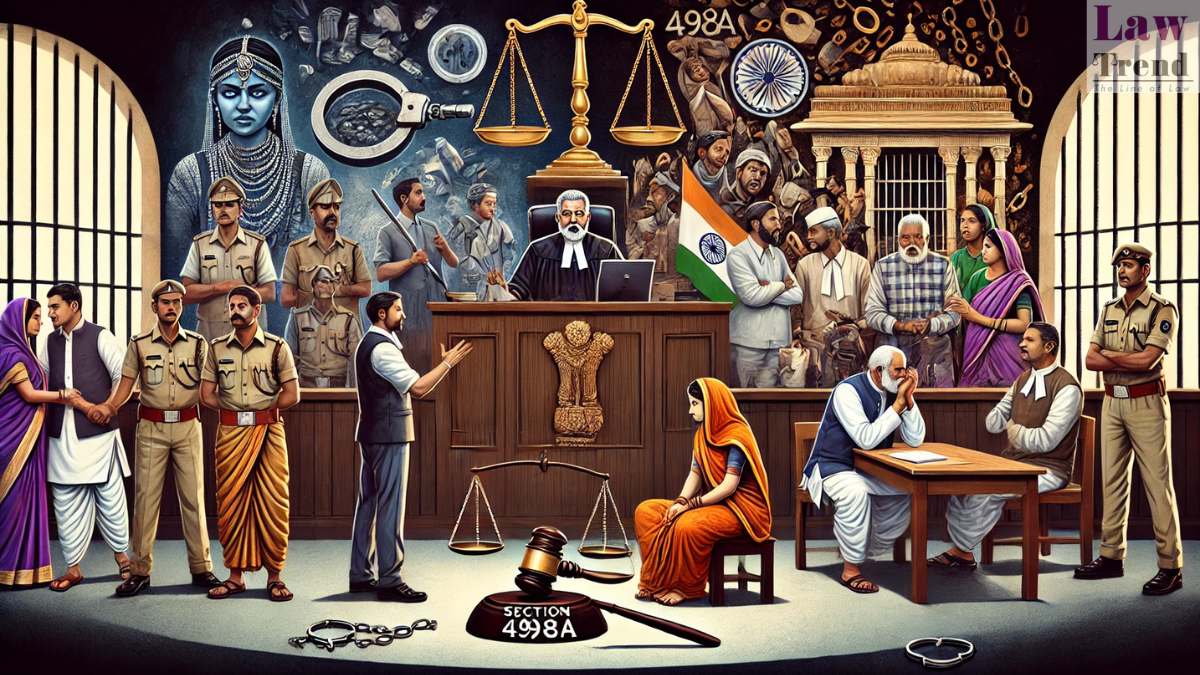
The Calcutta High Court has partly allowed a revisional application seeking the quashing of a criminal proceeding under Section 498A of the Indian Penal Code (IPC), distinguishing between “status-based implication” and “act-based liability.” Justice Uday Kumar, while quashing the proceedings against the husband’s brother, ruled that the trial against the husband must proceed as the allegations against him involved specific “hard facts” and “overt acts.”
The Court was presiding over a petition filed under Section 482 of the Code of Criminal Procedure (now Section 528 of the Bharatiya Nagarik Suraksha Sanhita, 2023) by Ashis Kumar Dutta (husband) and Tapas Kumar Dutta (brother-in-law). They sought to quash G.R. Case No. 1883 of 2017, arising from Bantra P.S. Case No. 99/2017, involving charges under Sections 498A (cruelty), 406 (criminal breach of trust), 506 (criminal intimidation), and 34 of the IPC, along with provisions of the Dowry Prohibition Act.
The Court decided to discharge the brother-in-law due to a lack of specific allegations but refused to quash the case against the husband, citing triable issues regarding dowry demands and physical ouster.
Background and Factual Matrix
The marital union between Ashis Kumar Dutta, a practicing advocate, and Kasturi Dutta (Opposite Party No. 2) commenced on November 28, 2005. The couple lived together for approximately twelve years and had twin daughters in 2012. The relationship deteriorated on March 30, 2017, when the wife left the matrimonial home.
The wife alleged she was subjected to sustained physical and mental cruelty for dowry. She claimed that on the day of her departure, she was assaulted and ousted “in a single cloth” after her father failed to provide ₹1,00,000 for a four-wheeler. She also alleged regular drunken abuse by her brother-in-law.
Conversely, the husband contended the departure was voluntary. He relied on a “No-Complaint” declaration purportedly signed by the wife’s father on the day of separation, stating there were no grievances against the in-laws. He also alleged the wife was involved in an extramarital affair.
Arguments of the Parties
For the Petitioners: Mr. Aritra Bhattacharyya argued that the FIR was a “counter-blast” to the husband’s previously filed matrimonial suit for restitution of conjugal rights. Citing State of Haryana v. Bhajan Lal (1992), he submitted the allegations were “absurd and inherently improbable.” Regarding the brother-in-law, he relied on Kahkashan Kausar @ Sonam v. State of Bihar (2022), arguing the claims were “vague and omnibus.”
For the State and Opposite Party No. 2: Mr. Bitasok Banerjee contended that since a Charge Sheet had already been filed, the High Court should not engage in a “mini-trial.” He argued that the veracity of the “No-Complaint” letter and allegations of an extramarital affair were factual defenses to be tested in the “crucible of a trial,” citing State of Delhi v. Gyan Devi and Others (2000).
The Court’s Analysis
The Court emphasized the need to prevent the “wholesale involvement” of family members in matrimonial disputes. Justice Kumar observed:
“It is a matter of common experience that most of these complaints under section 498-A IPC are filed in the heat of the moment over trivial issues… the allegations of the complaint are very often made with a view to involve the (husband’s) entire family.”
Applying what it termed the “Filter Theory” of jurisprudence, the Court noted that criminal liability must be individualized.
Regarding Petitioner No. 2 (Brother-in-law): The Court found that the allegations of “regular abuse in a drunken condition” lacked specific dates, times, or overt acts. Citing Kahkashan Kausar, the Court held:
“In the absence of any specific role attributed to the accused-appellants, it would be unjust if they are forced to go through the tribulations of a trial.”
Regarding Petitioner No. 1 (Husband): The Court reached a different conclusion for the husband, noting specific allegations of a ₹1,00,000 demand and a dated instance of physical ouster. While acknowledging the “No-Complaint” letter as a “potent weapon” for the defense, the Court held that its validity is a “disputed fact” that cannot be settled at the threshold stage.
The Decision
The High Court partly allowed the Revisional Application. The proceedings against Tapas Kumar Dutta (Petitioner No. 2) were quashed, and he was discharged from his bail bonds.
The prayer to quash proceedings against Ashis Kumar Dutta (Petitioner No. 1) was rejected. The Court directed the Trial Court to proceed with the trial against the husband as expeditiously as possible, remaining uninfluenced by the High Court’s observations.
- Case Name: Ashis Kumar Dutta & Anr. -Vs- State of West Bengal & Ors.
- Case Number: CRR 882 of 2022