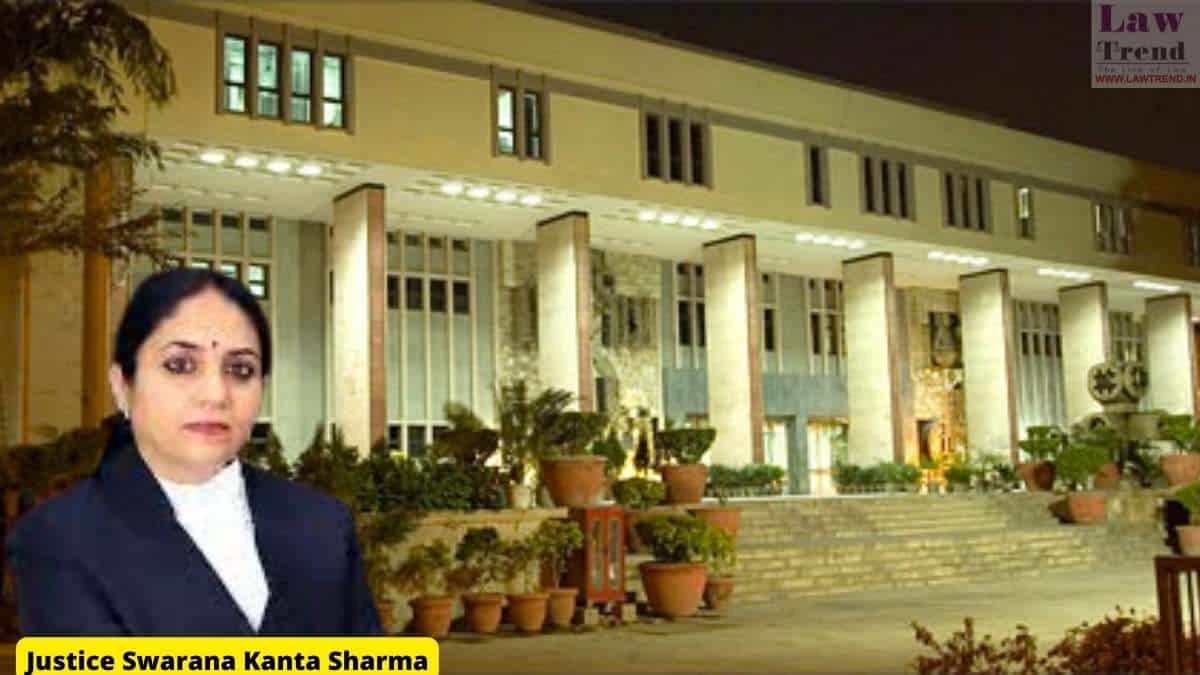
The Delhi High Court has dismissed a revision petition challenging the discharge of an accused from charges of rape, unnatural offences, and deceitful marriage, observing that a consensual relationship sustained over a long period cannot be retrospectively labelled as criminal merely because it has broken down.
The judgment was delivered by Justice Swarana Kanta Sharma in the case of Ms. A v. State & Ors. (CRL.REV.P. 1008/2024). The decision was pronounced on February 16, 2026.
Background of the Case
The petitioner (prosecutrix) lodged an FIR on September 8, 2022, alleging that she came into contact with Respondent No. 2 in 2011 at Karkardooma Courts. She alleged that he introduced himself as a Hindu, developed a relationship, and subjected her to non-consensual physical relations and blackmail using obscene photographs. She further claimed that on January 14, 2015, she was coerced into marriage according to Hindu rites, only to later discover that he was Muslim and already married. She alleged continuous cruelty, confinement, and threats.
The trial court, vide order dated April 15, 2024, discharged Respondent No. 2 from offences under Sections 376(2)(n) (repeated rape), 377 (unnatural offences), 341, 342, 493, 495, 201, 354D, and 506 of the Indian Penal Code (IPC), finding him liable to face trial only for offences under Sections 323/325 IPC (voluntarily causing hurt/grievous hurt). The petitioner approached the High Court challenging this discharge.
Submissions of the Parties
The petitioner’s counsel argued that the Sessions Court exceeded its jurisdiction at the stage of framing charges by relying on documents produced by the accused, specifically a Nikahnama, which were not part of the charge-sheet. It was contended that the Nikahnama was forged and that the prosecutrix only acknowledged the 2015 marriage ceremony performed under coercion.
Conversely, the counsel for the respondents submitted that the relationship was consensual and had existed since 2011. It was argued that the parties had solemnized a Nikah in 2012, and the prosecutrix, who became a lawyer during the relationship, was fully aware of the respondent’s religion. The defense highlighted the 11-year delay in lodging the FIR and relied on photographs and independent witness statements showing the couple living as husband and wife.
Court’s Analysis and Findings
On Consideration of Material at Charge Stage
The High Court rejected the contention that the trial court erred in relying on defense documents. The Court noted that the Sessions Court had directed the Investigating Officer (IO) to verify the documents produced by the accused. The IO verified the Nikahnama dated December 14, 2012, and recorded statements of the Quazi and independent witnesses. Citing Nitya Dharmanananda v. Gopal Sheelum Reddy (2018), the Court held that material of “sterling quality” can be considered even if not part of the charge-sheet.
On the Nature of the Relationship
The Court observed that the relationship spanned nearly eleven years, during which the prosecutrix pursued legal education and enrolled as an advocate. Verification revealed that the prosecutrix had been residing with the accused since 2012 and was known as his wife.
The Court noted:
“The Nikahnama, duly verified by the I.O., establishes that the prosecutrix was aware of the religious identity of respondent no. 2 as a Muslim and had voluntarily consented to the Nikah.”
Official documents, including the prosecutrix’s Aadhaar card (2013) and Voter ID (2017), recorded her address c/o the accused or listed him as her husband.
On Delay and Conduct
Addressing the 11-year delay in lodging the FIR, the Court observed:
“While it is well settled that delay in reporting sexual offences is not, by itself, fatal to the prosecution, the Court cannot remain oblivious to the surrounding circumstances.”
The Court highlighted that the prosecutrix lived openly as the accused’s wife, attended court proceedings, and even campaigned for him in Bar elections, as evidenced by photographs taken a month prior to the FIR.
On Specific Offences
- Sections 376/377 IPC: The Court found no prima facie case, noting the vague allegations of blackmail without any recovery of obscene material despite notices under Section 91 Cr.P.C. The consensual nature of the long-standing relationship was evident.
- Sections 493/495 IPC (Deceitful Marriage): The Court held that since the Nikah in 2012 was verified and the prosecutrix admitted in a withdrawn 2022 complaint that she knew his family, there was no deceit regarding his religion or marital status.
- Sections 341/342 IPC (Wrongful Confinement): The allegations were termed “vague and general” against the evidence of her free movement, professional practice, and public participation.
- Sections 323/325 IPC: The Court upheld the framing of charges for these offences, noting that the medical examination (MLC) revealed a fracture, which prima facie corroborated allegations of physical assault.
Judicial Observations on Misuse of Law
Justice Sharma made significant observations regarding the application of criminal law in intimate relationships:
“Criminal law cannot be permitted to become an instrument of retaliation, pressure, or personal vendetta arising out of a relationship that has irretrievably broken down.”
The Court further remarked:
“Consent, when freely given with full awareness of material facts and sustained over a considerable period, cannot be retrospectively withdrawn so as to convert a consensual relationship into a criminal offence merely because the relationship has broken down.”
Emphasizing personal responsibility, the Court stated:
“Irrespective of gender or faith, personal autonomy carries personal responsibility. The justice system cannot be turned into a forum for undoing conscious decisions taken by adults in full possession of their faculties.”
Decision
The High Court held that the Sessions Court had correctly discharged Respondent No. 2 from the major offences and Respondent Nos. 3 and 4 from the offence of criminal intimidation. Finding no infirmity or illegality in the impugned order, the Court dismissed the revision petition.
- Case Title: Ms A v. State & Ors.
- Case Number: CRL.REV.P. 1008/2024