

BCI Must Process Additional Intake Applications on Merit; ‘Need-Basis’ Policy Lacks Empirical Data: Madras High Court

The Madras High Court has directed the Bar Council of India (BCI) to process the applications of nine private law colleges seeking approval for additional sections and intake for their 3-year LL.B. and 5-year B.A., LL.B. courses for the Academic Year 2025-26. The Court observed that the BCI’s previous moratorium notification has been replaced by a new resolution and ordered that applications be decided on a “merit-basis” regarding infrastructure, rather than an unsupported “need-basis.”

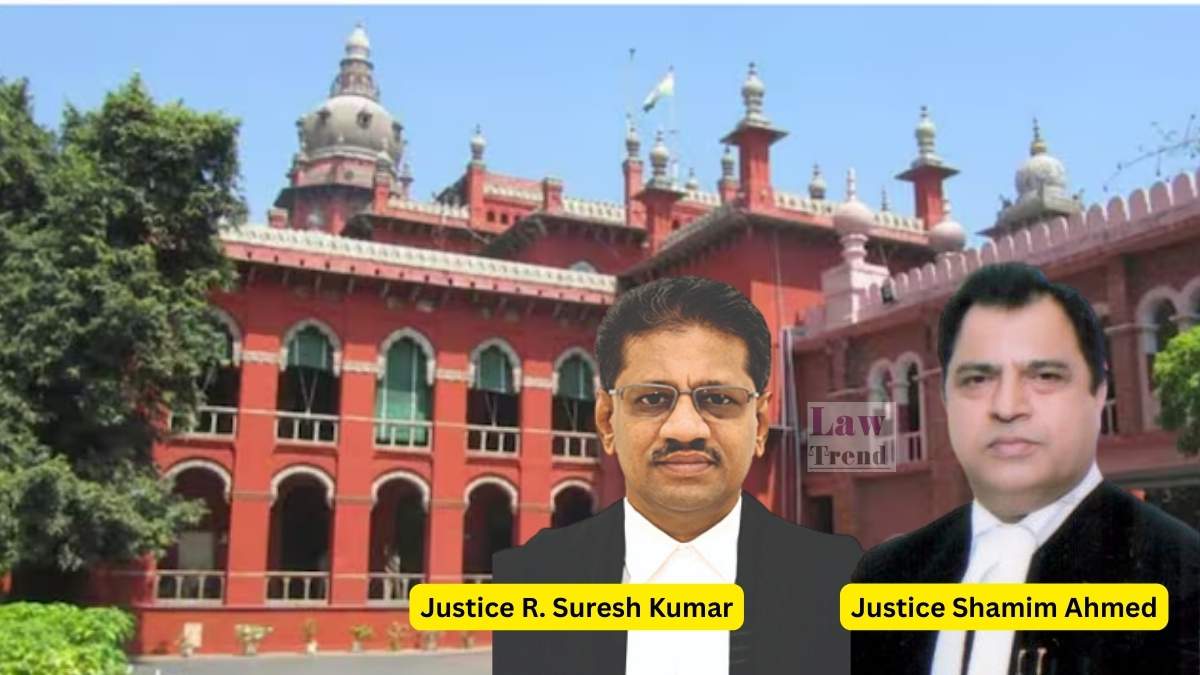
A Division Bench comprising Justice R. Suresh Kumar and Justice Shamim Ahmed heard a batch of writ petitions filed by existing Centers for Legal Education (CLEs), including KMC College of Law, Anandam Law College, and others. The petitioners sought a Writ of Mandamus directing the BCI to grant regular approval for additional sections after their applications were either kept pending or returned by the BCI citing a moratorium on new law colleges and courses.

The Court disposed of the petitions, directing the BCI to process the applications within three weeks, emphasizing that the decision must be based on the availability of infrastructural and institutional facilities rather than a policy of “need-basis” devoid of empirical data.

Background of the Case

The petitioners are existing CLEs that had already obtained No Objection Certificates (NOC) from the State Government and affiliation or consent of affiliation from the Tamil Nadu Dr. Ambedkar Law University for additional intake. Following the standard procedure, they applied to the BCI and paid the requisite processing fee of Rs. 6,50,000.

However, the BCI did not process these applications. For seven out of the nine petitioners, the applications were returned along with the fee, while two applications remained pending. The rejection was based on a BCI notification dated August 13, 2025, which imposed a three-year moratorium on the establishment of new CLEs.

The petitioners contended that while their applications were stalled, the BCI had granted approval to two other institutions, Sir Issac Newton Law College and Saraswathi Law College, on October 14, 2025.

READ ALSO  पीएमएलए के तहत तलाशी के दौरान बंद परिसर को सील करने का अधिकार ईडी के पास नहीं: केंद्र सरकार ने मद्रास हाईकोर्ट को बताया

Arguments of the Parties

Mr. M. Ravi, learned counsel for the petitioners, argued that the colleges were existing institutions seeking only additional intake, not the establishment of new colleges. He highlighted the disparity in the BCI’s actions regarding other similarly placed institutions.

Mr. S.R. Raghunathan, Standing Counsel for the BCI, initially relied on the press release dated August 13, 2025, which imposed the moratorium to “elevate and protect standards of legal education.” He submitted that exceptions were available under Rule 9 only for new sections or courses exclusively meant for marginalized communities (SC/ST/OBC/EWS) with 100% reservation.

However, during the hearing, the BCI Standing Counsel informed the Court of a significant development. The BCI held a meeting on January 11, 2026, passing a resolution that effectively replaced the August 13, 2025, notification. Under the new policy, an “Inspection Permission Team,” consisting of a former High Court Judge and a Law Professor in each state, would decide whether to permit inspections based on “need-basis” and infrastructural availability.

Court’s Analysis and Observations

The Bench analyzed the BCI’s new resolution dated January 11, 2026, noting that the “three-year moratorium period is gone.” The Court observed that the new process involves the Inspection Permission Committee granting permission to inspect institutions, followed by a decision.

On ‘Merit-Basis’ vs. ‘Need-Basis’

The Court distinguished between “merit-basis” and “need-basis.” It defined “merit-basis” as the verification of whether an institution has established the necessary infrastructural and instructional facilities to support additional intake.

READ ALSO  Unbecoming of a Judge, Virtually Auctioned His Chair-Allahabad HC Quashes FIR Lodged by CJM Against Electricity Department Officials

Regarding the “need-basis” theory proposed by the BCI—which suggests rejecting applications if there is no requirement for more legal seats in an area—the Court took a critical view of the lack of empirical evidence.

The Bench observed:

“Insofar as the need-basis theory is concerned, the fact remains that, while taking the policy decision, as reflected in the Resolution dated 11.01.2026 of the BCI, whether it is taken on the basis of any available data or not is not reflected.”

The Court further stated:

“If such a decision is taken by the BCI to put a ban on CLEs to be established hereinafter on the basis of such data, where, on need-basis, there is no further need to establish any new Institution, additional intake or additional course, such a drastic decision could be taken by the BCI supported by data and in the absence of any such data being filed before this Court for judicial scrutiny, we do not wish to comment on the decision taken by the BCI on the arena of need-basis.”

Application to Existing CLEs

The Court clarified that the petitioners are not seeking to establish new institutions but are existing CLEs applying for additional intake. The Court noted that since the moratorium had been replaced by the January 11, 2026 resolution, there was no impediment to processing the applications.

The Bench expressed concern over the delay, noting that the Academic Year 2025-26 has already commenced. It stated that further delays would defeat the purpose and render the infrastructural facilities created by these institutions a “National waste.”

READ ALSO  लोक सेवकों की संपत्ति और देनदारियाँ निजी नहीं हैं, आरटीआई प्रकटीकरण पूरी तरह से छूट प्राप्त नहीं है: मद्रास हाईकोर्ट

Decision and Directions

The High Court disposed of the writ petitions with the following specific directions:

  1. Direction to Process: The BCI must process the applications submitted by all the writ petitioners within three weeks.
  2. Resubmission: The seven petitioners whose applications were returned must resubmit them within three days from the receipt of the order.
  3. Basis of Approval: The BCI is to conduct inspections and consider granting approval “only on merit-basis, that is on fulfillment of infrastructural and institutional facilities and not on the basis of the alleged need-basis, as the policy reflected in 11.01.2026 Resolution of the BCI does not reflect with any empirical data.”
  4. Final Orders: The BCI must pass final orders on the applications before the completion of the stipulated three-week period, “unmindful of such policy decision” regarding the need-basis criteria.

Case Details:

  • Case Title: KMC College of Law v. The State of Tamil Nadu & Others (and connected batch cases)
  • Case Number: W.P.Nos.48845, 48849, 48870, 48874, 48880, 48893, 48906, 48907 and 48911 of 2025
  • Coram: Justice R. Suresh Kumar and Justice Shamim Ahmed
  • Counsel for Petitioners: Mr. M. Ravi and Ms. Dakshayani Reddy (Senior Counsel)
  • Counsel for Respondents: Mr. A. Selvendran (Special Govt Pleader for State), Mr. S.R. Raghunathan (Standing Counsel for BCI), Mr. S. Siva Shanmugam (Standing Counsel for Tamil Nadu Dr. Ambedkar Law University).

Law Trend
Law Trendhttps://lawtrend.in/
Legal News Website Providing Latest Judgments of Supreme Court and High Court

Related Articles

Latest Articles

