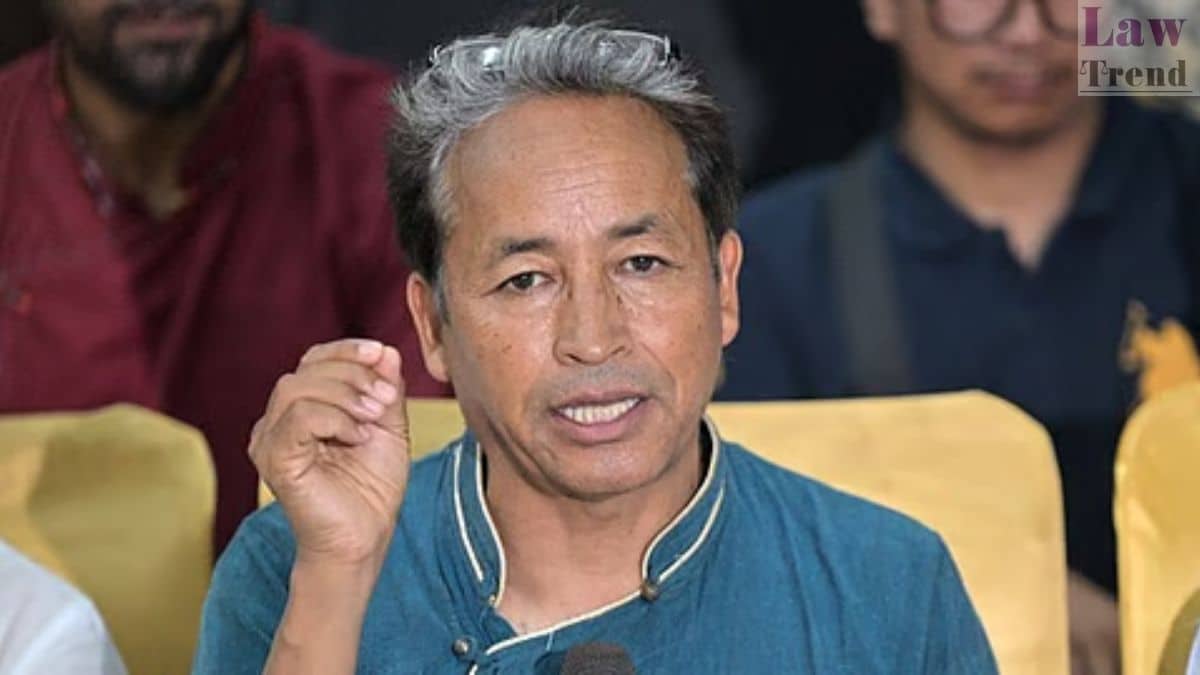
The Supreme Court on Monday asked the Centre to place on record the actual transcripts of videos relied upon for detaining climate activist Sonam Wangchuk under the National Security Act (NSA), observing that translations must be precise, particularly “in the era of Artificial Intelligence”.
A bench of Justices Aravind Kumar and P.B. Varale made the observation while hearing a habeas corpus petition filed by Wangchuk’s wife, Gitanjali Angmo, challenging his preventive detention.
The bench told Additional Solicitor General K.M. Nataraj that it wanted the original transcript of Wangchuk’s speech, noting discrepancies between the activist’s alleged statements and the government’s version.
“We want an actual transcript of the speech. What he relied upon and what you say are different. We will decide. There should be an actual transcript of what he says,” the court said.
It further observed:
“Whatever he stated, the true translation should be there… Your translation goes on for 7 to 8 minutes, but the speech is for 3 minutes. We are in the era of Artificial Intelligence; precision is at least 98 per cent for translation.”
Senior advocate Kapil Sibal, appearing for the petitioner, contended that certain statements attributed to Wangchuk were never made by him and questioned the basis of the detention order.
He submitted that the order relied on material that did not exist, arguing:
“This is a very unique detention order — you rely on something that does not exist and then you say it is based on subjective satisfaction.”
Nataraj responded that a dedicated department prepares transcripts and stated that the law officers were not experts in the process.
Solicitor General Tushar Mehta told the court that Wangchuk had been medically examined 24 times since his detention and was “fit, hale and hearty”.
“He had some digestive issues; he is being treated. There is nothing to worry about, nothing alarming. We can’t make exceptions like this,” Mehta submitted.
He added that the grounds for the detention continued to exist and that release on medical grounds was neither feasible nor desirable.
The petition challenges Wangchuk’s detention under the NSA, 1980, which permits preventive detention to prevent individuals from acting in a manner “prejudicial to the defence of India”. The statute allows detention for up to 12 months, subject to earlier revocation.
Angmo contended that violence in Leh on September 24 last year could not be attributed to Wangchuk and pointed out that he had publicly condemned the incident on social media, describing it as the “saddest day” of his life and stating that it would undermine Ladakh’s peaceful movement.
The Supreme Court directed the Centre to produce the actual transcript of the speech relied upon in the detention and posted the matter for further hearing on Thursday.