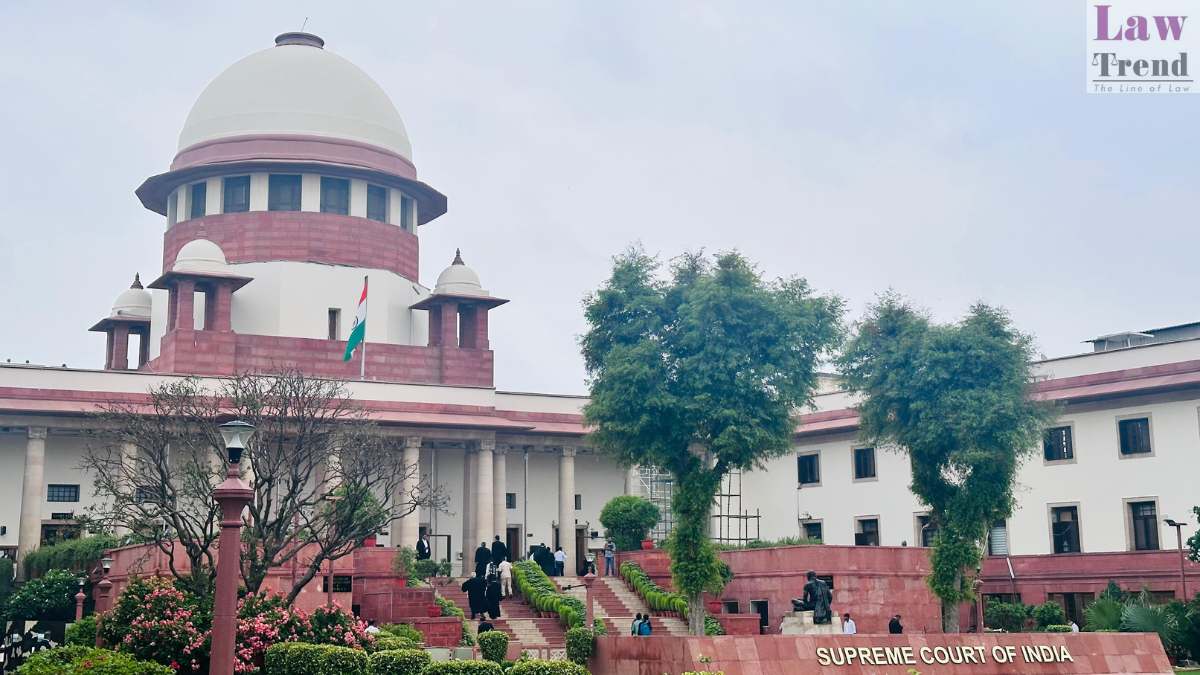
The Supreme Court has set aside a judgment of the Punjab and Haryana High Court which had acquitted a man accused of murdering his wife. The Apex Court termed the High Court’s order “cryptic” and observed that the reasoning for acquittal appeared to be based on “assumptions and presumptions.”
A Division Bench comprising Justice B.V. Nagarathna and Justice Manmohan allowed the appeal filed by the State of Punjab and remanded the matter back to the High Court for a fresh hearing on merits.
Background of the Case
The proceedings originated from FIR No. 72/2001, registered on July 13, 2001, at Police Station Sri Hargobindpur. The prosecution’s case was that on the said date, the respondent, Sarabjit Singh, was found hitting his wife with a dattar (a sharp-edged weapon), resulting in injuries that led to her death.
The Sessions Judge, Gurdaspur, by a judgment dated May 8, 2003, convicted the respondent under Section 302 of the Indian Penal Code (IPC). He was sentenced to undergo imprisonment for life and to pay a fine of Rs. 2,000.
Aggrieved by the conviction, the respondent approached the High Court of Punjab and Haryana. In the impugned judgment dated January 14, 2019, the High Court allowed the appeal and set aside the conviction and sentence, thereby acquitting the accused. The State of Punjab subsequently approached the Supreme Court challenging this acquittal.
Arguments Before the Court
The Standing Counsel for the State of Punjab presented a two-fold submission. Firstly, it was argued that the Sessions Court had rightly convicted the accused based on evidence proving the case beyond reasonable doubt. The counsel contended that the High Court reversed this well-reasoned judgment without finding sufficient fault with the trial court’s findings.
Alternatively, the State submitted that if the Supreme Court was not inclined to decide the case on merits immediately, the matter should be remanded to the High Court. The counsel argued that the High Court’s judgment was rendered in a “cryptic manner,” devoid of vital reasoning while setting aside a life sentence. It was pointed out that the judgment listed facts and depositions but lacked the necessary analysis to justify an acquittal.
Per contra, the learned Amicus Curiae appearing for the respondent-accused supported the High Court’s decision. He argued that the High Court was “perfectly justified” in acquitting the respondent and drew the Court’s attention to specific paragraphs of the impugned judgment which, according to him, led to the conclusion of acquittal.
Supreme Court’s Analysis and Observations
The Supreme Court accepted the alternative submission made by the State of Punjab. Upon perusing the High Court’s order, the Bench observed that the judgment was indeed cryptic.
Justice Nagarathna, writing for the Bench, observed:
“Moreover, the reasons assigned for acquittal prima facie are not correct as they are based on assumptions and presumptions and conjectures. We also note that a mere discussion of the facts and the depositions of the various witnesses in the absence of any analysis and reasoning as such cannot render a judgment of conviction into one of acquittal.”
The Court held that a mere recitation of facts without substantive analysis and reasoning is insufficient to overturn a judgment of conviction rendered by a trial court.
Decision
The Supreme Court allowed the appeal, setting aside the High Court’s judgment dated January 14, 2019, on the ground that it lacked proper reasoning.
The Bench remanded the matter to the High Court for a rehearing of the appeal, directing that it be heard “having regard to the evidence on record and in accordance with law.”
Regarding the custody of the respondent, the Court directed:
“Since the respondent-accused has been acquitted by virtue of the impugned judgment which we have now set aside, we direct that he shall be produced before the concerned Sessions Court and he shall execute bail bonds subject to the terms and conditions to be imposed by the Sessions Court.”
The Apex Court clarified that it had not made any observations on the merits of the case. The Court also placed on record its appreciation for the services rendered by the Amicus Curiae, Sri Meghan.
Case Details:
- Case Title: The State of Punjab vs. Sarabjit Singh
- Case Number: Criminal Appeal No. 1781 of 2019
- Bench: Justice B.V. Nagarathna and Justice Manmohan