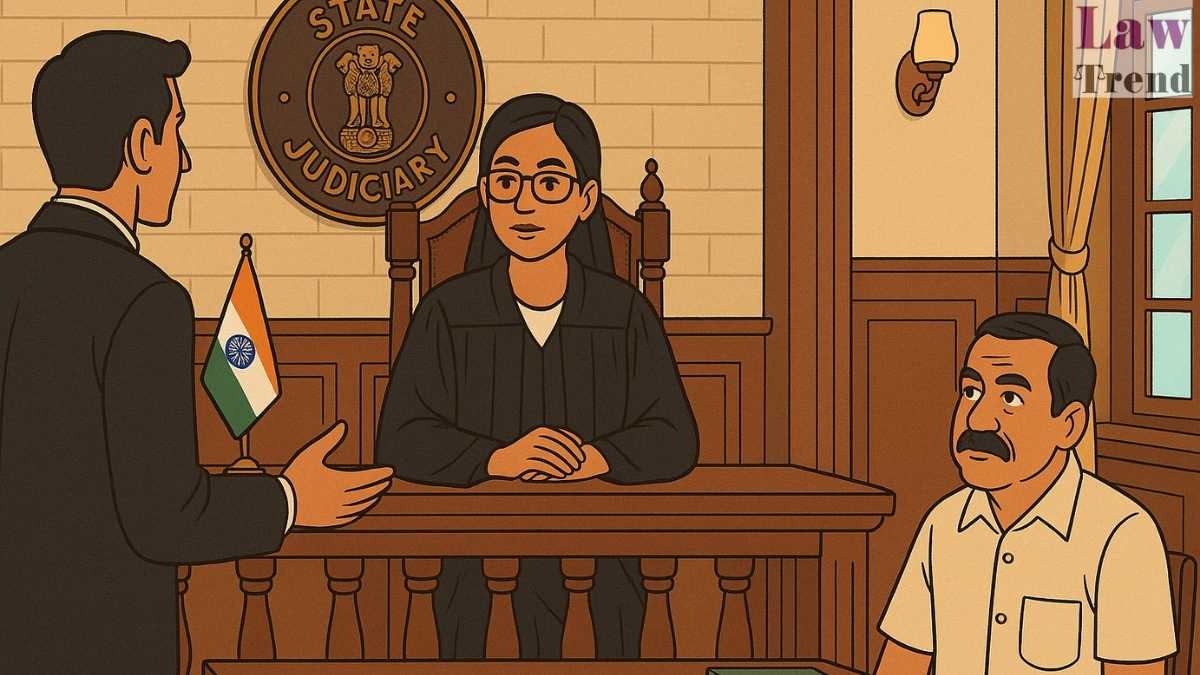
The Uttarakhand High Court has set aside the removal from service of former Civil Judge (Senior Division) Deepali Sharma, ordering her reinstatement with consequential seniority and 50% back wages. In a judgment delivered on January 6, 2026, the Division Bench comprising Chief Justice G. Narendar and Justice Subhash Upadhyay termed the departmental inquiry against the officer as a case of “no evidence” and a “carefully crafted edifice without a foundation.”
The Court allowed the writ petition filed by Sharma challenging the dismissal orders passed by the State Government and the High Court administration in October 2020.
Background of the Case
The proceedings against Deepali Sharma originated from an anonymous email complaint received on January 10, 2018. The complaint alleged that Sharma, then posted in Haridwar, was physically abusing a minor girl kept as a maidservant at her official residence in the Judges’ Colony.
Acting on the complaint, a “raid” was conducted on January 29, 2018, by the then District Judge, Haridwar, accompanied by a police team including the Senior Superintendent of Police (SSP) and Additional Superintendent of Police (ASP). The girl, Tanuja @ Tiruja Dani, was removed from the residence and placed in an Ashram. Following a preliminary report, Sharma was suspended, and a departmental inquiry was initiated.
The chargesheet alleged violations of Rule 3(1) and 3(2) of the Uttarakhand Government Servants’ Conduct Rules, 2002, accusing the officer of failing to maintain absolute integrity and devotion to duty by employing a minor as a domestic servant and inflicting torture. The Inquiry Officer found the charges proved, leading to her removal from service via orders dated October 14, 2020, and October 20, 2020.
Arguments of the Parties
The petitioner, represented by Senior Advocate Rajendra Dobhal, argued that the inquiry was vitiated by bias, conspiracy, and a lack of evidence. It was contended that the anonymous complaint originated from the wife of a neighboring Additional District Judge (PW-1), with whom the petitioner had strained relations. Sharma argued that the girl was not a minor, as confirmed by an ossification test which placed her age at roughly 17 years, and was being educated and treated as a family member, not a maid.
The Department relied on the testimony of the neighbor ADJ (PW-1), police officers, and a medical report alleging 20 injuries on the girl. They contended that the girl’s subsequent denial of abuse during the inquiry was a result of her being “won over” by the petitioner.
Court’s Analysis and Observations
The High Court dismantled the findings of the Inquiry Officer (IO), pointing out glaring procedural lapses and a lack of substantive evidence.
1. The “Raid” and Pre-determination: The Court expressed shock at the manner in which the “raid” was conducted, noting that a “battalion of policemen” and senior officers surrounded the house of a lady judicial officer without a search warrant. The Bench observed:
“The manner and method raises questions and leaves us wondering as to whether it is a case of over-kill or motivated? … The surrounding of the house by armed personnel, in our opinion, was an act of overreach and an act in excess of the mandate conferred on the District Judge.”
2. The Medical Evidence: The Court found it “alarming” that the medical certificate detailing 20 injuries was proved in the inquiry by a staff nurse and a pharmacist, not by a qualified doctor. The Court noted the absence of the original certificate and case history. The Bench stated:
“The claim that medical records, i.e. medical (wound) certificate have been duly proved, is in a manner unheard of and unknown to law as the persons examined in support of it are a nurse and pharmacist and both of whom are not competent to prove a ‘wound certificate’.”
3. Testimony of the Alleged Victim: Crucially, the girl (PW-2) testified in favor of Sharma during the inquiry. She categorically denied being beaten or starved, stating that injuries were caused by falls from a bicycle and a tree. She alleged that police officers threatened her to implicate Sharma. The Inquiry Officer had discarded this testimony, labeling the witness as “won over.”
Rejecting the IO’s conclusion, the High Court noted:
“Despite the young child being subjected to such detailed searching and exhaustive examination, not a single admission has been elicited which would cast a cloud… The IO has simply brushed aside the evidence of PW-2 the girl… with her single line conclusion that she has been bought over.”
4. Role of the Neighbor (PW-1): The Court took serious note of the evidence linking the anonymous complaint email to a mobile number registered in the name of the wife of PW-1 (the neighboring ADJ). The Court observed that the Inquiry Officer failed to appreciate that PW-1 appeared to be acting “beyond the call of duty.”
5. Non-Examination of Best Witnesses: The Court questioned why the department failed to examine the two court peons assigned to Sharma’s residence, who were the best possible eye-witnesses to any alleged abuse. The Bench remarked:
“Why these two peons have not been examined is the million dollar question… This omission on the part of the IO and the Department, in our considered opinion, kicks at the very root of the charges.”
6. Charge of Child Labor: The Court highlighted that while the petitioner was punished for misconduct, no specific charge under Rule 3(4) (prohibition of employing children below 14) was framed. Furthermore, evidence showed the girl was approximately 17 years old. The Court held:
“The conclusion in Para 608 holding that the misconduct… stand proved because the delinquent officer has failed to follow Rule 3(4) is to state the least, perverse.”
7. Reliance on Preliminary Inquiry: Citing the Supreme Court’s judgment in Nirmala J. Jhala vs. State of Gujarat, the High Court held that the Inquiry Officer erred by extensively relying on the preliminary inquiry report prepared behind the petitioner’s back, while ignoring evidence recorded during the actual disciplinary proceedings.
Decision
The Court concluded that the inquiry report was based on “conjectures and surmises” and subjective satisfaction rather than objective evidence.
“The Inquiry Officer has attempted to make a ‘mountain out of a molehill’… We find that the petitioner has been wrongly held guilty of misconduct of a non-existent charge.”
The High Court set aside the inquiry report dated June 9, 2020, and the subsequent removal orders. The petitioner is deemed to have continued in service. While granting full seniority, the Court restricted monetary benefits to 50% of arrears, stating it would be “inequitable to burden the State Exchequer to pay 100% of the arrears for work not rendered.”
Case Details:
- Case Title: Deepali Sharma v. State of Uttarakhand & another
- Case Number: Writ Petition (S/B) No. 266 of 2021
- Coram: Chief Justice G. Narendar and Justice Subhash Upadhyay
- Counsel for Petitioner: Mr. Rajendra Dobhal (Senior Counsel) with Mr. Aditya Pratap Singh
- Counsel for High Court: Mr. Shobhit Saharia
- Counsel for State: Mr. Gajendra Tripathi