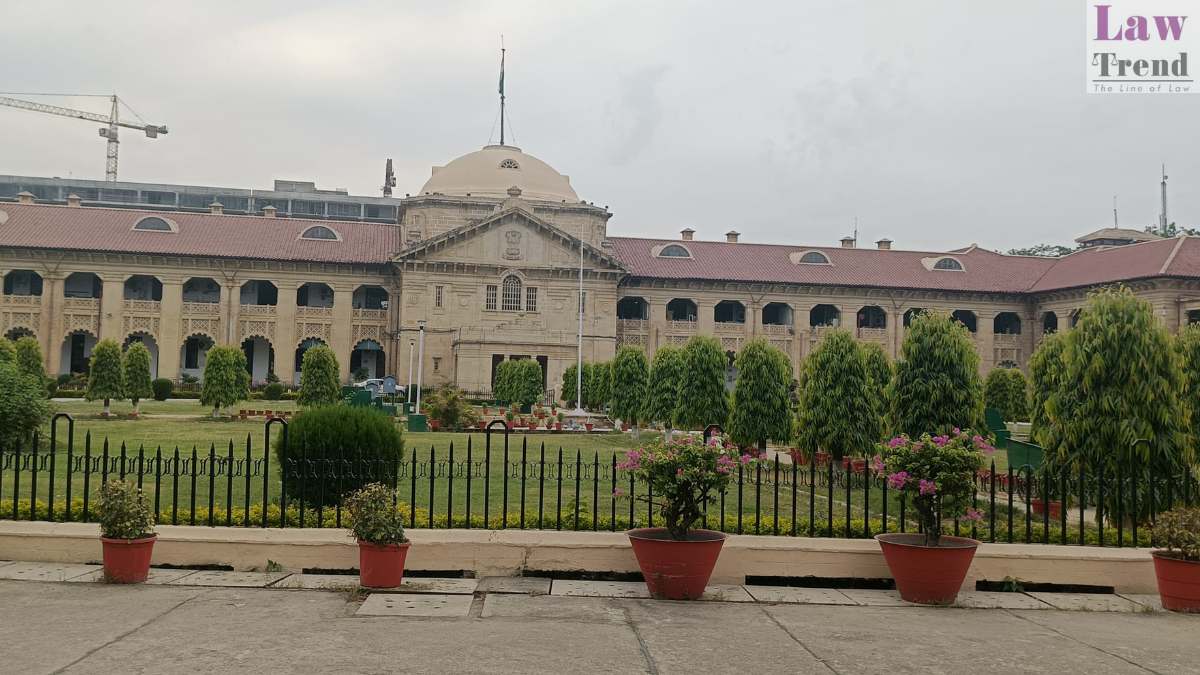
The High Court of Judicature at Allahabad has set aside the conviction of two men in a 34-year-old murder case, observing that the “last seen” theory is legally unsustainable when there is a significant time gap between the last sighting of the deceased with the accused and the discovery of the body.
The Division Bench, comprising Justice Siddharth and Justice Jai Krishna Upadhyay, allowed the appeal filed by Anoop Singh and Ram Kumar, who had been sentenced to life imprisonment by a trial court in Saharanpur in 2005.
Background of the Case
The case dates back to February 1992. According to the prosecution, Anoop Singh and Ram Kumar allegedly kidnapped Chandraprakash from his house in Saharanpur on February 7, 1992, with the intent to kill him. It was alleged that the deceased had previously given the accused ₹7,500 for securing a job.
The dead body of Chandraprakash was recovered on February 9, 1992, near the Ballabhgarh railway station in Haryana. The informant, Baldev Singh (brother of the deceased), lodged an FIR on February 12, 1992, after a missing report was initially filed. The trial court convicted the appellants under Sections 364 and 302/34 of the Indian Penal Code (IPC). During the pendency of the appeal, two other appellants, Balak Ram and Vinod, passed away, and the appeal stood abated against them.
Arguments of the Parties
The counsel for the appellants, Sri Chetan Chatterjee, argued that the case rested entirely on circumstantial evidence and that the chain of circumstances was incomplete. He highlighted a five-day delay in reporting the incident and pointed out contradictions regarding the motive (the alleged money given for a job). Furthermore, it was argued that medical evidence suggested the death could have been an accident resulting from falling from a moving train.
The State, represented by Sri G. N. Kanojiya (A.G.A.-I), supported the trial court’s judgment, stating that the motive was proven and the “last seen” evidence clearly pointed toward the guilt of the accused.
Court’s Analysis and Observations
The High Court emphasized that in cases of circumstantial evidence, the circumstances must be of a conclusive nature, excluding every hypothesis except the guilt of the accused. Referring to the “last seen” theory, the Court noted that the deceased was last seen with the accused at approximately 6:00 PM on February 7, 1992, while the body was discovered at noon on February 9, 1992.
The Court observed:
“The last seen theory comes into play where the time-gap between the point of time when the accused and the deceased were last seen alive and when the deceased is found dead is so small that the possibility of any person other than the accused being the author of the crime becomes impossible.”
Citing several Supreme Court precedents, including Sharad Birdhichand Sarda V. State of Maharashtra and Rambraksh v. State of Chhattisgarh, the Bench remarked that a significant gap of several hours—or in this case, nearly two days—makes such evidence unreliable as the possibility of third-party interference cannot be ruled out.
The Bench further noted:
“Therefore, last seen theory is legally unsustainable in this case as law requires a strict proximity of time and place between last sighting and the death. In this case there exists significant gap which is not narrow enough to exclude the possibility of third party interference.”
Regarding the medical evidence, the Court noted the testimony of PW5 Dr. M. S. Ahlawat, who stated that the injuries could have been caused by falling from a moving train, which raised the possibility of an accidental death.
Decision of the Court
Holding that the prosecution failed to establish its case beyond a reasonable doubt, the High Court set aside the judgment dated September 24, 2005, passed by the Additional Sessions Judge, Saharanpur.
The Court ordered:
“The judgement passed by the trial Court is set aside. The appellants nos. 2 and 3 namely Anoop Singh and Ram Kumar, are acquitted of all the charges for which they have been tried.”
The Court directed the immediate release of the appellants, who were in jail, and cancelled their bail bonds.
Case Details:
- Case Name: Balak Ram And Others Versus State of U.P.
- Case No.: Criminal Appeal No. 4445 of 2005
- Coram: Justice Siddharth and Justice Jai Krishna Upadhyay