

Wife Cannot Be Treated as Separate Tenure Holder When Husband Is; Land Liable to Be Clubbed Under U.P. Ceiling Act: Allahabad HC
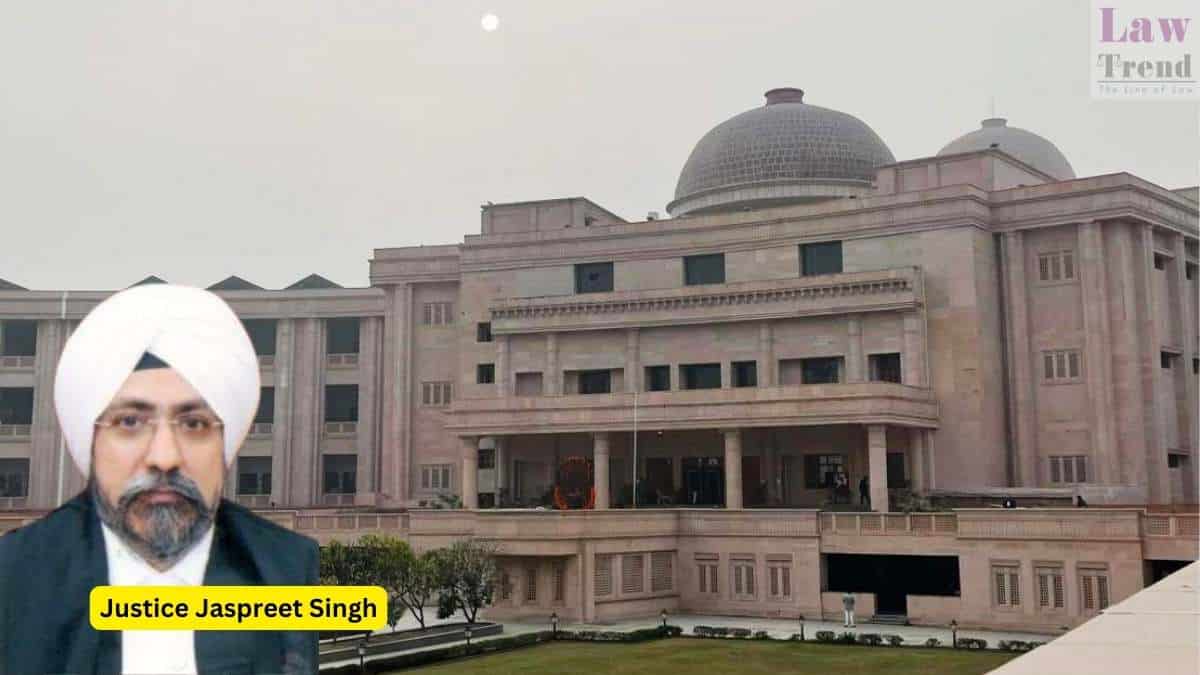

The Allahabad High Court (Lucknow Bench) has dismissed a writ petition challenging the inclusion of a wife’s separate landholding into the tenure holder’s surplus land determination under the U.P. Imposition of Ceiling on Land Holdings Act, 1960. The Court ruled that under the amended definition of “family” and “tenure-holder,” a wife’s land is liable to be clubbed with her husband’s land, and previous orders passed prior to the 1973 and 1976 amendments do not operate as res judicata.

Justice Jaspreet Singh, delivering the judgment on February 6, 2026, affirmed the orders passed by the Prescribed Authority and the Appellate Authority in 1986 and 1993, respectively, bringing an end to a litigation spanning over four decades.

Background of the Case

The dispute arose from proceedings under the U.P. Imposition of Ceiling on Land Holdings Act, 1960. Initially, a notice was issued to the original petitioner, Himanshu Dhar Singh, in 1962. This notice was discharged by the Prescribed Authority on July 24, 1964, a decision that was not challenged by the State.

However, following amendments to the Act, a fresh notice under Section 10(2) was issued on June 15, 1976. The petitioner contested this, arguing that land recorded in the name of his wife, as well as his adult sons and daughters, was wrongly clubbed with his holding. While the Prescribed Authority eventually excluded the land of the adult sons and daughters in 1978, the land belonging to the petitioner’s wife remained clubbed.

The matter went through multiple rounds of litigation:

  • Second Round: The Appellate Authority remanded the matter in 1979 for re-determination regarding irrigated/non-irrigated land and to allow the petitioner to exercise his choice of land retention.
  • Third Round: The Prescribed Authority’s order was again challenged, leading to another remand by the Appellate Authority on September 16, 1983, with specific directions to treat certain plots as non-irrigated and permit the petitioner to submit his choice.
  • Fourth Round: The Prescribed Authority, vide order dated June 27, 1986, declared 7.3 hectares as retainable and the rest as surplus. The authority rejected the petitioner’s vague choice which was conditioned on separate exchange proceedings. An appeal against this order was dismissed on June 11, 1993.
READ ALSO  Section 27 Of the Evidence Act Would Apply Even If Accused Is Interrogated By Police But Not Formally Arrested: Allahabad HC

The petitioner approached the High Court in 1993 challenging the 1986 and 1993 orders. During the pendency of the petition, the original petitioner passed away and was substituted by his legal heir.

Arguments of the Parties

Senior Advocate Vivek Raj Singh, appearing for the petitioner, argued that the initial discharge of notice in 1964 had attained finality. He contended that the re-initiation of proceedings in 1976 was barred. Relying on the transitory provisions of Section 19(2) of the U.P. Amending Act No. 18 of 1973, he argued that since the determination had been finalized before the amendment, proceedings should have been concluded under the Principal Act as it stood prior to the amendment.

The petitioner further argued that the findings from 1964 operated as res judicata and cited the Supreme Court decision in Devendra Nath Singh v. Civil Judge, Basti to support the claim that settled issues could not be reopened. It was also urged that the amended provisions should be read prospectively to avoid unsettling vested rights.

Standing Counsel Hemant Kumar Pandey, representing the State, countered that the U.P. Amending Act No. 18 of 1973 and Act No. 20 of 1976 drastically altered the scheme of the Principal Act, reducing the ceiling limit and changing the definition of “family.” He argued that Section 38-B, introduced in 1976, explicitly barred the application of res judicata to findings given prior to the amendment.

The State contended that the fresh notice issued in 1976 was in compliance with the statutory mandate to re-determine surplus land under the amended law. It was further submitted that the petitioner had failed to exercise a clear choice despite multiple opportunities, attempting instead to link the choice to unrelated exchange proceedings.

Court’s Analysis

On Jurisdiction and Transitory Provisions: The Court rejected the petitioner’s reliance on the transitory provisions of Section 19(2) of the 1973 Amendment Act. Justice Singh observed that this provision applied only to proceedings pending at the time of enforcement or specific proceedings under Section 14 and Chapters III & IV.

READ ALSO  इलाहाबाद हाई कोर्ट ने लखनऊ विश्वविद्यालय द्वारा कॉलेज पर लगाए गए जुर्माने को रद्द किया

The Court noted:

“It is not a case where any pending proceedings had abated in light of the transitory provision… Admittedly, here it is a case of fresh determination made in pursuance of the notice issued under Section 10(2) post the U.P. Amending Act No.20 of 1976 having been introduced.”

Referring to Section 38-B of the Act, the Court held that prior findings do not bar retrial under the amended Act. The Court distinguished the case from the Supreme Court’s ruling in Arvind Kumar v. State of U.P., noting that the present matter involved a fresh determination mandated by the 1976 Amendment, which required authorities to re-determine surplus land within two years from October 10, 1975.

On Clubbing of Wife’s Land: The Court analyzed the amended definitions of “family” under Section 3(7) and “tenure-holder” under Section 3(17). The Act defines a family to include the tenure-holder and their spouse. Crucially, the definition of “tenure-holder” excludes a woman whose husband is a tenure-holder.

The Court observed:

“Thus, it would be seen that a determination has to be made as to who would be a tenure holder, then for the purposes of Ceiling Act either the husband or the wife can only be treated as a tenure holder but both cannot be tenure holders together to exclude the land held by them, while determining the ceiling and surplus land under the Act of 1960.”

The judgment clarified that since the husband (original petitioner) was treated as the tenure-holder, his wife could not be treated as a separate tenure-holder, and her land was rightly clubbed with his. The Court cited the Supreme Court’s decision in Darshan Prasad v. Civil Judge-II, Gorakhpur, which held that land owned by a wife must be included in the husband’s holding unless she is judicially separated.

On Petitioner’s Choice of Land: The Court found that the petitioner had been granted ample opportunity to exercise his choice under Section 12-A of the Act but failed to do so effectively. The petitioner had conditioned his choice on separate proceedings under Section 161 of the U.P. Z.A. & L.R. Act (regarding exchange of land).

READ ALSO  अकबर नगर निवासियों को इलाहाबाद हाईकोर्ट से बड़ा झटका- 31 मार्च तक खाली करना होगा अकबर नगर

Justice Singh stated:

“Once the exchange proceedings under Section 161 of the Act of 1950 could not have any bearing on the ceiling authorities, it could not be treated as a valid expression of choice.”

Decision

The High Court dismissed the writ petition, confirming the orders of the Prescribed Authority dated June 27, 1986, and the Appellate Authority dated June 11, 1993. The Court held that the impugned orders did not suffer from any jurisdictional error or illegality.

The Court concluded:

“This Court unhesitatingly holds the writ petition to be sans merit and it is dismissed.”

Case Details:

  • Case Title: Himanshu Dhar Singh vs. State of U.P.
  • Case Number: WRIT-C No. 3000084 of 1993
  • Coram: Justice Jaspreet Singh
  • Counsel for Petitioner: Shri Vivek Raj Singh (Senior Advocate), Shri Shantanu Sharma
  • Counsel for Respondent: Shri Hemant Kumar Pandey (Standing Counsel)

Law Trend
Law Trendhttps://lawtrend.in/
Legal News Website Providing Latest Judgments of Supreme Court and High Court

Related Articles

Latest Articles

