

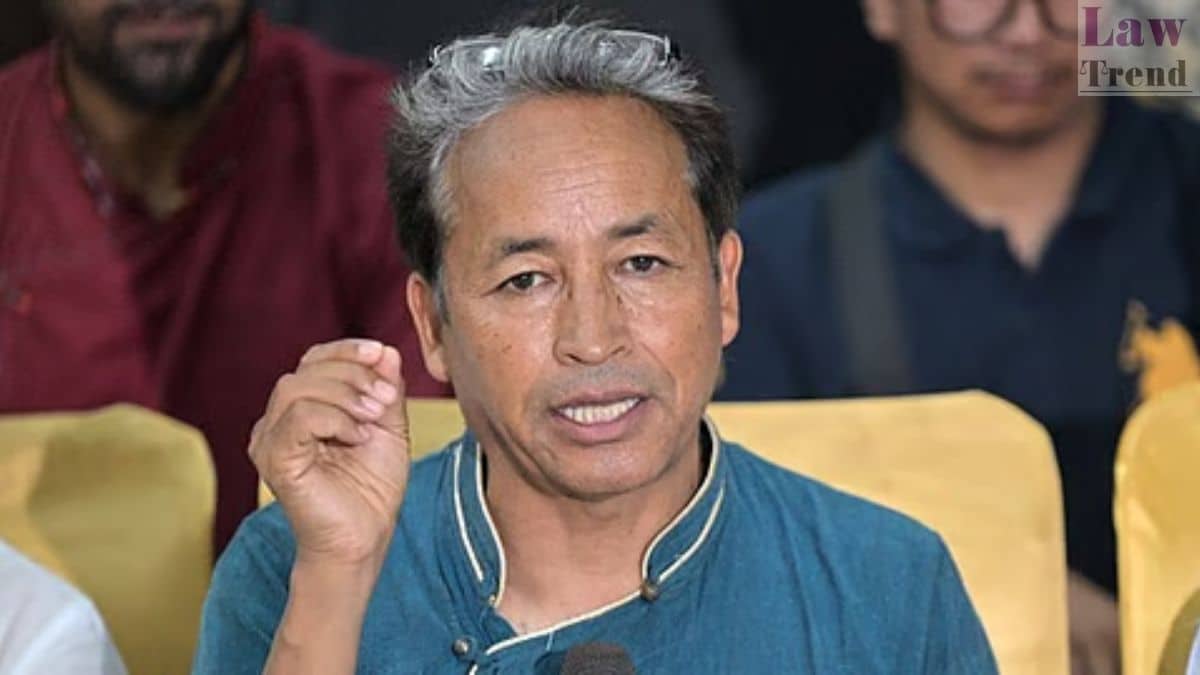
The Centre and the Union Territory of Ladakh administration on Monday defended the preventive detention of climate activist Sonam Wangchuk under the National Security Act (NSA), alleging before the Supreme Court that he attempted to incite the youth of Ladakh by invoking mass protest movements such as those in Nepal, Bangladesh, and the Arab Spring.
A bench comprising Justices Aravind Kumar and P V Varale was told by Solicitor General Tushar Mehta that Wangchuk “carefully crafted his speech” to rally Generation Z, masking the alleged incitement with references to Mahatma Gandhi. Mehta claimed the activist’s speech drew parallels with the Arab Spring—a wave of uprisings that toppled several governments in the Middle East—and called for agitations modelled on recent events in neighbouring countries.
“He spoke of ‘us’ versus ‘them’, called for plebiscites and referendums—phrases previously used in Jammu and Kashmir—and tried to mislead the youth while cloaking his rhetoric in Gandhian language,” Mehta submitted.
The solicitor general contended that the fragile geography and strategic importance of Ladakh, which borders both Pakistan and China, made such inflammatory speeches especially dangerous. “Ladakh is vital for our armed forces. Disrupting harmony there has serious national implications,” Mehta argued, adding that Wangchuk’s references to “referendums” and “plebiscites” sought to create a divide between Ladakhis and the rest of India.
He also rebutted the contention of Wangchuk’s wife, Gitanjali J Angmo, who has challenged the detention, stating it was based on “borrowed material” and lacked direct evidence. “The district magistrate need not personally attend each speech. Officials recorded the videos and presented them. The detention order was based on those relevant materials,” Mehta explained.
Represented by senior advocate Kapil Sibal, Angmo argued that the detention violated constitutional protections and was based on vague and outdated FIRs. She claimed Wangchuk was being targeted despite decades of acclaimed service in education, environmental activism, and innovation.
Wangchuk, currently lodged in Jodhpur Central Jail, has denied all allegations. In his submission on January 29, he maintained that he has the democratic right to protest and has never advocated violence or regime change. He categorically denied comparing his movement to the Arab Spring and condemned the violence that broke out during protests in Leh on September 24, 2025.
Four people had died and around 90 were injured during those protests demanding statehood and inclusion of Ladakh under the Sixth Schedule. The administration had accused Wangchuk of inciting the violence and detained him two days later under the NSA.
The plea filed by Angmo terms the detention as a “gross abuse of authority” and claims that Wangchuk’s calls for peaceful resistance were misconstrued to justify punitive action. “It is wholly preposterous that a person celebrated nationally and internationally for non-violent grassroots work would suddenly pose a threat to national security,” she argued.
After hearing arguments from both sides, the bench adjourned proceedings, with the matter set to resume on Tuesday. The outcome of the case could have significant implications for the exercise of preventive detention laws in contexts involving civil rights, dissent, and regional autonomy movements.




