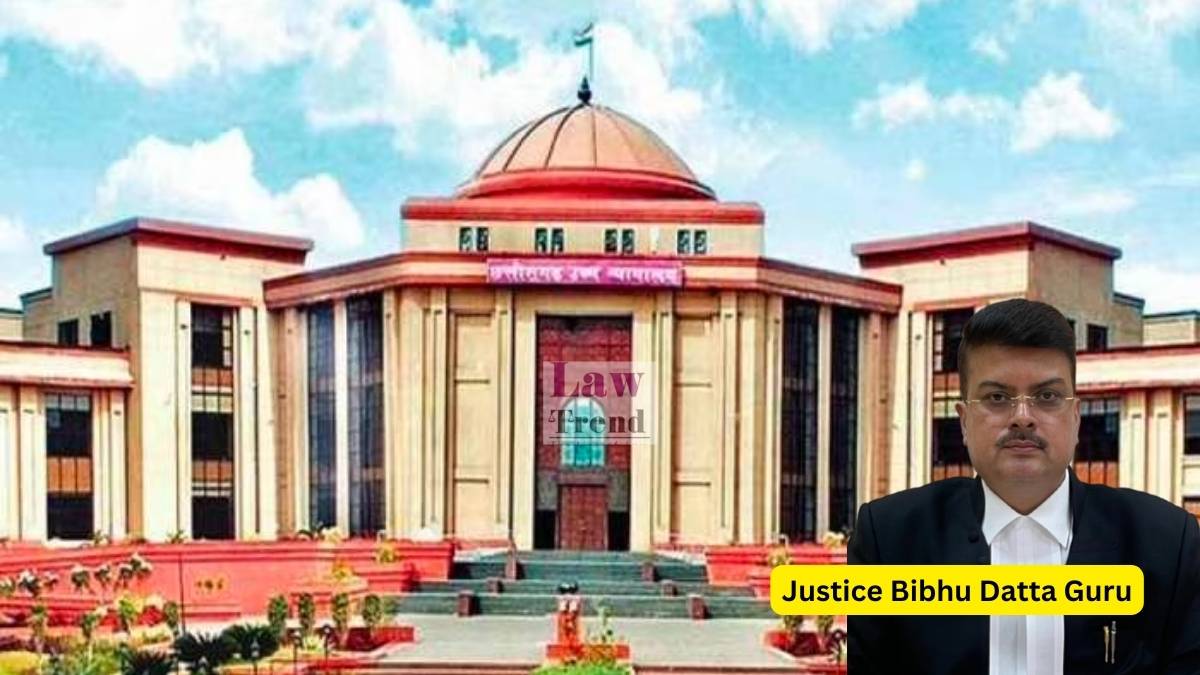
The High Court of Chhattisgarh has held that the presumption of validity available to documents that are thirty years old under Section 90 of the Indian Evidence Act, 1872, does not apply to Wills. The Court ruled that a Will must be strictly proved in accordance with Section 63(c) of the Indian Succession Act, 1925, and Section 68 of the Evidence Act, regardless of its age.
Justice Bibhu Datta Guru dismissed the Second Appeal filed by the plaintiffs, affirming the decisions of the lower courts which had declined to accept a registered Will from 1958 solely on the basis of its antiquity.
Background of the Case
The appeal arose from a property dispute between family members. The appellants (plaintiffs), Rampyare and Shivshankar, filed a civil suit seeking a declaration of title, possession, and permanent injunction regarding the suit land. They claimed that their grandfather, Mahadev, executed a registered Will on August 12, 1958, bequeathing his agricultural land to their father, Ramavatar (Mahadev’s nephew). The plaintiffs asserted that after the death of Mahadev in 1988 and Ramavatar in 1998, they became the owners. They alleged that the defendant, Ramkishun (Ramavatar’s brother and their uncle), forcibly took possession of the land in 2007-08.
The defendant, Ramkishun, contested the suit, denying the execution of the Will. He argued that the ancestral property was mutually partitioned between him and his brother Ramavatar after the death of their father Jagdev and uncle Mahadev. He claimed that Mahadev had no special affection for Ramavatar and that the alleged Will was forged and fabricated.
The Trial Court dismissed the suit, holding that the Will (Exhibit P-2) was not proved in accordance with legal requirements. The First Appellate Court subsequently dismissed the appeal, affirming the Trial Court’s findings. The plaintiffs then approached the High Court.
Arguments of the Parties
Mr. Hemant Kumar Agrawal, learned counsel for the appellants, argued that the disputed land had been in their possession for over 40 years. He emphasized that the Will was executed and registered on November 28, 1958, making it a document more than 30 years old.
The counsel contended that since all attesting witnesses to the Will had passed away, the due execution should be presumed under Section 90 of the Indian Evidence Act. Reliance was placed on the Supreme Court’s decision in Muddasani Venkata Narsaiah (Dead) through LRs Vs. Muddasani Sarojana (2016) and a Madhya Pradesh High Court decision in Goverdhandas Agrawal Vs. Gopibai Agrrawal (2008) to argue that the presumption regarding the signature and execution should be drawn in favor of the plaintiffs.
Court’s Analysis and Observations
Justice Bibhu Datta Guru rejected the appellants’ contention that the age of the document dispensed with the need for formal proof. The Court observed that while the scribe and attesting witnesses had passed away, the plaintiffs failed to prove the Will in the manner prescribed under Section 69 of the Indian Evidence Act.
The Court referred to the Supreme Court’s judgment in M.B. Ramesh (dead) by LRs. Vs. K.M. Veeraje URS (dead) by LRs & Ors (2013), quoting:
“A presumption regarding documents 30 years old does not apply to a will. A will has to be proved in terms of Section 63(c) of the Succession Act read with Section 68 of the Evidence Act.”
Further reliance was placed on Ashutosh Samanta (Dead) by LRs & Ors. v. Ranjan Bala Dasi & Ors. (2023), where the Apex Court held that Wills cannot be proved only on the basis of their age. The High Court noted:
“It is further well settled that the presumption contemplated under Section 90 of the Indian Evidence Act in respect of documents more than 30 years old does not apply to a will, as a will is required to be proved by strict compliance with statutory provisions governing its execution and attestation.”
The Court reasoned that a Will speaks only from the death of the testator and remains revocable during their lifetime; therefore, “its genuineness cannot be presumed merely on account of its antiquity.”
The Court found that the testimonies of the plaintiffs’ witnesses (P.W.-1 and P.W.-2) merely stated the factum of execution, while other witnesses (P.W.-3 and P.W.-4) admitted they did not personally see the execution. Consequently, the Will was not held to be duly proved.
Decision
The High Court held that the concurrent findings of fact recorded by the Trial Court and the First Appellate Court were not perverse or based on no evidence. The Court stated that the appellants failed to raise any substantial question of law as required under Section 100 of the Code of Civil Procedure.
“Mere registration of the will does not dispense with the mandatory requirement of proof by attesting witnesses,” the Court observed.
Accordingly, the Second Appeal was dismissed, and the impugned judgment and decree were upheld.
Case Details
- Case Title: Rampyare & Anr vs. Ramkishun & Anr
- Case No: SA No. 183 of 2021
- Coram: Justice Bibhu Datta Guru
- Counsel for Appellants: Mr. Hemant Kumar Agrawal
- Counsel for State: Mr. Santosh Singh, G.A.