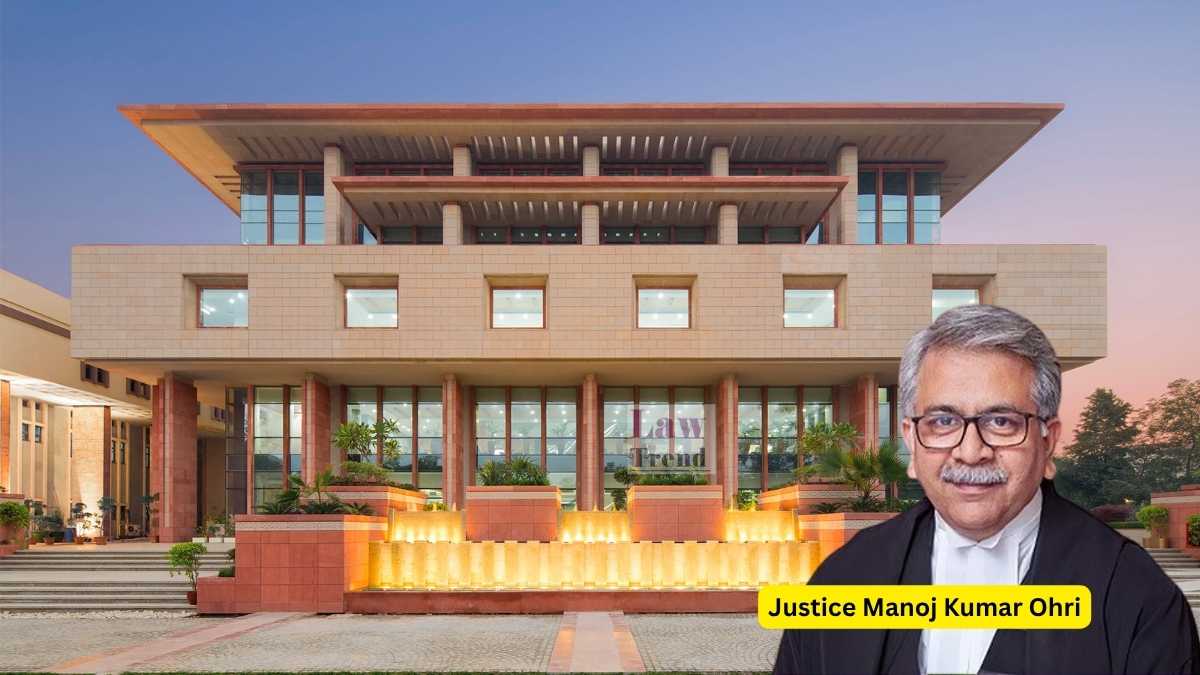
The High Court of Delhi has set aside a judgment of the Railway Claims Tribunal (RCT) that had dismissed a compensation claim for a death caused by a fall from a train. Justice Manoj Kumar Ohri held that the liability under Section 124-A of the Railways Act, 1989 is one of “strict liability,” and the Tribunal erred in dismissing the claim on “hyper-technical” grounds regarding the manner of purchasing tickets and the delay in their production.
The Court allowed the appeal in the case of Priyanka Sharma & Ors v. Union of India (FAO 59/2020), awarding compensation to the family of the deceased, Tara Chand Sharma.
Background of the Case
The appeal challenged the RCT’s judgment dated December 7, 2017, which had rejected the claim for compensation. The appellants—the wife and parents of the deceased—stated that on February 27, 2016, Tara Chand Sharma was travelling in the Jhansi-Hazrat Nizamuddin Taj Express (Train No. 12279) from Agra Cantt to Hazrat Nizamuddin.
According to the claimants, while the train was approaching Okhla Railway Station around 10:00 PM, the deceased, who was standing near the gate due to a heavy passenger load, lost his balance because of a sudden jerk and fell. He died on the spot.
The Tribunal had dismissed the claim primarily on three grounds:
- The body was recovered more than nine hours after the alleged incident (at 7:25 AM on Feb 28, 2016).
- There was a delay in handing over the journey tickets to the police by the co-passenger, Bhagwan Prashar, who produced them only the next afternoon.
- The Tribunal questioned why two separate tickets were purchased when the co-passenger and the deceased were relatives.
Consequently, the Tribunal held that the deceased was not a bona fide passenger and that no “untoward incident” had occurred.
Condonation of Delay in Filing Appeal
Before addressing the merits, the High Court condoned a delay of 690 days in filing the appeal. The appellants pleaded poverty and inability to obtain legal advice. Relying on a Co-ordinate Bench decision in Mohsina v. Union of India (2017), which condoned delay due to “extreme poverty and illiteracy,” Justice Ohri allowed the application, noting the appellants’ economic disadvantage.
Arguments
Appellants’ Submissions: Mr. Rajan Sood, counsel for the appellants, argued that the Tribunal erred in its reasoning regarding the tickets. He relied on the High Court’s decision in Charan Singh Vs. Union of India (2023), where a six-day delay in producing a ticket was held insufficient to cast doubt on a passenger’s bona fide status.
The counsel submitted that the Divisional Railway Manager (DRM) report itself concluded that the death occurred due to a fall from the train, although it attributed negligence to the deceased. It was further argued that the co-passenger had corroborated the events in his statement to the police.
Respondent’s Submissions: Ms. Arunima Dwivedi, Standing Counsel for the Union of India, defended the RCT’s decision. She contended that the incident was a case of negligence and self-inflicted injury, not an “untoward incident.” She argued there was no evidence of overcrowding and questioned why the co-passenger did not pull the emergency chain but instead went to Janakpuri. She asserted that since no ticket was recovered during the Jamatalashi (search of the body), the deceased was not a bona fide passenger.
Court’s Analysis and Observations
Justice Manoj Kumar Ohri examined the evidence, including the co-passenger’s statement explaining that he had purchased two tickets at Agra and, after the fall, had proceeded to Janakpuri for urgent work, unaware of the death until informed by a relative the next day.
On Strict Liability: The Court reiterated that the Railways Act is a beneficial legislation requiring liberal interpretation. Citing the Supreme Court’s decision in Union of India vs. Prabhakaran Vijaya Kumar and Ors. (2008), the Court observed:
“It is further well settled that the liability under Section 124-A of the Railways Act is one of strict liability, and in such cases, no proof of fault or negligence on the part of the Railways is required.”
Consequently, the Court held that the DRM’s conclusion attributing negligence to the deceased and the Respondent’s defence based on it were “legally unsustainable.”
On Bona Fide Passenger Status: The Court noted that the appellants had produced the journey tickets and filed an affidavit reiterating the facts. Referring to the Supreme Court’s judgment in Rajni v. Union of India (2025), the High Court held that the burden had shifted to the Railways to rebut the presumption of bona fide travel, which they failed to discharge.
On Tribunal’s Reasoning: The High Court sharply criticized the Tribunal’s grounds for dismissal, particularly regarding the tickets:
“The Tribunal’s findings with respect to the manner of purchasing tickets (i.e., separate vs. combined tickets for relatives) are hyper-technical in nature and thus, erroneous.”
The Court accepted the co-passenger’s explanation for the delay in producing the tickets and held that the adverse inferences drawn by the Tribunal were “based on conjectures and surmises, being bereft of evidence.”
Decision
The High Court concluded that the death was a result of an “untoward incident” under Section 123(c)(2) of the Railways Act. The impugned judgment of the Tribunal was set aside.
Compensation: Regarding the quantum of compensation, the Court applied the principle laid down in Union of India v. Rina Devi (2019), as the accident occurred prior to the 2016 revision of compensation rules.
The Court directed the Respondent to pay the higher of the