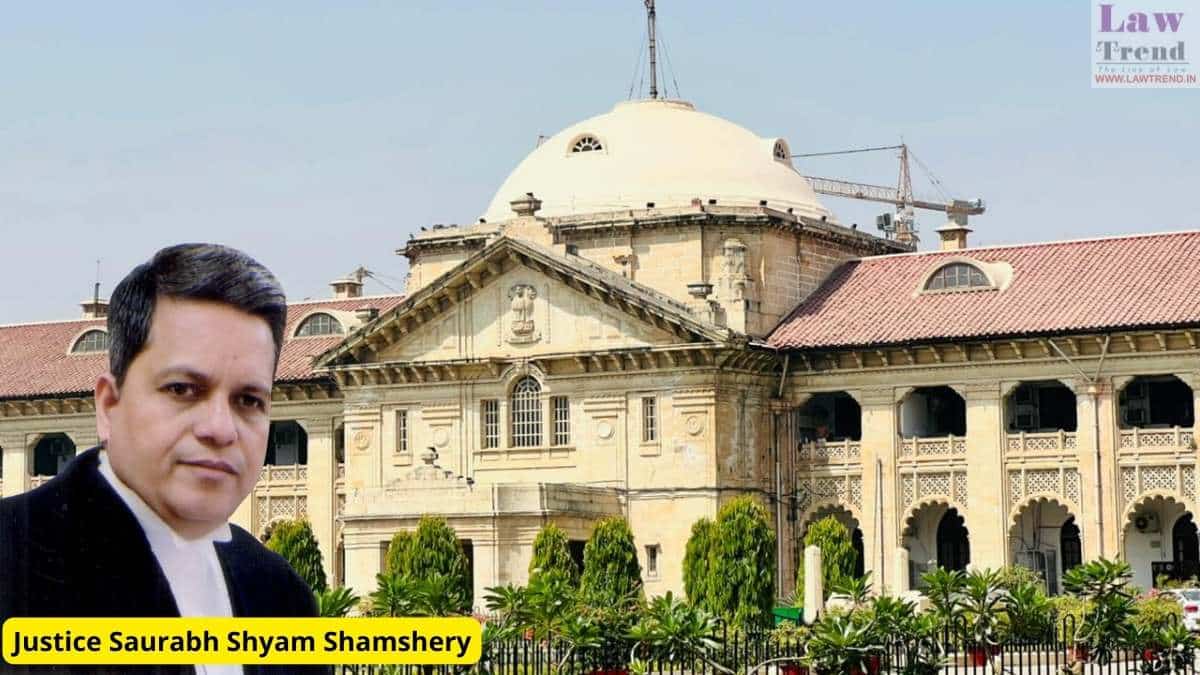
The Allahabad High Court has ruled that a teacher promoted as an ad-hoc Principal or Head Master is entitled to the salary of the post of Principal/Head Master only if the mandatory preconditions prescribed under Section 18 of the U.P. Secondary Education Service Selection Board Act, 1982, are strictly fulfilled.
The Court held that if the Committee of Management failed to notify the vacancy to the Board as required by the statute, the ad-hoc appointee cannot claim the higher salary attached to the post of Principal.
Background of the Dispute
The ruling came on a bunch of writ petitions, with the leading case being Samita vs. State of U.P. and 2 others. The core legal question before the Court was whether an ad-hoc Principal or Head Master, appointed by promoting the senior-most qualified teacher under the Regulations of the U.P. Intermediate Education Act, 1921, would be entitled to the salary of the Principal/Head Master, or if such entitlement is governed by the strict conditions of Section 18 of the U.P. Secondary Education Service Selection Board Act, 1982.
The petitioners argued that the issue of salary payment for ad-hoc Principals was already settled by previous Division Bench judgments of the Court in Dhaneshwar Singh Chauhan (1980), Narbdeshwar Misra (1982), and Soloman Morar Jha (1985), as well as a Full Bench judgment in Dr. Jai Prakash Narayan Singh (2014).
Arguments Raised
Senior Advocate Prabhakar Awasthi, appearing for the petitioners, contended that even if the preconditions of Section 18 of the Act of 1982 were not complied with, a promotion made on a temporary vacancy entitled the appointee to the salary of the Principal from the date of joining. He argued that Section 18(2) places a duty on the District Inspector of Schools (DIOS) to address defaults by the Management.
Per contra, Additional Advocate General Kartikeya Saran, representing the State, argued that the judgments relied upon by the petitioners were delivered prior to the substitution of Section 18 of the Act of 1982 by U.P. Act No. 5/2001 (effective from December 3, 2000). He submitted that the Full Bench decision in Dr. Jai Prakash Narayan Singh pertained to the U.P. State Universities Act, 1973, and the Higher Education Service Commission Act, 1980, and thus did not govern cases arising under the Intermediate Education Act, 1921 and the Act of 1982.
Judicial Analysis and Observations
Justice Saurabh Shyam Shamshery, delivering the judgment, observed that the earlier Division Bench judgments of 1980, 1982, and 1985 were decided primarily on the basis of Government Orders existing at that time and did not consider Section 18 of the Act of 1982 as it stands today.
Regarding the Regulations under Chapter II of the Act of 1921, specifically the Proviso to Regulation 2(1), which allows for promotion of the “senior most qualified teacher, if any, in the highest grade in the institution,” the Court clarified the interpretation of “highest grade.”
Justice Shamshery observed:
“The words ‘highest grade in the Institution’ does not mean that it would be grade of the post of Principal or Head Master, as the case may be. Being used in continuing in Statute, it would be highest grade in the Institution on post of a teacher.”
The Court analyzed Section 18 of the Act of 1982, which sets specific preconditions for ad-hoc appointments:
- The Management must notify the vacancy to the Board in accordance with Section 10(1).
- The post must actually remain vacant for more than two months.
The Court held that these conditions are mandatory.
“In case preconditions of Section 18 that Management had notified the vacancy and it remained vacant for two months and ad-hoc promotion was made, then only such ad-hoc promotee will be entitled for salary of the post of Principal,” the Court stated.
The Court rejected the applicability of the Full Bench judgment in Dr. Jai Prakash Narayan Singh to the present facts, noting that the Full Bench was considering different statutes.
Addressing the argument regarding higher responsibility, the Court held:
“An argument that after ad-hoc vacancy is filled by promotion and such promotee have discharged duties with higher responsibility, therefore also, they are entitled for salary of promoted post especially when it is for more than a year is also unacceptable since it would be against the provisions.”
The Decision
The High Court disposed of the writ petitions with the following directions:
- The DIOS concerned must examine the facts of each case. Ad-hoc promotees are entitled to the Principal’s salary only if the Management had notified the vacancy to the Board and the post remained vacant for two months.
- In cases where the vacancy was not notified, the ad-hoc Principal “will not be entitled for payment of salary on the post of Principal or Head Master.”
- Colleges where such vacancies were not notified are directed to notify them within four weeks.
- If salary of the Principal/Head Master post was paid to an ad-hoc appointee despite non-compliance with the conditions, such payment “shall be stopped from the date of present judgment.”
- However, the Court directed that “salary if already paid to earlier appointed ad-hoc Principal or Head Master… shall not be recovered.”
The Court also noted that under the newly enacted Uttar Pradesh Education Service Selection Rules, 2023, there is no provision for Ad-hoc Principals or Head Masters, and the Act of 1982 stands repealed.
Case Details:
- Case Title: Samita vs. State of U.P. and 2 others (and connected matters)
- Case Number: WRIT – A No. 19185 of 2025
- Bench: Justice Saurabh Shyam Shamshery