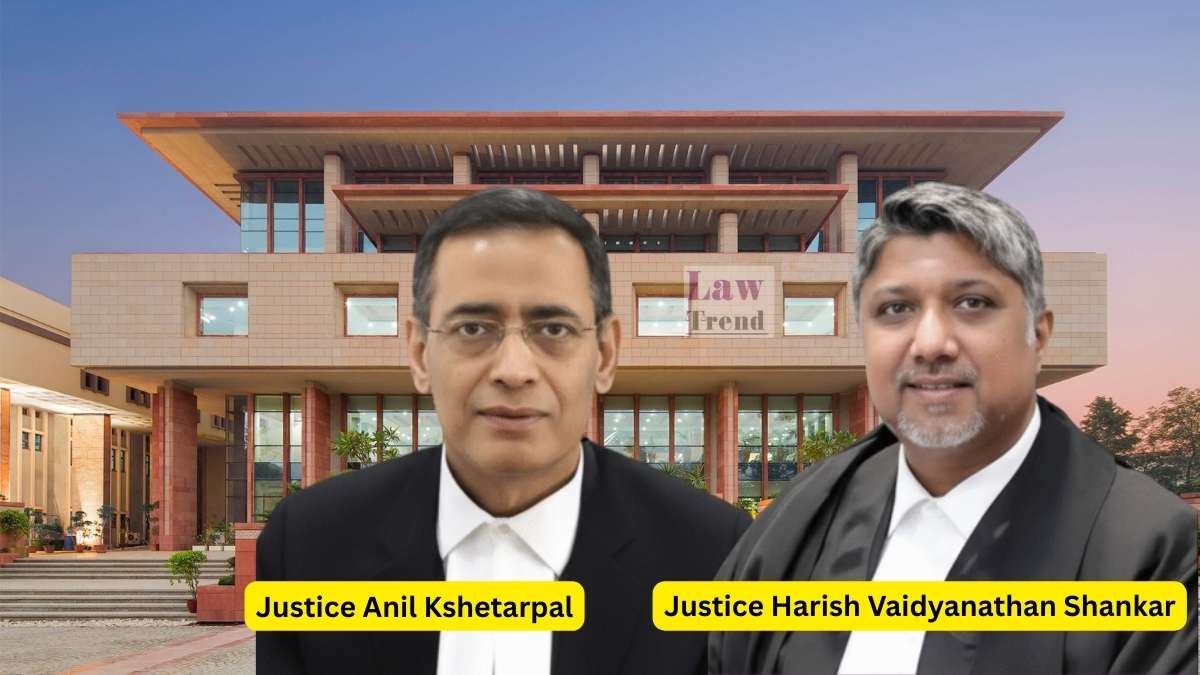
The Delhi High Court, in a significant judgment pronounced on January 23, 2026, has observed that the “Tender Years Doctrine” is founded on a “highly stereotypical premise” and may no longer be apposite in the modern era. The Division Bench comprising Justice Anil Kshetarpal and Justice Harish Vaidyanathan Shankar upheld the Family Court’s decision granting custody of two minor children to the father, ruling that the “welfare and best interest of the child” is the paramount consideration which outweighs presumptive doctrines.
The Court dismissed the appeal filed by the mother against the Family Court’s order and directed that the custody of the 12-year-old son and 6-year-old daughter be vested with the father.
Background of the Case
The appeal, Debarati Bhunia Chakraborty v. Suman Sankar Bhunia (MAT.APP.(F.C.) 279/2024), arose from a judgment dated July 1, 2024, passed by the Family Court, Patiala House Courts, New Delhi. The parties were married in 2011 and had two children—a son born in 2013 and a daughter born in 2019.
The Respondent-father alleged that on September 4, 2018, the Appellant-mother left the matrimonial home in West Bengal, leaving the minor son behind, but subsequently removed him on September 9, 2018. The mother, conversely, alleged cruelty and harassment, claiming she was compelled to leave for the safety of her unborn child (the daughter).
Following the separation, multiple legal proceedings ensued, including an FIR under Section 498A/506 IPC and proceedings under the Protection of Women from Domestic Violence Act, 2005. The guardianship proceedings, initially instituted in West Bengal, were transferred to the Family Court in New Delhi by the Supreme Court in 2021.
During the pendency of the litigation, the mother secured employment as a Lecturer in the United Kingdom and has been residing there since August 2023. The children, however, remained in India, residing in Bangalore with their maternal grandparents.
The Family Court, after a detailed trial, appointed the father as the sole custodian, citing “sustained parental alienation” by the mother and the adverse impact of repeated relocations on the children’s welfare.
Arguments of the Parties
The Appellant-Mother’s Contentions: The mother challenged the Family Court’s judgment, arguing that she had been the primary caregiver since the separation. Her counsel relied on the “Tender Years Doctrine,” asserting that custody of young children ought ordinarily to remain with the mother. It was contended that the children, particularly the son, had expressed a preference to stay with her and exhibited reluctance to meet the father.
The mother also raised serious allegations of sexual abuse against the father regarding the minor son, which she claimed were disclosed to her. Furthermore, she argued that her financial capacity, being substantially higher than the father’s, placed her in a better position to provide for the children’s needs.
The Respondent-Father’s Contentions: The father’s counsel supported the Family Court’s verdict, arguing that the mother had engaged in a “continuous and deliberate pattern of behaviour calculated to ensure parental alienation.” It was submitted that the mother had moved the children across multiple cities (Jodhpur, Vijayawada, Bangalore) without court leave, disrupting their stability.
Regarding the allegations of sexual abuse, the father contended they were “wholly devoid of substance” and a “counterblast” to the custody proceedings, noting that they were introduced only at the evidence stage and not in the initial pleadings. He further argued that since the mother was residing in the UK while the children were with grandparents, their welfare would be better served with the biological father in India.
Court’s Analysis and Observations
The Division Bench undertook a comprehensive review of the case, addressing key legal and factual issues:
1. Rejection of the ‘Tender Years Doctrine’ The Court explicitly declined to apply the ‘Tender Years Doctrine’ as a determinative principle. The Bench observed:
“Historically, the doctrine appears to have evolved at a time when societal norms rigidly ascribed the role of breadwinner to the father and that of homemaker and primary caregiver to the mother… Such rigid compartmentalisation of parental roles no longer accords with contemporary realities… the invocation of the Tender Years Doctrine in custody battles such as the present one may no longer be apposite.”
2. Welfare of the Child as Paramount Citing Supreme Court precedents including Gaurav Nagpal v. Sumedha Nagpal and Mausami Moitra Ganguli v. Jayant Ganguli, the Court reiterated that the “welfare and best interest of the child” is the “overarching and paramount consideration,” which far outweighs the competing rights of parents.
3. Parental Alienation The Court concurred with the Family Court’s findings on parental alienation. It noted that the mother’s conduct reflected a “sustained effort to deny the Respondent-father access to the children” from the date of her voluntary departure. The Court observed:
“The pronounced and unyielding hostility expressed by the son towards the father, seen in the backdrop of prolonged minimal contact and systematic exclusion, appears not to stem from an independent or spontaneous articulation, but is more consistent with a conditioned or influenced response.”
4. Allegations of Sexual Abuse The Court strongly deprecated the conduct of the mother in levelling allegations of sexual abuse against the father. The Bench noted that these allegations were absent in her reply to the custody petition and surfaced only in the affidavit of evidence. The Court held:
“The absence of any reference to such grave allegations at the stage of pleadings leads us to conclude that the same do not inspire confidence or appear to be genuine… [they] appear to be clearly motivated and in the nature of a counterblast.”
5. Relocation to the UK Denied The Court rejected the mother’s application for relocation, reasoning that moving the children outside Indian jurisdiction would reduce the father’s role to one of “episodic virtual presence.” The Judges remarked:
“The law must recognise that childhood is not lived on screens, and the bond between a parent and a child cannot be sustained across time zones through intermittent digital interfaces alone.”
6. Separating Siblings The Court held that separating the siblings would be “inimical to their holistic development and emotional stability,” stating that their bond often functions as an “anchor of continuity” amidst familial discord.
The Decision
The High Court dismissed the appeal and affirmed the directions of the Family Court.
- Custody: The custody of both minor children shall vest with the Respondent-father.
- Relocation: The children shall not be removed from the territorial jurisdiction of Indian courts.
- Mother’s Role: The Court clarified that the mother is expected to continue contributing meaningfully towards the children’s education and well-being, consistent with her professed financial capacity.
- Counseling: The Court directed that the children continue to undergo counseling to ensure the “gradual restoration and strengthening of parental bonds.”
The Court also disposed of the contempt petition (CONT.CAS(C) 203/2025) filed by the father alleging non-compliance with interim orders, stating that since the main appeal was decided on merits, it was not expedient to adjudicate on interim disputes.
Case Details:
- Case Title: Debarati Bhunia Chakraborty v. Suman Sankar Bhunia (Appeal) and Suman Sankar Bhunia v. Debarati Bhunia Chakraborty (Contempt)
- Case Number: MAT.APP.(F.C.) 279/2024 and CONT.CAS(C) 203/2025
- Coram: Justice Anil Kshetarpal and Justice Harish Vaidyanathan Shankar
- Counsel for Appellant (Mother): Ms. Padma Priya, Ms. Chitrangda Rastrauara, Mr. Abhijeet Singh, et al.
- Counsel for Respondent (Father): Mr. Prosenjeet Banerjee, Ms. Shreya Singhal, Ms. Mhasilenuo Keditsu, et al.