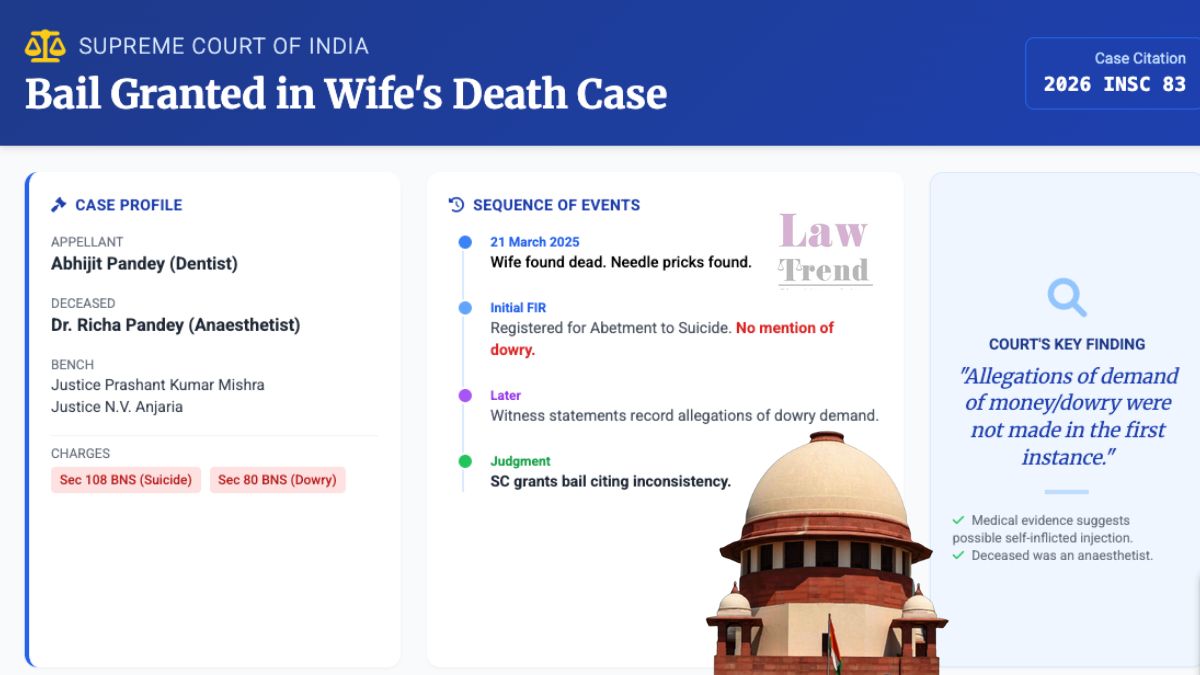
The Supreme Court has granted regular bail to a Bhopal-based dentist accused in connection with the death of his wife, observing that allegations regarding the demand for money and dowry were absent in the initial statements but appeared in subsequent versions.
A Bench comprising Justice Prashant Kumar Mishra and Justice N.V. Anjaria set aside the order of the Madhya Pradesh High Court which had declined bail to the appellant, Abhijit Pandey. The Court noted that the First Information Report (FIR) was initially registered for the offence of abetment to commit suicide and that the deceased, being an anaesthetist herself, died of an anaesthesia injection.
Background of the Case
The appellant, Abhijit Pandey, a dentist running a clinic in Bhopal, married Dr. Richa Pandey on December 4, 2024, after a relationship of one and a half years. The couple resided in Sky Dream Colony, Bhopal. On March 21, 2025, Dr. Richa Pandey was found dead.
According to the appellant, on the morning of the incident, the deceased did not open her room door. Upon breaking the lock, he found her unresponsive with needle pricks on her left hand. She was declared dead upon arrival at the hospital.
An FIR was registered on March 24, 2025, alleging that the appellant’s extra-marital relationship with a woman named Mahi led the deceased to commit suicide. The appellant was arrested on March 25, 2025. While the FIR was initially registered under Section 108 (abetment of suicide) of the Bharatiya Nyaya Sanhita (BNS), 2023, the charge-sheet was subsequently filed for offences punishable under Sections 108 and 80 (dowry death) of the BNS and Sections 3 and 4 of the Dowry Prohibition Act. Charges were later framed under Sections 108 and 80(2), and alternatively under Sections 103 (murder) and 85 of the BNS.
Arguments of the Parties
Senior Advocate Vivek K. Tankha, appearing for the appellant, argued that the present case is an unfortunate case of commission of suicide by the deceased as she was suspecting an extra-marital relation of the appellant with one woman, namely Mahi, who was working in his clinic. He submitted that there is “absolutely no material which would amount to abetment of committing suicide” or justify a conclusion of murder or dowry death.
Mr. Tankha emphasized that “in the FIR and in the initial case diary statements of the witnesses, there was no allegation of demand of money/dowry, which has come in the subsequent statements of the said witnesses by way of improvement.” He further contended that the appellant is not a hardened criminal and has been in custody since March 25, 2025.
Opposing the plea, Additional Advocate General Sridhar Potaraju for the State of Madhya Pradesh and the counsel for the complainant argued that this was a case of murder using an “Atracurium Besylate Injection.” They highlighted that the post-mortem report revealed five injuries, suggesting physical assault. They relied on statements from the deceased’s family members alleging that the appellant used to demand money.
The State also referred to a suicide note and audio recordings recovered from the deceased’s phone, where she could be heard saying, “You only give importance to Mahi, You do everything for her, You don’t do anything for me. You will see my dead face tomorrow morning.”
Court’s Analysis and Observations
The Supreme Court examined the medical evidence and the sequence of allegations. Regarding the injuries noted in the post-mortem report, the Court observed:
- Injuries (i), (ii), and (iii) were likely caused by a needle or syringe and could be self-inflicted.
- Injury (iv) (contusion on the thigh) was opined to be four to five days prior to death.
- The cause of injury (v) (subscalp hematoma) was not specified regarding the probable time.
The Bench noted, “Significantly, the post-mortem report indicates that injury no.(iv) is within four to five days prior to death. Injury nos. (i), (ii) and (iii) were probably caused by the needle of syringe/injection.”
Crucially, the Court pointed out the evolution of the allegations against the husband. The Bench observed: “In the counter affidavit filed by the State, it is stated that the first case diary statement of Vinod Chandra Pandey (father of the deceased) in which there is no allegation of demand of dowry. Similar is the case with the statements of Renu Pandey (mother of the deceased) and Himanshu Pandey (brother of the deceased). Thus, allegation concerning demand of money/dowry came in the subsequent case diary statements.”
The Court further took into account that the deceased was an anaesthetist and the substance used was an anaesthetic agent.
Decision
The Apex Court allowed the appeal, considering that the FIR was initially for abetment to commit suicide, the medical evidence, and the delay in raising dowry allegations.
The Court held: “Considering that the FIR was registered for an offence concerning abetment to commit suicide and the deceased had not sustained any such injury which can be said to be the cause of her death and prima facie it is found that she died of Atracurium Besylate Injection which is a medicine given as anaesthesia and the deceased herself was an anaesthetist and that the allegation of demand of money/dowry was not made in the first instance but was made in the subsequent case diary statements… we are inclined to allow the present Appeal and release the appellant on bail.”
The Court clarified that these observations are solely for considering the bail application and shall not influence the main trial.
Case Details:
- Case Title: Abhijit Pandey v. The State of Madhya Pradesh and Another
- Case Number: Criminal Appeal No. 446 of 2026 (Arising out of S.L.P. (Criminal) No. 16817 of 2025)
- Coram: Justice Prashant Kumar Mishra and Justice N.V. Anjaria