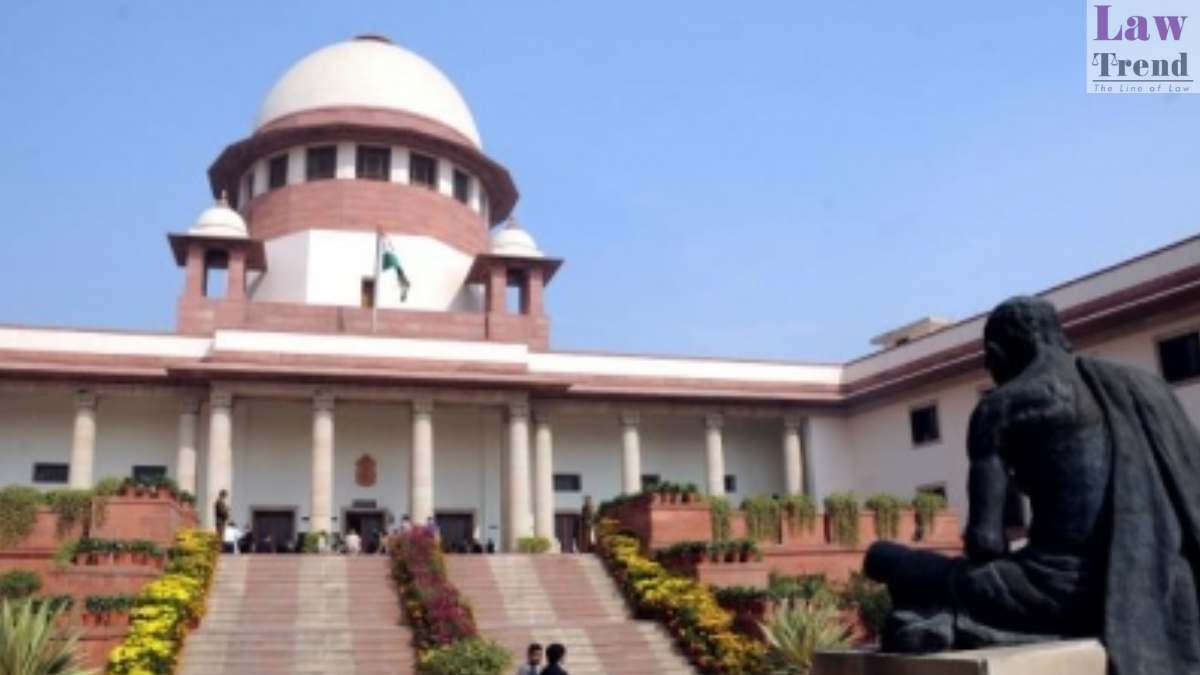
The Supreme Court has held that the State Anti-Corruption Bureau (ACB) is fully authorized to register cases, investigate, and prosecute Central Government employees for offences under the Prevention of Corruption Act, 1988 (PC Act). The Bench comprising Justice J.B. Pardiwala and Justice Satish Chandra Sharma dismissed a petition which claimed that the Central Bureau of Investigation (CBI) holds exclusive jurisdiction over such matters.
Background of the Case
The matter reached the Apex Court through a Special Leave Petition (SLP) filed by Nawal Kishore Meena, challenging a judgment of the Rajasthan High Court dated October 3, 2025. The High Court had ruled against the petitioner on two substantial questions of law:
- Whether the State agency of Anti-Corruption Bureau (ACB) has the jurisdiction to register a criminal case against a person serving under the Central Government, or if such jurisdiction lies exclusively with the CBI.
- Whether a charge-sheet filed by the ACB against a Central Government employee without the approval or consent of the CBI is valid in law.
The petitioner contended that for offences committed by a Central Government employee, the ACB cannot proceed without the prior approval of the CBI, and that the investigation falls exclusively within the CBI’s domain.
The Court’s Analysis
The Supreme Court affirmed the High Court’s decision, recording that the State ACB has jurisdiction “despite the fact that the accused is an employee of the Central Government.” The Bench observed that “it is incorrect to say that it is only the CBI who could have instituted the prosecution.”
On the Role of CBI and State Police
The Court analyzed the Delhi Special Police Establishment Act (DSPE Act), under which the CBI is constituted. While acknowledging that the CBI is a specialized agency often entrusted with cases involving Central Government employees to “avoid duplication of work,” the Court clarified that this administrative arrangement does not strip the state police of their statutory powers.
The Court observed:
“The PC Act does not specifically envisage a separate procedure for conducting investigation. The offences under the PC Act can be investigated into by the State agency or by the Central agency or by any police agency as can be seen from Section 17 of the said Act with the qualification that the police officer shall be of a particular rank.”
Statutory Interpretation
Referring to Section 156 of the Code of Criminal Procedure (CrPC), the Court noted that the CrPC is the parent statute for investigation and trial. “Unless the special law expressly or impliedly provides a separate provision for investigation, the general provision under Section 156 of Cr.P.C shall prevail,” the Bench stated.
The Court held that Section 17 of the PC Act does not exclude the State Police or a Special Agency of the State from registering a crime against Central Government employees. The Bench explained:
“Section 17 does not exclude or prevents the State Police or a Special Agency of the State from registering a crime or investigating cases relating to bribery, corruption and misconduct against Central Government employess.”
Precedents Cited
The Supreme Court relied on its earlier judgment in A.C. Sharma v. Delhi Administration (1973), which held that the DSPE Act does not divest regular police authorities of their jurisdiction. The Court reiterated that the DSPE Act is “permissive or empowering, intended merely to enable the Delhi Special Police Establishment also to investigate into the offences specified… without impairing any other law empowering the police authorities to investigate offences.”
The Court also agreed with the dictum laid down by the High Courts of Madhya Pradesh and Andhra Pradesh in cases such as Ashok Kumar Kirtiwar v. State of Madhya Pradesh and G.S.R. Somayaji v. State through CBI. These judgments established that the investigation done by a State agency against Central Government employees “cannot be questioned on the premises that it is illegal for want of jurisdiction.”
Decision
Finding “no error, not to speak of any error of law” in the impugned judgment of the Rajasthan High Court, the Supreme Court dismissed the Special Leave Petition.
Case Details:
Case Title: Nawal Kishore Meena @ N.K. Meena v. State of Rajasthan
Case No.: S.L.P. (Crl.) No. 492/2026
Coram: Justice J.B. Pardiwala and Justice Satish Chandra Sharma
Counsel for Petitioner: Dr. Manish Aggarwal, Mr. Vishal Arun Mishra (AOR)
Counsel for Respondent: Mr. Shivmangal Sharma, AAG