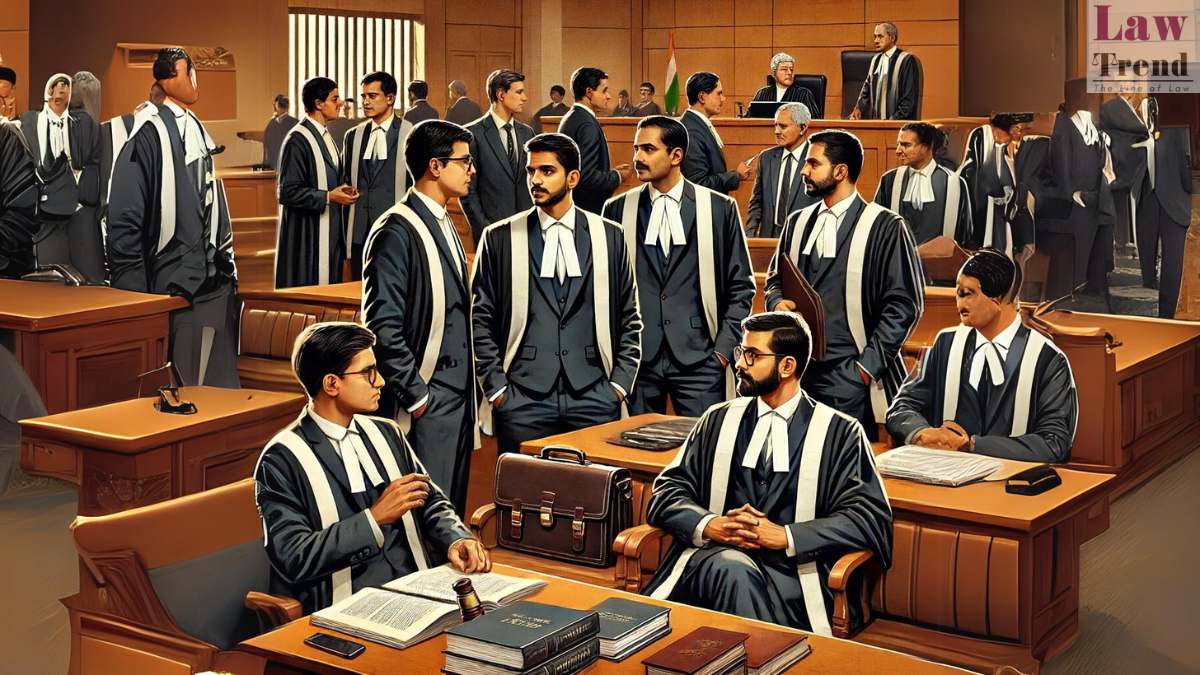
The Delhi High Court has dismissed an appeal filed by an advocate seeking directions against the New Delhi Bar Association regarding a chamber dispute. The Division Bench, comprising Chief Justice Devendra Kumar Upadhyaya and Justice Tejas Karia, held that the Bar Association is a private body functioning for the welfare of its members and does not perform public functions. Consequently, the Court ruled that the Association is not ‘State’ or an instrumentality of the State under Article 12 of the Constitution, and thus, a writ petition against it is not maintainable.
Background of the Case
The appeal, Sangita Rai v. New Delhi Bar Association & Ors., challenged an order dated October 30, 2023, passed by the learned Single Judge dismissing the appellant’s writ petition.
The appellant, an Advocate enrolled with the Bar Council since 2000, claimed that in 2013, one Mr. Asgar Ali, an allottee of Chamber No. 279A at Patiala House Court Campus, requested her to utilize the chamber on a monthly rent basis. She asserted that she had been functioning from the said chamber since then.
The dispute arose when the appellant alleged that Mr. Asgar Ali, along with ten others, broke open the lock and occupied the chamber. She further alleged that on February 4, 2023, office bearers of the New Delhi Bar Association threatened her to vacate the premises and placed their own lock on the chamber. She contended that her case files and belongings were thrown out on the street on March 6, 2023.
In her writ petition, the appellant sought:
- A direction to the respondents to remove their lock and hand over possession of the chamber.
- A direction to the Bar Association and the Bar Council of Delhi to “take appropriate action against the said Advocates, who have indulged in illegal and criminal activities of committing criminal acts trespassing in respect of the Chamber.”
The learned Single Judge dismissed the petition, observing that the appellant was not an allottee but claimed possession based on a permissive arrangement. Regarding the alleged criminal acts, the Single Judge noted that the appellant had remedies available under the Code of Criminal Procedure, relying on the Supreme Court judgments in Sakiri Vasu v. State of U.P. and Priyanka Srivastava v. State of U.P..
Arguments of the Parties
In the appeal, the counsel for the appellant submitted that they were pressing the appeal confined to Prayer B of the writ petition. The appellant argued that the learned Single Judge erred by not entertaining the prayer for a direction to the Bar Association and/or the Bar Council of Delhi to take action against the advocates who allegedly committed criminal trespass.
The respondents had raised a preliminary objection regarding the maintainability of the writ petition, arguing that the Bar Association is neither ‘State’ nor its instrumentality under Article 12 of the Constitution.
Court’s Analysis
The Division Bench examined the status of the Bar Association and the nature of the relief sought.
1. Bar Association is Not ‘State’: The Court categorically stated that the Bar Association is an association of lawyers registered under the Societies Registration Act, 1860, with the primary object of ensuring the welfare of its members.
The Bench observed:
“Bar Association is a body of private individual lawyers and in normal discharge of its functions, it does not perform any function which can be said to be a public function… It is in fact, a purely private entity and cannot in any manner or for any reason, whatsoever, be termed to be ‘State’ or its instrumentality or agency or authority.”
Consequently, the Court held that “no Mandamus can be issued by the Court to Bar Association in exercise of our jurisdiction under Article 226 of the Constitution of India.”
2. Alternative Remedies for Criminal Acts: Regarding the appellant’s allegation of criminal trespass by certain advocates, the Court agreed with the learned Single Judge’s view. The Bench noted:
“Such acts of the lawyers, which have been complained of by the appellant, may warrant criminal action, however, for the said purpose; the learned Single Judge has rightly observed that the appellant could take appropriate steps by instituting proceedings under the criminal law so as to put criminal law machinery in motion.”
3. Writ Against Bar Council: The Court also addressed the prayer for directions to the Bar Council of Delhi. The Bench laid down that for seeking a Writ of Mandamus, a petitioner must first approach the concerned authorities.
“It is trite that for seeking Writ of Mandamus, the person approaching the Court has to first approach the authorities concerned… and it is only in case of failure on the part of the public authorities concerned that a Writ of Mandamus can be sought…”
The Court noted that the appellant had neither represented her cause to the Bar Council of Delhi nor impleaded them as a party respondent before the Single Judge. Therefore, no Mandamus could be issued.
Decision
The High Court found no force in the appeal and dismissed it. However, the Court clarified that the dismissal does not bar the appellant from seeking other legal avenues.
“Notwithstanding dismissal of the instant appeal, it is needless to say that it will always be open to the appellant to take recourse to appropriate civil or criminal action, as may be permissible under law… or by approaching the authority concerned, including the Bar Council of Delhi.”
Case Details
- Case Title: Sangita Rai v. New Delhi Bar Association & Ors.
- Appeal Number: LPA 368/2024
- Coram: Chief Justice Devendra Kumar Upadhyaya and Justice Tejas Karia