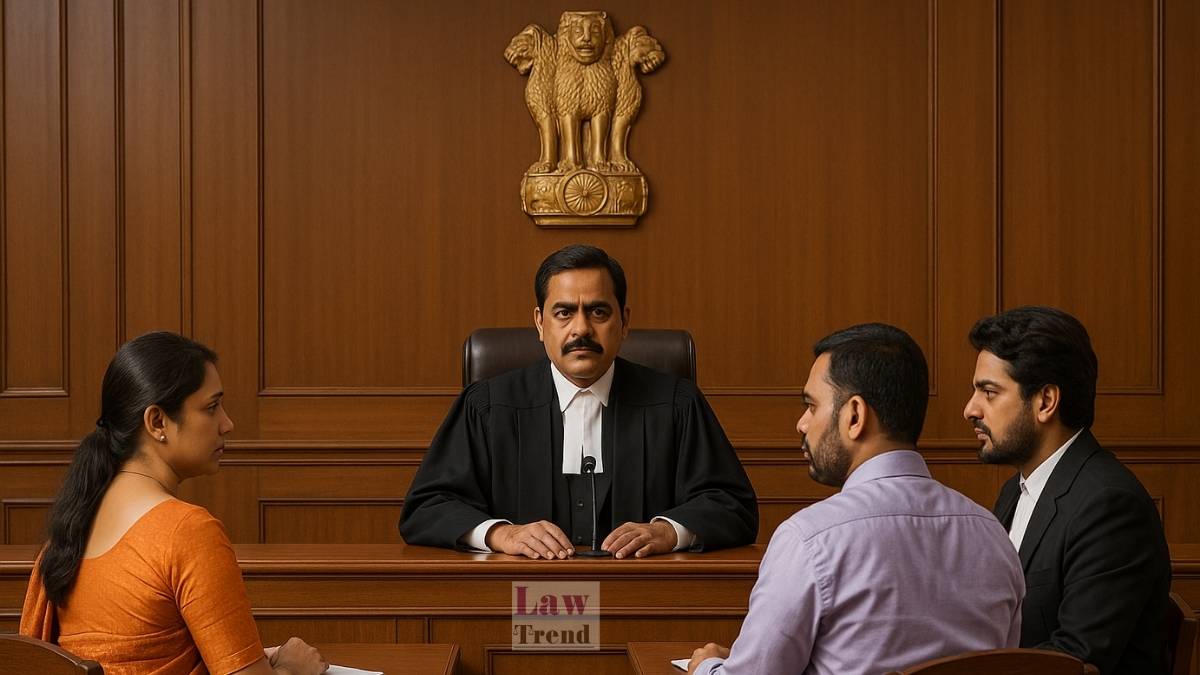
The High Court of Jharkhand at Ranchi has affirmed a decree of divorce in a matrimonial appeal, characterizing the marriage as “dead wood” due to prolonged separation and the husband’s second marriage. The Division Bench comprising Justice Sujit Narayan Prasad and Justice Arun Kumar Rai directed the respondent-husband, a Border Security Force (BSF) constable, to pay a cumulative sum of ₹35,000 per month towards the maintenance of his first wife and minor daughter, subject to a periodic enhancement of 5% every two years.
The appeal challenged the Family Court’s decision to grant a divorce on the grounds of cruelty. The High Court, observing that the marriage had become “lifeless and without emotional or practical value,” upheld the dissolution of the marriage. Consequently, the Court focused on determining just alimony, ultimately awarding ₹25,000 per month to the wife and ₹10,000 per month to the daughter based on the husband’s salary and the Supreme Court’s recent precedents.
Background of the Case
The appellant-wife filed the appeal (F.A. No. 324 of 2023) against the judgment dated April 18, 2023, passed by the Additional Principal Judge, Additional Family Court No. II, Dhanbad. The Family Court had allowed the Original Suit No. 839 of 2021 filed by the respondent-husband seeking a decree of divorce under Section 13(1)(i-a) of the Hindu Marriage Act, 1955.
The parties were married on November 23, 2008, and a daughter was born from the wedlock. The husband alleged that the wife’s behavior was “reluctant and intemperate” and that she used “abusive words and foul language.” He stated that the wife left the matrimonial home on September 16, 2014, without his consent and subsequently filed multiple cases against him, including criminal complaints.
In the Family Court proceedings, the wife was debarred from filing a written statement due to delays and did not adduce oral or documentary evidence. The Family Court, relying on the husband’s evidence, decreed the suit on the ground of cruelty.
Arguments of the Parties
During the appeal, the counsel for the appellant-wife submitted that the factual scenario had changed as the respondent-husband had entered into a relationship with another woman. Recognizing that there was “no possibility to live together,” the counsel argued that the primary issue for consideration was the quantum of alimony, emphasizing that the minor daughter residing with the appellant also required financial support.
The respondent-husband filed an affidavit admitting that he had solemnized a second marriage and that a male child was born from that union. He disclosed his employment as a Constable in the BSF with a gross monthly salary of ₹86,706 (as of November 2025). He contended that he also bears the financial burden of his bedridden father, a separated sister, and his second family, urging the Court to consider his actual financial condition.
Court’s Analysis and Observations
The High Court observed that the long separation and the husband’s second marriage rendered the union irretrievable.
“In the aforesaid circumstances, the considered view of this Court is that now the marital relation between the parties has become ‘dead wood marriage’ and marital relation has become lifeless and without emotional or practical value,” the Bench observed.
Citing the Supreme Court’s decision in Durga Prasanna Tripathy v. Arundhati Tripathy (2005), the Court noted that “forcing a couple to remain in such a relationship only prolongs their suffering and no purpose will be served in sailing the dead wood.” Consequently, the Court found no reason to interfere with the Family Court’s decree of divorce.
Determination of Maintenance: The Court then addressed the quantum of permanent alimony under Section 25 of the Hindu Marriage Act, 1955. The Bench referred to the recent Supreme Court judgment in Rakhi Sadhukhan Vs. Raja Sadhukhan (2025 SCC OnLine SC 1259), where approximately 30% of the husband’s salary was awarded as maintenance.
Applying this precedent to the husband’s gross salary of ₹86,706, the Court held:
- For the Wife: A sum of ₹25,000 per month was deemed “just, fair and reasonable” for her sustenance.
- For the Daughter: A sum of ₹10,000 per month was awarded to ensure her financial stability, education, and future prospects.
Decision
The High Court disposed of the appeal with the following specific directions regarding maintenance:
- The respondent-husband must pay the total amount of ₹35,000 to the appellant-wife’s account by the 10th of each month.
- The awarded amount shall be enhanced to the extent of 5% after every two years.
- The maintenance for the daughter shall continue until she attains majority, after which the amount shall be deposited directly into her account.
The Court affirmed the divorce decree passed by the Family Court, Dhanbad.
Case Details:
- Case Title: Sushma Devi vs. Raj Kumar Prasad
- Case Number: F.A. No. 324 of 2023
- Coram: Justice Sujit Narayan Prasad and Justice Arun Kumar Rai
- Counsel for Appellant: Mr. Vijay Bahadur Singh, Advocate
- Counsel for Respondent: Ms. Nishi Rani, Advocate