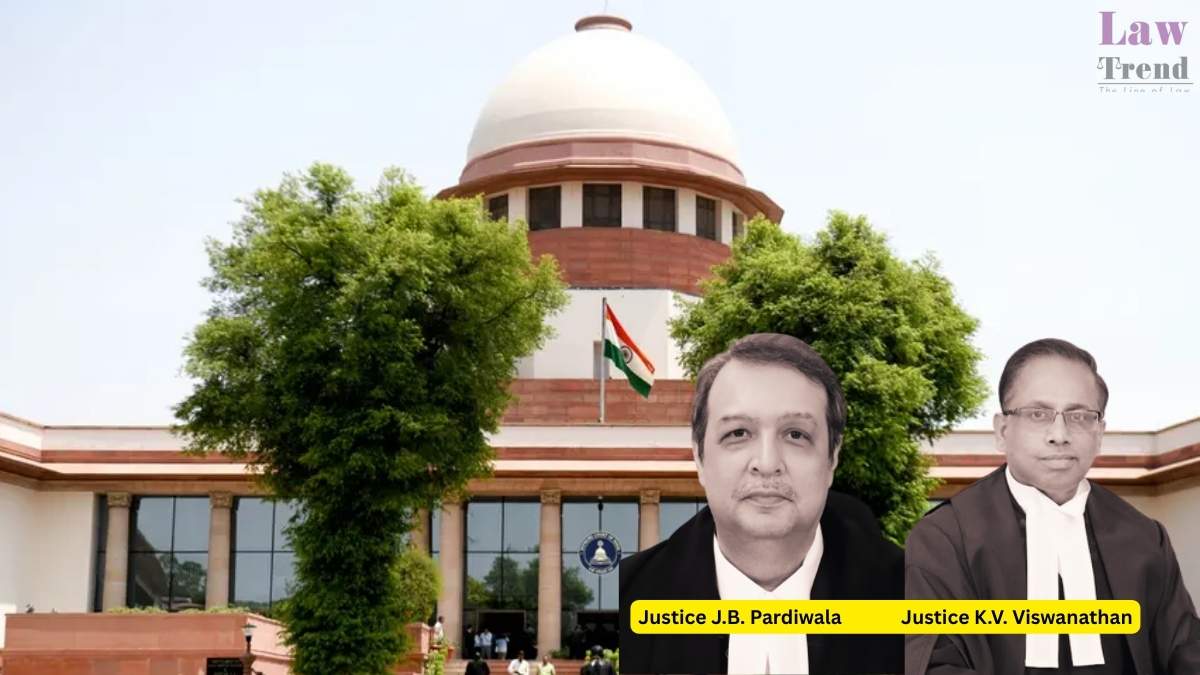
The Supreme Court of India has held that fees paid to international booking agents for procuring speakers for a summit cannot be taxed under the category of “Event Management Service” under the Finance Act, 1994. The Bench comprising Justice J.B. Pardiwala and Justice K.V. Viswanathan set aside the order of the Customs, Excise and Service Tax Appellate Tribunal (CESTAT), ruling that individual contracts for booking persons for participation in an event are not commonly understood as event management contracts.
The core legal issue before the Apex Court was whether the fee paid by the appellant, HT Media Limited, to personalities and speakers through their booking agents was liable to Service Tax under the reverse charge mechanism under the taxable category of “Event Management Service” defined under Sections 65(40) and 65(41) read with Section 65(105)(zu) of the Finance Act. The Court ruled in favor of the appellant, holding that the activity of booking speakers does not amount to planning, promoting, organizing, or presenting an event.
Background of the Case
The appellant, HT Media Limited, organizes the annual “Hindustan Times Leadership Summit.” To secure the attendance of prominent speakers from outside India, the appellant entered into contracts with booking agents such as the Washington Speakers Bureau and Harry Walker Agency. These agents booked speakers including Mr. Tony Blair, Mr. Jerry Linenger, and Mr. Al Gore.
The Revenue Department issued show cause notices proposing to impose Service Tax on the fees paid to these booking agents under the category of “Event Management Service.” The Adjudicating Authority confirmed the demand, invoking the extended period of limitation. On appeal, the CESTAT set aside the extended period of limitation but affirmed the demand for the normal period, holding the appellant liable to pay Service Tax under the category of “Event Management Service.”
Arguments of the Parties
Submissions on Behalf of the Appellant: Counsel for HT Media, Mr. Ashok Dhingra, argued that the Tribunal erred in affirming the demand. He submitted that:
- The agents were merely “lecture booking agents” and provided no service to the appellant regarding the management of the event.
- To fall under Section 65(105)(zu), the service provider must be an “Event Manager” engaged in planning, promotion, organizing, or presentation of an event.
- Relying on the TRU Circular dated August 8, 2002, it was argued that an Event Manager is expected to manage the venue, decoration, sound, light, security, and publicity. The booking agents performed none of these tasks.
- The agents did not provide any consultation regarding the summit.
Submissions on Behalf of the Revenue: Mr. V. Chandrashekara Bharathi, Counsel for the Revenue, defended the tax demand, contending that:
- The speakers constitute the summit, and without them, the event would have no significance.
- By ensuring the speakers’ presence for a consideration, the booking agents rendered a service in relation to the planning, promotion, organizing, or presentation of the summit.
- Therefore, the agents acted as “Event Managers” liable to tax under Section 65(105)(zu).
Court’s Analysis
The Supreme Court examined the definitions of “Event Manager” under Section 65(41) and “Event Management” under Section 65(40) of the Finance Act. The Court observed that the agreements were strictly for booking a particular speaker and outlining logistics such as travel, accommodation, and the schedule of the speech.
Nature of Services: The Bench observed, “The tenor of the contracts and the declaration given by the agents clearly indicate that the services rendered by such agents to the assessee were in the nature of booking the speakers for the event to be organized by the assessee… Such services cannot be equated with ‘event management service’ which has been statutorily defined to mean ‘any service provided in relation to planning, promotion, organizing or presentation of any arts, entertainment, business, sports, marriage or any other event and includes any consultation provided in this regard’.”
Distinction Between Participation and Management: Addressing the Revenue’s argument that the speakers are integral to the event, the Court clarified: “However, whether the service of the speaker or the agent on behalf of the speaker can be considered to be ‘event management service’ is altogether a different issue. The speaker does not plan, promote, organize or present the event… Participation in the event cannot be considered as management of the event. This precisely is the fundamental error committed by the revenue as well as by the Tribunal…”
Strict Interpretation of Taxing Statutes: Citing the decision in Shiv Steels v. State of Assam (2025), the Court reiterated the principle of strict interpretation of taxing statutes. The Court stated, “If… the case is not covered within the four corners of the provisions of the taxing statute, no tax can be imposed by inference or by analogy…”
Common Parlance Test: The Court also applied the “common parlance test,” noting that in ordinary understanding, “event management” implies appointing someone to manage or organize the entire event. The Court held: “Individual contract for booking of persons required for participation in the event are not commonly understood as ‘event management’ contracts.”
Decision
The Supreme Court allowed the appeals and set aside the impugned judgment of the Tribunal. The Court concluded that the fee paid to the speakers through booking agents is not liable to Service Tax under the category of “Event Management Service.”
Case Details:
Case Title: HT MEDIA LIMITED VERSUS PRINCIPAL COMMISSIONER DELHI SOUTH GOODS AND SERVICE TAX
Case No.: CIVIL APPEAL NOS. 23525-23526 OF 2017
Bench: Justice J.B. Pardiwala and Justice K.V. Viswanathan