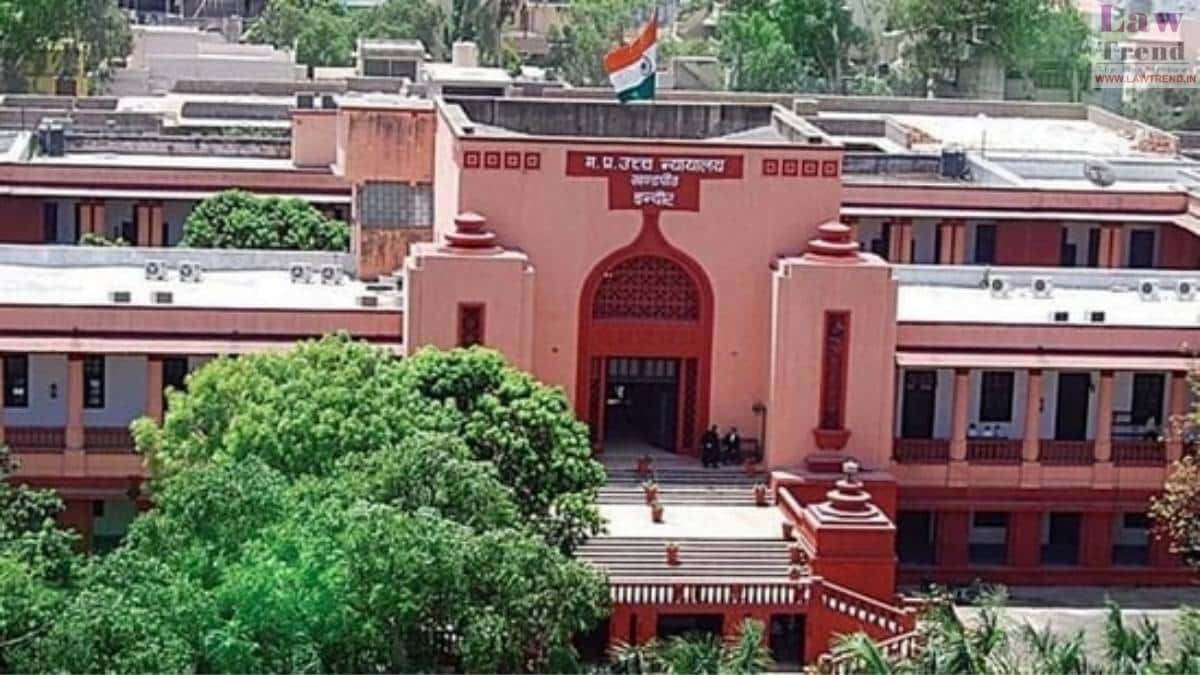
In a significant judgment concerning reservation benefits for married women in the state, the Madhya Pradesh High Court has held that women who were residents of other states prior to their marriage but settled in Madhya Pradesh after marrying a permanent resident are entitled to reservation benefits, provided their caste is recognized as a reserved category in both states.
Justice Jai Kumar Pillai allowed a batch of writ petitions filed by candidates whose candidatures for the post of Uchha Madhyamik Shikshak were cancelled solely because they did not possess a caste certificate issued by the Competent Authority of Madhya Pradesh, despite holding valid certificates from their native states.
Background of the Case
The Court was hearing a batch of petitions, including Anusuiya Prajapati v. State of Madhya Pradesh and connected matters. The petitioners were originally residents of other states and belonged to reserved communities (SC/ST/OBC) in their respective home states. After marrying permanent residents of Madhya Pradesh, they shifted their residence and obtained domicile certificates of Madhya Pradesh in accordance with government policy.
The petitioners applied for the post of Uchha Madhyamik Shikshak (High School Teacher) in various streams under the SC/ST/OBC categories. They qualified the written examination and were called for document verification. However, their candidatures were cancelled at the verification stage on the ground that they failed to submit a caste certificate issued by the Competent Authority of Madhya Pradesh.
Arguments of the Parties
The petitioners argued that they possessed the requisite educational qualifications and valid domicile certificates of Madhya Pradesh. They contended that the cancellation of their candidature without a show-cause notice was arbitrary. It was submitted that since they acquired domicile status after marriage, they were entitled to constitutional benefits available to reserved classes in the state. They further argued that the advertisement did not specifically bar candidates holding caste certificates from other states.
The State, represented by the Government Advocate, opposed the plea. It was argued that while the petitioners qualified the eligibility test, they “failed to produce a valid Domicile/Caste Certificate of Madhya Pradesh at the stage of document verification.” The State contended that the petitioners had falsely declared themselves as domiciles of Madhya Pradesh in the online application. It was asserted that under the applicable recruitment rules, a caste certificate issued by the Madhya Pradesh authorities was mandatory, and the rejection was lawful.
Court’s Analysis
The Court examined the Madhya Pradesh School Education Service (Teaching Cadre) Service Conditions and Recruitment Rules, 2018, and the relevant advertisement. Justice Pillai observed that there was “no clear, specific or express clause stipulating that only those candidates who possess a Caste Certificate issued by the Competent Authority of the State of Madhya Pradesh would be eligible for appointment.”
Addressing the status of the petitioners, the Court held:
“In the present case, although the petitioners were originally residents of another State, upon their marriage to permanent resident of the State of Madhya Pradesh, they are not to be treated as migrants and for all service and reservation-related purposes, they shall be reckoned as domiciled residents of the State of Madhya Pradesh, subject to fulfillment of the prescribed statutory requirements.”
The Court relied on the Division Bench decision in Dr. Alka Singh v. State of M.P. (2012), which established that a lady belonging to a reserved class in both her state of birth and marital state cannot be treated as a migrant merely due to marriage and is entitled to a permanent caste certificate in the state after marriage.
The Court heavily criticized the introduction of a new condition regarding the caste certificate issuance authority mid-way through the selection process. Relying on the Supreme Court judgments in K. Manjusree v. State of Andhra Pradesh (2008) and the recent Constitution Bench decision in Tej Prakash Pathak & Ors. v. Rajasthan High Court (2024), the Court reiterated that “the rules of the game… cannot be altered by the authorities concerned in the middle or after the process of selection has commenced.”
Justice Pillai observed:
“However, the cases in hand, where the advertisement does not contain any clear, specific or express stipulation requiring submission of a Caste Certificate issued only by the State of Madhya Pradesh, the respondents cannot introduce such a condition at a later stage.”
Furthermore, citing the Apex Court’s decision in S. Pushpa & Ors. v. Sivachanmugavelu & Ors. (2005) and Indra Sawhney v. Union of India (1992), the Court emphasized that reservation provisions must receive a liberal and purposive interpretation. The Court stated:
“Further, where the caste/community of the petitioners is notified as a reserved category in both the State i.e. from which the Certificate was issued and the State of Madhya Pradesh, rejection of candidatureship solely on the ground that the Caste Certificate was issued by another State would be arbitrary and unsustainable.”
Decision
The High Court allowed all the writ petitions and quashed the impugned orders cancelling the petitioners’ candidatures. The Court directed the respondents to verify the status of the petitioners’ castes.
“This Court thus directs the respondents to verify whether the caste or community of the petitioners are recognized as a reserved category in both the States or not and if it is found that the caste is a reserved caste in both the States, The Appropriate Authorities shall proceed with the appointments of petitioners who are found eligible…”
The respondents have been directed to complete this verification and take consequential action, including determination of seniority and notional pay fixation, within 60 days.
Case Details:
- Case Title: Anusuiya Prajapati v. The State of Madhya Pradesh and Other (and connected petitions)
- Case No: W.P. No. 10277/2021 (with W.P. Nos. 18396/2022, 19690/2022, 19986/2022, 20187/2022, 4358/2023)
- Bench: Justice Jai Kumar Pillai
- Counsel for Petitioners: Shri L.C. Patne
- Counsel for Respondents: Shri Anirudh Mapani, Government Advocate