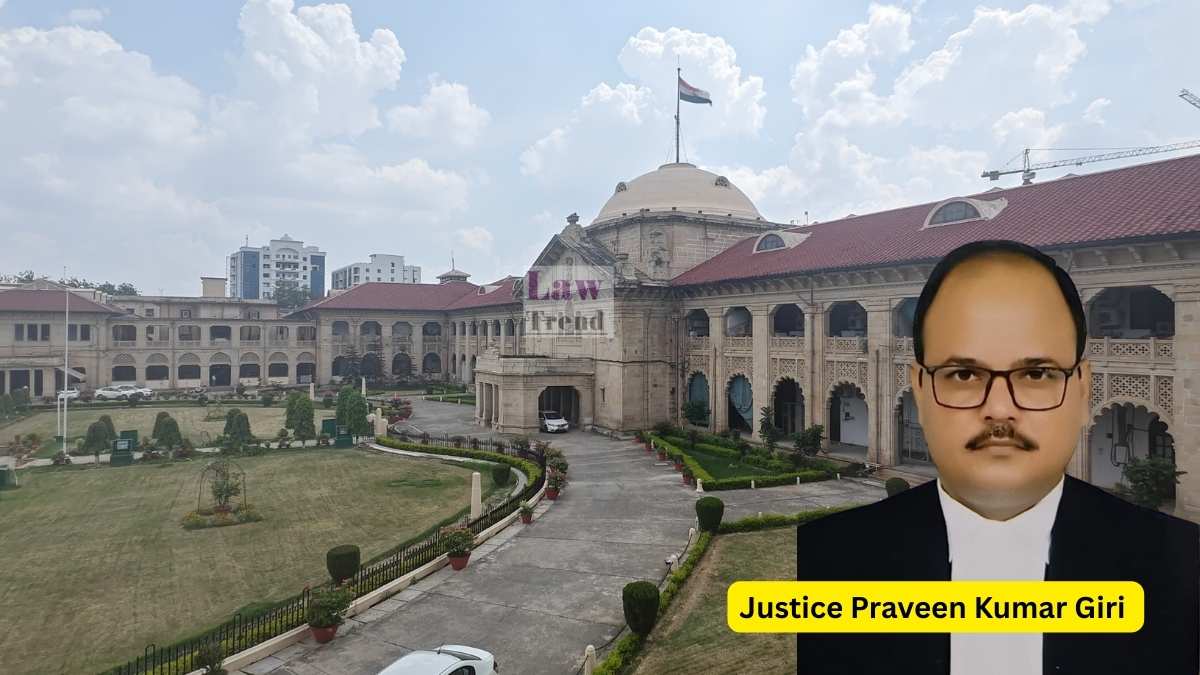
The Allahabad High Court has ruled that if an investigation reveals that a First Information Report (FIR) was lodged based on false information, the Investigating Officer (IO) is under a statutory obligation to file a written complaint against the informant for perjury. The Court further clarified that a police report submitted in a non-cognizable offence must be treated as a “complaint” and not as a State case.
Delivering the judgment in the case of Umme Farva v. State of U.P. and Another, Justice Praveen Kumar Giri quashed a cognizance and summoning order passed by the Chief Judicial Magistrate, Aligarh, which had treated a protest petition in a non-cognizable case as a police case under Section 190(1)(b) of the Code of Criminal Procedure (Cr.P.C.).
Background of the Case
The matter arose from a matrimonial dispute. The Opposite Party No. 2 (husband) lodged an FIR as Case Crime No. 1004 of 2023 at Police Station Kwarsi, District Aligarh, against the applicant (his wife), alleging offences under Sections 504 (Intentional insult with intent to provoke breach of the peace) and 507 (Criminal intimidation by an anonymous communication) of the Indian Penal Code (IPC).
The informant alleged that his wife, who was in a live-in relationship with another individual in Korea, was using Facebook to defame him and his daughter and had threatened him with elimination if he returned to India.
Following the investigation, the police found no evidence to substantiate the allegations and submitted a Final Report (Closure Report) on June 19, 2024. The informant subsequently filed a protest petition. On October 23, 2024, the Chief Judicial Magistrate, Aligarh, allowed the protest petition, rejected the Final Report, and took cognizance of the offences under Sections 504 and 507 IPC under Section 190(1)(b) Cr.P.C., proceeding with the matter as a “State case.”
Arguments
Counsel for the applicant, Mr. Manoj Kumar Pandey, argued that the applicant had been falsely implicated due to malafide intentions arising from matrimonial discord. He submitted that since the investigation resulted in a Final Report, and the alleged offences were non-cognizable, the Magistrate erred in taking cognizance as a State case.
Per contra, Mr. Najam Uz Zaman Khan, counsel for the Opposite Party No. 2, and the learned Additional Government Advocate argued that the Magistrate had correctly appreciated the evidence collected during the investigation and that the order suffered from no illegality.
Court’s Analysis and Observations
The High Court observed that both Sections 504 and 507 IPC are non-cognizable and bailable offences, punishable with imprisonment of up to two years. The Court noted that the police initially erred by registering an FIR instead of a Non-Cognizable Report (NCR) under Section 155 Cr.P.C.
On Procedure for Non-Cognizable Offences The Court relied on the Explanation to Section 2(d) of the Cr.P.C. (corresponding to the Explanation to Section 2(1)(h) of the Bharatiya Nagarik Suraksha Sanhita, 2023 [BNSS]), which states that a report made by a police officer after investigation into a non-cognizable offence “shall be deemed to be a complaint; and the police officer by whom such report is made shall be deemed to be the complainant.”
Justice Giri observed:
“In the present matter, the learned Chief Judicial Magistrate, Aligarh has not followed the provisions of law and treated a non-cognizable offence as a cognizable offence… The learned Judicial Magistrate has to proceed with the case as a complaint case and if the complainant is a public servant then there is no need of recording the statement of the complainant as well as witness…”
On False FIRs and Statutory Obligation of Police A significant portion of the judgment addressed the misuse of police machinery through false FIRs. The Court held that if an IO submits a closure report finding the allegations false, they must also file a complaint under Sections 177 and 182 IPC (corresponding to Sections 212 and 217 of the Bharatiya Nyaya Sanhita [BNS]) for furnishing false information.
The Court observed:
“The Investigating Officer is under statutory obligation, not only to submit a final report/closure report but also to submit a report of offence of Section 177 and 182 IPC (corresponding Section 212 and 217 BNS) in form of complaint as provided, under Section 195(1)(a) Cr.P.C. (corresponding Section 215(1)(a) of BNSS) for taking cognizance.”
The Court further warned that failure to do so would render the police officers liable for “committing an offence as mentioned under Section 199 (b) BNS (corresponding Section 166A(b) of Cr.P.C.).”
Referring to the Supreme Court judgment in State of Punjab vs. Raj Singh (1998), the High Court reiterated that while police can investigate, the Court cannot take cognizance of these specific offences (perjury/false information) without a written complaint from the public servant concerned.
Decision and Directions
The High Court quashed the cognizance/summoning order dated October 23, 2024, and remanded the matter to the Judicial Magistrate to pass a fresh order within three months, treating the matter in accordance with the law and providing an opportunity of hearing to the accused.
The Court issued the following mandatory directions to the Director General of Police, U.P. and judicial officers, to be implemented within 60 days:
- Mandatory Complaint Filing: In every case where a Final Report (Closure Report) is submitted exonerating the accused due to false or misleading information, the police “must be filed” a written complaint under Section 215(1) BNSS (Section 195(1) Cr.P.C.) for offences under Sections 212 and 217 BNS (Sections 177 and 182 IPC) against the informant and witnesses.
- Procedure for Magistrates: Magistrates must not accept a Final Report in such cases unless it is accompanied by the said written complaint. If a protest petition is filed, proceedings on the police complaint shall be kept in abeyance until the protest petition is decided.
- Strict Compliance: The Court warned that non-compliance with these observations “would amount to contempt of court” and that the “aggrieved person may approach this Court for appropriate action.”
The Court also provided a specific format (in Hindi and English) for the police to use when filing such complaints.