

Minor’s Passport Cannot Be Withheld Merely Due to Matrimonial Dispute Between Parents: Allahabad High Court
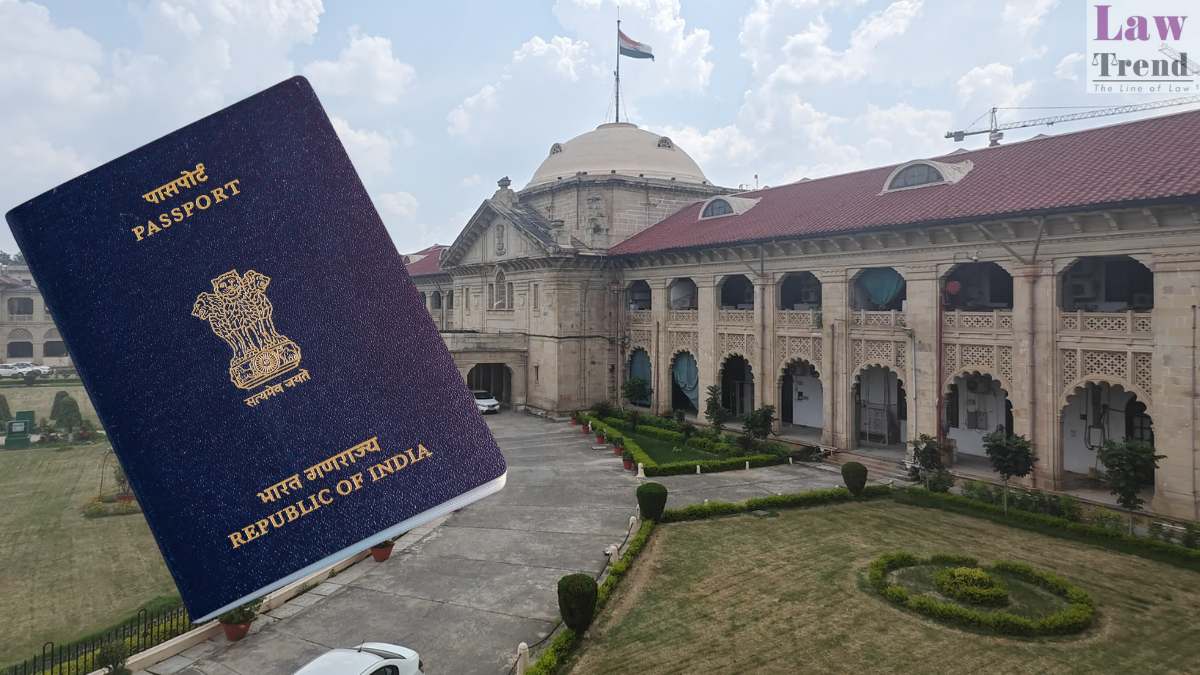
The Allahabad High Court has held that a minor child’s passport application cannot be kept pending merely on account of matrimonial or criminal disputes between her parents. The Court observed that the right to obtain a passport and travel abroad is a facet of the fundamental right to personal liberty under Article 21 of the Constitution of India and cannot be arbitrarily denied due to parental disagreements.

The Division Bench comprising Justice Ajit Kumar and Justice Swarupama Chaturvedi allowed a writ petition filed by a two-year-old minor girl, represented by her mother, seeking a direction to the Regional Passport Officer to issue a passport in her favour.

Background of the Case

The petitioner, Poem Jaiswar, a minor aged two years, applied for a passport through her mother on January 17, 2025. The application was registered on January 27, 2025. The petitioner approached the High Court alleging that despite the completion of all formalities under the Passports Act, 1967, no decision was taken on her application.

The Court was informed that matrimonial disputes had arisen between the petitioner’s parents. The mother had lodged an FIR against the father and his family members (Case Crime No. 0042 of 2024) under Sections 498-A, 323, 504, 506, 406 of the IPC and Sections 3/4 of the Dowry Prohibition Act at Mahila Thana, District Jaunpur.

The petitioner contended that solely due to the pendency of the criminal case and the matrimonial dispute, the passport authority had orally declined to proceed with the issuance of the passport.

READ ALSO  Court Lacks Expertise to Match Signatures, Must Seek Handwriting Expert's Opinion: Allahabad High Court

Submissions of the Parties

Arguments for the Petitioner: Counsel for the petitioner submitted that the father of the petitioner was not cooperating and was unwilling to grant consent for the issuance of the passport due to the ongoing matrimonial dispute. It was argued that such “non-cooperation on the part of the father cannot be acceptable reason to violate the rights of a minor child,” which are guaranteed under Article 21 of the Constitution.

The counsel further asserted that the right to obtain a passport is an integral part of personal liberty and cannot be curtailed for a minor due to disputes between parents.

Arguments for the Respondents: The counsel representing the Union of India and the passport authorities submitted written instructions stating that the application had not been refused outright. A letter was sent to the petitioner on April 22, 2025, requiring her to appear before the office with specified documents to comply with legal requirements. The respondents submitted that upon compliance, the application would be processed in accordance with the law.

Court’s Analysis and Observations

The principal issue before the Court was “whether the passport application of a minor child can be kept pending merely on account of matrimonial or criminal disputes between her parents.”

Right to Travel under Article 21 Referencing the Supreme Court judgment in Maneka Gandhi v. Union of India (1978), the Court reiterated that the right to travel is encompassed within the right to life and personal liberty. The Bench also cited the recent apex court decision in Mahesh Kumar Agarwal v. Union of India & Another (2025), observing that procedural safeguards cannot be converted into “rigid barriers.”

Statutory Provisions: Section 6 of the Passports Act The Court examined Section 6 of the Passports Act, 1967, which enumerates specific grounds for the refusal of a passport, such as threats to sovereignty, national security, or pending criminal proceedings against the applicant.

READ ALSO  Student Accuses Teacher of Attempting Conversion, Establishing Sexual Relation: Allahabad High Court Orders Probe

The Bench observed:

“The authorities do not have a general or discretionary power to deny a passport on other extraneous or administrative grounds. In the present case of a minor, no such conditions exist that would justify rejection of the application. Parental disputes or pending matrimonial and criminal matters between the natural guardians cannot constitute a valid statutory reason for refusal.”

Passport Rules and Annexure-C The Court highlighted that the Passport Rules, 1980 and the Passport Manual provide mechanisms for such situations. Specifically, Annexure-C allows a parent to submit a declaration when the other parent’s consent is not available.

The Court noted:

“There is no prohibition in the Passport Rules that without any consent of the father, passport cannot be issued to minor child. Even there is no provision that in the absence of any prohibitory order, the permission from the Court is required.”

The Bench further stated that the passport authority “cannot sit over an application indefinitely on the basis of unsubstantiated objections” when a declaration under Annexure-C is submitted and there is no court order restraining the issuance of the passport.

READ ALSO  [COVID] देवरिया में एक दिन में 70 लाशे जलाई जा रही है, गंगा में लाशें तैर रही है, ये क्या हो रहा है: इलाहाबाद हाई कोर्ट

Reliance on Precedents The Court relied on the Delhi High Court judgment in Smita Maan Vs Regional Passport Officer (2023), which held that the Passport Manual’s requirements must be construed flexibly. It also referred to the Bombay High Court’s decision in Yushika Vivek Gedam vs. Union of India (2025) and the Madhya Pradesh High Court’s ruling in Devyani Nitish Bharadwaj Vs Union of India (2025), which affirmed that a minor’s right to travel cannot be prejudiced by a father’s refusal to consent due to matrimonial discord.

Decision

The High Court allowed the writ petition and issued the following directions:

  1. The respondent authorities are directed to process and issue the passport of the petitioner forthwith, subject to the completion of routine verification formalities.
  2. The passport must be issued within four weeks from the date the petitioner complies with the procedural requirements (specifically regarding Annexure-C) through her mother.

The Court concluded that “where the minor’s application is otherwise in order and all formalities under the Rules are complied with, there exists no lawful reason to deny the passport.”

Case Details

Case Title: Poem Jaiswar vs. Union Of India And Another

Case No.: WRIT-C No.-9771 of 2025

Coram: Justice Ajit Kumar and Justice Swarupama Chaturvedi

Counsel for Petitioner: Chandra Mohan Singh, Rajesh Kumar, Gaurav Pandey

Counsel for Respondents: A.S.G.I., Sanjay Dwivedi

Law Trend
Law Trendhttps://lawtrend.in/
Legal News Website Providing Latest Judgments of Supreme Court and High Court

Related Articles

Latest Articles
