The Supreme Court has directed Coal India Limited (CIL) to appoint a candidate suffering from visual disability and partial hemiparesis to the post of Management Trainee, setting aside a Calcutta High Court Division Bench order that had denied relief due to the expiry of the recruitment panel. The Court invoked the principles of “reasonable accommodation” and the “intersectionality of disability with gender,” exercising its powers under Article 142 of the Constitution to do complete justice.
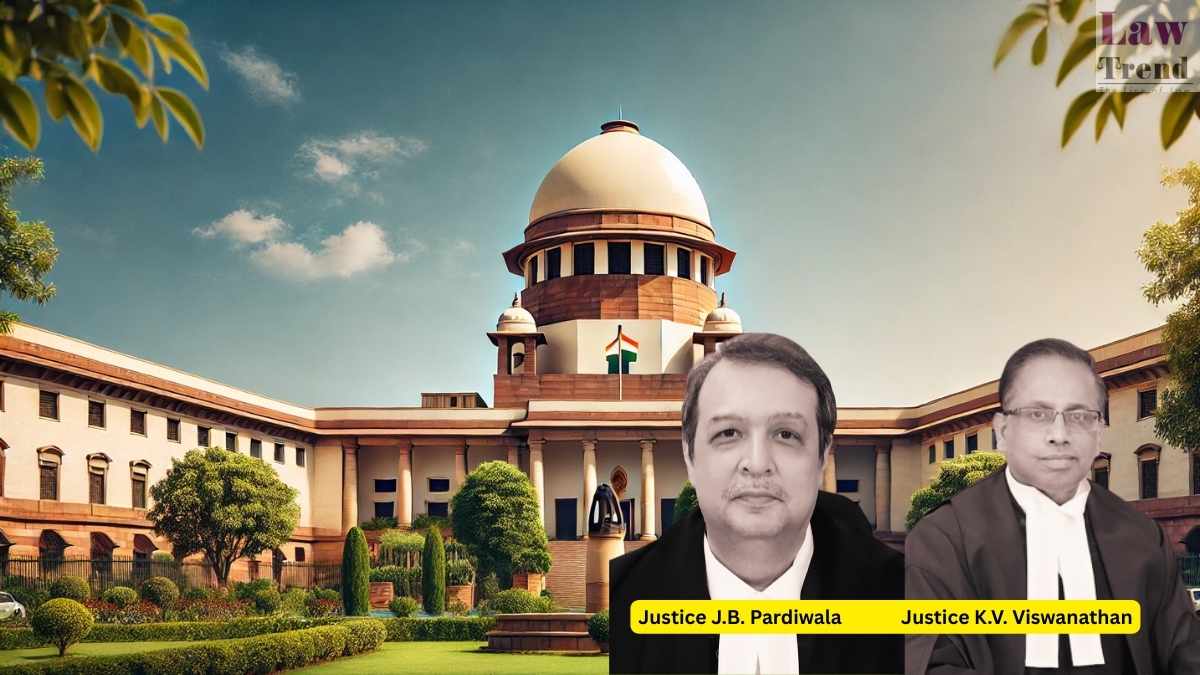
A Bench comprising Justice J.B. Pardiwala and Justice K.V. Viswanathan held that the expiry of a selection panel cannot be a ground to deny employment to a candidate who was wrongly rejected due to a rigid interpretation of disability categories. The Court observed, “Lack of physical sight does not equate to a lack of vision.”
Background of the Case
The case arose from a 2019 recruitment advertisement by Coal India Limited for Management Trainees. The appellant, Sujata Bora, applied under the Visually Handicapped (VH) category. She was selected for the interview and called for document verification and Initial Medical Examination (IME) in July 2021.
However, in September 2021, she was declared medically unfit. The authorities reasoned that she suffered not only from visual disability but also from “residuary partial hemiparesis,” categorizing her under “multiple disabilities,” which was arguably not covered in the specific notification parameters for the VH category.
Aggrieved, the appellant approached the Calcutta High Court. The Single Judge (Justice Lapita Banerjee) ruled in her favor on August 10, 2023, quashing the medical unfitness declaration. The Single Judge directed that she be allowed to participate in the ensuing 2023 recruitment process from the IME stage.
CIL challenged this before a Division Bench, which set aside the Single Judge’s order. The Division Bench reasoned that the writ petition was filed after the expiry of the panel, and even the interim order reserving a post was passed post-expiry. Consequently, it held that directing consideration for the past or next recruitment process was not tenable.
Proceedings Before the Supreme Court
The appellant challenged the Division Bench order before the Supreme Court. The Apex Court directed the All India Institute of Medical Sciences (AIIMS), New Delhi, to constitute a Board of Experts to assess the appellant’s functional disability. The Court specifically directed the co-option of Dr. Satendra Singh, a known disability rights advocate, into the Board.
An initial report dated December 16, 2025, was inconclusive, prompting the Court to order an immediate re-examination. A final report dated January 1, 2026, confirmed that the appellant suffers from 57% disability, which is above the benchmark disability of 40%.
Court’s Observations and Analysis
The Supreme Court criticized the Division Bench’s reliance on technicalities. The Bench observed: “The Division Bench on facts was not justified in setting aside the judgment of the Single Judge merely because the panel had expired. The appellant at the first instance was wrongly denied her employment pursuant to the 2019 notification.”
The judgment extensively discussed three key legal concepts:
1. Reasonable Accommodation Citing precedents like Omkar Ramchandra Gond v. Union of India (2024 INSC 775) and Om Rathod v. Director General of Health Services (2024 SCC OnLine SC 3130), the Court reiterated that reasonable accommodation is a fundamental right.
Quoting Om Rathod, the Court stated:
“Reasonable accommodation is a fundamental right. It is a gateway right for persons with disabilities to enjoy all the other rights enshrined in the Constitution and the law. Without the gateway right of reasonable accommodation, a person with disability is forced to navigate in a world which excludes them by design.”
2. Intersectionality of Disability with Gender The Court highlighted the unique challenges faced by women with disabilities, referring to the “intersectionality of disability with gender justice.”
The Bench remarked:
“Here is a case where a single woman is before us who has the urge to succeed notwithstanding the disability she encounters. Can technicalities like expiry of panel for the year or the factum of interim order reserving a vacancy having come to be passed after the expiry of panel cannot come in the way of our doing complete justice? We certainly do not think so…”
The Court cited Jane Kaushik v. Union of India (2025 SCC OnLine SC 2257), noting that “factors or markers of discrimination do not operate in isolation” and that distinct identities intersect to create qualitatively different experiences of discrimination.
3. Corporate Social Responsibility (CSR) The Court linked disability rights to CSR, stating that private and public enterprises have an obligation to respect human rights.
“True equality at the workplace can be achieved only with the right impetus given to disability rights as a facet of Corporate Social Responsibility… Disability inclusion is a vital component of the ‘Social’ dimension in the Environmental, Social and Governance (ESG) framework.”
The Decision
The Supreme Court allowed the appeal and set aside the Division Bench’s order. It issued the following directions:
- Creation of Post: A supernumerary post be created for the appellant.
- Appointment: The Court declared the appellant eligible for the post of Management Trainee.
- Posting and Facilities: The Chairman of Coal India Limited was requested to post the appellant at North Eastern Coalfields, Margherita, Tinsukia, Assam.
- Workplace Accessibility: The appellant must be provided a “suitable desk job with a separate computer and keyboard, as per universal design as defined under section 2(ze) of the Rights of Persons with Disabilities Act, 2016.”
The Court concluded by expressing gratitude to the counsel for CIL, Mr. Vivek Narayan Sharma, for his cooperation, and to the AIIMS doctors.
Case Details
Case Title: Sujata Bora v. Coal India Limited & Ors.
Case No.: Civil Appeal No. 120 of 2026 (Arising out of SLP (C) No. … of 2025)
Bench: Justice J.B. Pardiwala and Justice K.V. Viswanathan