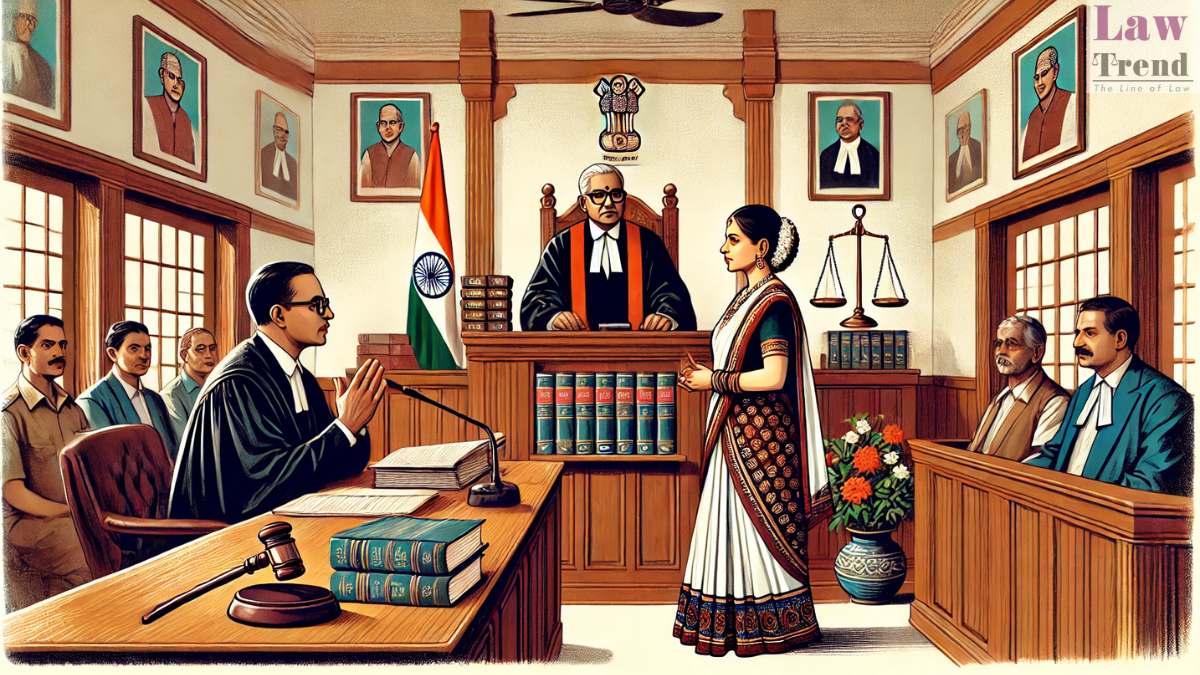
The Supreme Court of India has ruled that a daughter-in-law who becomes a widow after the death of her father-in-law qualifies as a “dependant” under the Hindu Adoptions and Maintenance Act, 1956, and is entitled to claim maintenance from his estate.
The Division Bench comprising Justice Pankaj Mithal and Justice S.V.N. Bhatti dismissed the appeals challenging the High Court’s order, which had held that the maintenance petition filed by such a daughter-in-law was maintainable. The Court held that the definition of “dependant” under Section 21(vii) of the Act includes “any widow of his son” irrespective of whether the son died before or after the father-in-law.
Background of the Case
The controversy emerged regarding the estate of late Dr. Mahendra Prasad, who passed away on December 27, 2021. Dr. Prasad had three sons:
- Ranjit Sharma, who died on March 2, 2023 (after his father’s death).
- Devinder Rai, who pre-deceased his father (his wife, Kanchana Rai, is the appellant).
- Rajeev Sharma.
The appellant, Kanchana Rai, claimed that Dr. Mahendra Prasad had executed a registered Will on July 18, 2011, appointing her as the executor and bequeathing properties to her sons.
Geeta Sharma (Respondent No. 1), the wife of Ranjit Sharma, applied for maintenance from the estate of her late father-in-law before the Family Court. However, the Family Court dismissed her petition as not maintainable, reasoning that she was not a widow on the date of Dr. Mahendra Prasad’s death, as her husband was alive at that time.
Aggrieved by this, Geeta Sharma approached the High Court. The High Court set aside the Family Court’s order on August 20, 2025, holding that she was the widow of a son and thus a dependant. Kanchana Rai and Uma Devi (alleged partner of the deceased) filed appeals before the Supreme Court challenging this decision.
The Legal Issue
The precise legal question before the Supreme Court was:
“Whether a daughter-in-law, who becomes a widow after the death of her father-in-law, is a dependant upon the estate of the father-in-law, and entitled to claim maintenance from his estate.”
Arguments
The appellants contended that the respondent had no legal right to seek maintenance as she was not a widow at the time of the father-in-law’s demise. The arguments centered on the interpretation of Section 21 of the Act, with the appellants suggesting a restrictive reading that would only include the widow of a “predeceased” son.
Court’s Analysis and Observations
The Supreme Court decided the issue based on the strict interpretation of the statutory provisions, independent of the Hindu Succession Act.
1. Interpretation of “Dependant”
The Court examined Section 21(vii) of the Hindu Adoptions and Maintenance Act, 1956, which defines dependants to include “any widow of his son or of a son of his predeceased son, so long as she does not remarry.”
Rejecting the appellants’ restrictive interpretation, Justice Pankaj Mithal observed:
“The aforesaid definition nowhere uses the word ‘widow of a predeceased son’. It simply uses the words ‘any widow of a son’. The legislature in its wisdom has deliberately avoided to use the word ‘predeceased’ before the ‘son’ so as to include any widow of the son. The time of her becoming a widow or the death of the son is immaterial.”
2. The Literal Rule of Interpretation
Citing precedents such as Crawford v. Spooner, B. Premanand v. Mohan Koikal, and Vinod Kumar v. DM, Mau, the Court reiterated that when statutory language is clear, courts cannot add or subtract words. The Court stated:
“The courts cannot add or subtract any word from the text of the statute. The provisions of the statute cannot be re-written by the courts by assuming or inferring something which is not implicit from the plain language of the statute.”
3. Constitutional Validity (Article 14 & 21)
The Bench held that distinguishing between widowed daughters-in-law based on the timing of their husband’s death would be arbitrary and violative of Article 14 of the Constitution.
“The classification sought to be made between widowed daughters-in-law based solely on the timing of the husband’s death… is manifestly unreasonable and arbitrary. Such a classification bears no rational nexus with the object and purpose of the Act.”
Further, the Court noted that such a denial would infringe upon Article 21 (Right to Life and Dignity):
“Denying maintenance to a widowed daughter-in-law from the estate of her deceased father-in-law on a narrow or technical construction of the statute would expose her to destitution and social marginalization, thereby offending her fundamental right to live with dignity.”
4. Reference to Ancient Hindu Law
The Court referred to Manu Smriti (Chapter 8, verse 389) to highlight the pious obligation to maintain female family members:
“No mother, no father, no wife, and no son deserves to be forsaken… This verse emphasizes duty of the family head to support female family members.”
5. Distinction Between Section 19 and Section 22
The Court clarified the scope of Section 19 versus Section 22 of the Act:
- Section 19: Casts an obligation on the father-in-law to maintain the daughter-in-law during his lifetime.
- Section 22: Contemplates maintenance of dependants from the estate of the deceased.
“Section 22 contemplates ‘maintenance of dependants’ including ‘widowed daughter-in-law’ from the estate of her father-in-law meaning thereby that a claim under Section 22 can be raised only after the death of the father-in-law.”
Decision
The Supreme Court concluded that Respondent No. 1, being a “widow of the son” of the deceased, falls within the definition of a dependant under Section 21(vii) and is entitled to claim maintenance under Section 22.
The Court held:
“We are clearly of the opinion that ‘any widow of the son’ of a deceased Hindu is a dependant within the meaning of Section 21 (vii) of the Act and is entitled to claim maintenance under Section 22 of the Act.”
Consequently, the appeals filed by Kanchana Rai and Uma Devi were dismissed, and the High Court’s direction to the Family Court to decide the maintenance claim on merits was upheld.
Case Details
Case Title: Kanchana Rai vs. Geeta Sharma & Ors. (Connected with Uma Devi vs. Geeta Sharma & Ors.)
Case No.: Civil Appeal arising out of SLP(C) Nos. 1544-1545 of 2026
Coram: Justice Pankaj Mithal and Justice S.V.N. Bhatti