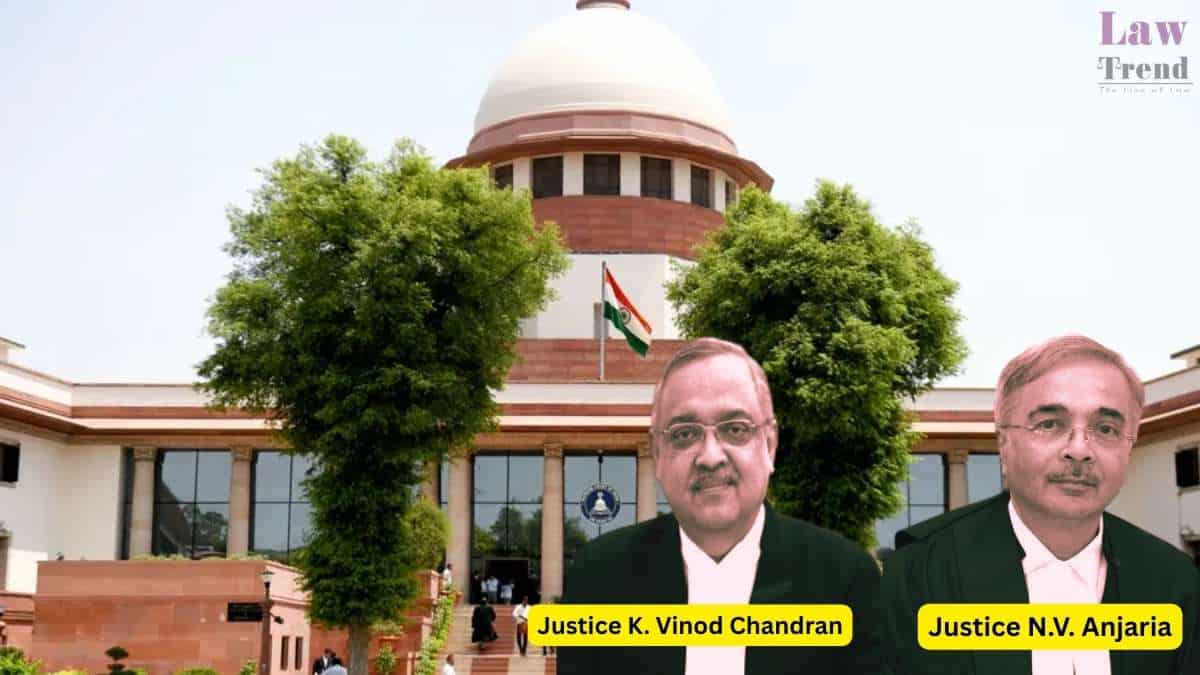
The Supreme Court of India has upheld the conviction of an octogenarian appellant under Section 304 Part II of the Indian Penal Code (IPC) for a 1992 homicide but reduced his sentence to the period of imprisonment already undergone. Observing that the appellant is in the “December of his life,” the Court remarked that it would be “harsh and inadvisable” to send him back to prison.
The Division Bench comprising Justice K. Vinod Chandran and Justice N.V. Anjaria delivered the judgment in the case of Shrikrishna v. The State of Madhya Pradesh.
Background of the Case
The case dates back to December 10, 1992, at Village Dudankhedi. According to the prosecution, a quarrel occurred between the son of the appellant, Shrikrishna, and the son of the deceased, Ram Singh. When Ram Singh went to the appellant’s house to complain about the beating of his son, a group of accused persons allegedly assembled with weapons.
The prosecution alleged that while co-accused persons held axes (Farsa), others, including the appellant, were armed with lathis. They assaulted Ram Singh, who succumbed to his injuries on December 11, 1992, leading to the registration of a case under Section 302 IPC. A cross-FIR was also lodged by the appellant against the complainant party, alleging that he was attacked with a Farsa and a lathi, raising a plea of private defence.
The Additional Sessions Judge, Basoda, convicted Shrikrishna and others on December 9, 1997, under Section 302 read with Section 149 IPC, sentencing them to life imprisonment.
Upon appeal, the High Court of Madhya Pradesh altered the conviction from Section 302 (murder) to Section 304 Part II (culpable homicide not amounting to murder) and sentenced the appellant to seven years of rigorous imprisonment with a fine of Rs. 5,000. Aggrieved by this, Shrikrishna approached the Supreme Court.
Court’s Analysis: Culpable Homicide Not Amounting to Murder
The Supreme Court examined whether the offence fell under Section 302 (murder) or Section 304 (culpable homicide). Justice N.V. Anjaria, authoring the judgment, analyzed the medical evidence provided by Dr. Anand Uniya (PW-2) and Dr. Ashok Kumar (PW-12). The medical reports indicated that Ram Singh suffered a lacerated wound and a fracture of the parietal bone caused by a hard and blunt object.
The Court observed that the incident was a result of a “free fight” and a “sudden quarrel” where both sides suffered injuries. The Bench noted:
“The High Court was justified in its reasoning that in such circumstances, it is not possible to reason and to conclude that there was a formation of unlawful assembly with common object of causing death.”
Referring to the precedent in Kesar Singh and Another vs. State of Haryana (2008), the Court reiterated the distinction between intention and knowledge in culpable homicide. The Court held that while the appellant hit the deceased on the head with a lathi, the act was committed “in the midst of commotion and group clash” without premeditation.
The judgment stated:
“Having regard to the evidence on record regarding the role played by the appellant and the injuries caused by him on the head of the deceased by using lathi, he could be presumed to have acted with an intention to cause death or such bodily injury which he knew that it would be of such kind and nature that would cause, in ordinary course, the death… However, the degree of the offence… could not be said to be partaking the offence of murder under Section 302.”
Consequently, the Supreme Court held that the High Court was correct in convicting the appellant under Section 304 Part II, IPC.
Sentencing and “December of Life”
While upholding the conviction, the Supreme Court turned its attention to the quantum of the sentence. The Court noted that the appellant had already undergone incarceration for a total period of six years and three months.
Taking a humanitarian view of the appellant’s advanced age, the Bench observed:
“The appellant is more than 80 years of age at present. Since the appellant is an old and aged person, and in the December of his life, it would be harsh and inadvisable to send him behind the bars again at this stage. The courts are not supposed to be insensitive.”
Decision
The Supreme Court dismissed the appeal regarding the conviction but modified the sentence. The Court directed that the sentence be reduced to the period already undergone by the appellant.
The judgment concluded:
“Therefore, in view of the advanced age of the appellant and considering the totality of the facts and circumstances, while upholding the conviction of the appellant under Section 304, Part II, IPC, the sentence of the appellant is reduced to what is already undergone, to be substituted accordingly.”
All pending interlocutory applications were disposed of in view of the main judgment.
Case Details:
- Case Title: Shrikrishna v. The State of Madhya Pradesh
- Case Number: Criminal Appeal No. 1533 of 2011
- Coram: Justice K. Vinod Chandran and Justice N.V. Anjaria