

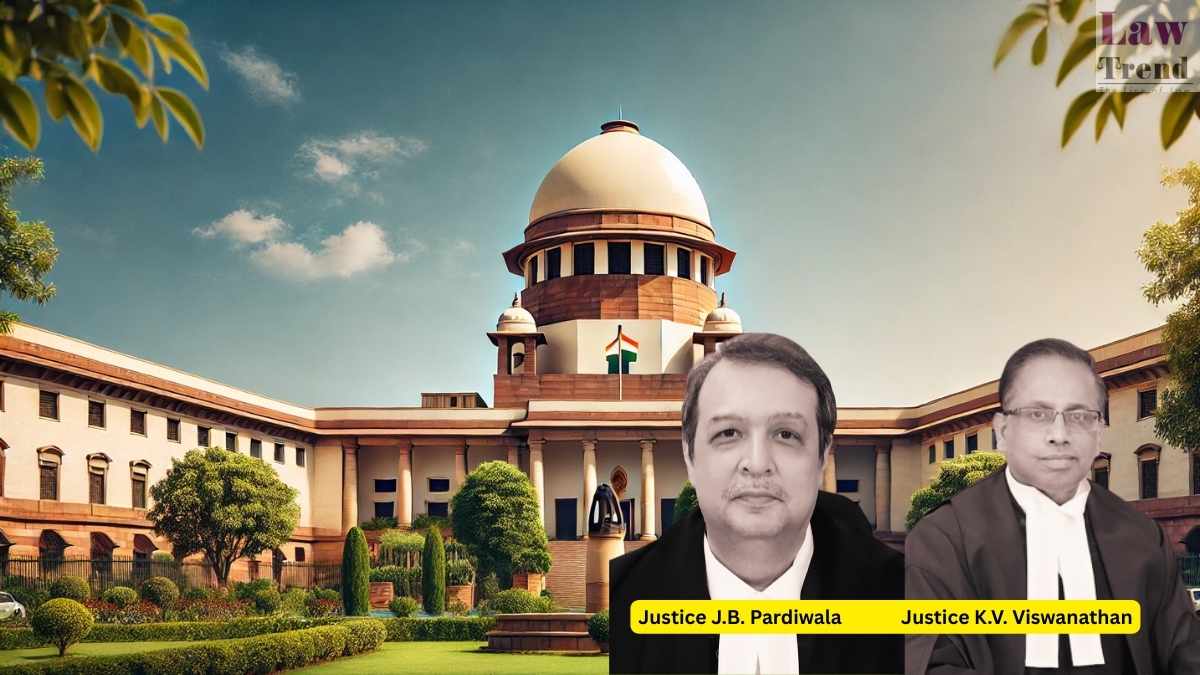
The Supreme Court on Monday observed that the rising trend of frivolous allegations against judicial officers has created an atmosphere of fear, making trial court judges reluctant to grant bail and consequently burdening the Higher Courts with bail petitions.
The observation came as a bench of Justices JB Pardiwala and KV Viswanathan set aside the termination of a Madhya Pradesh judicial officer, Nirbhay Singh Suliya, who was removed from service in 2015 after 27 years of service.
The “Fear Factor” in Lower Judiciary
The apex court addressed a critical systemic issue plaguing the Indian justice system: the hesitation of subordinate courts to grant bail. The bench noted that honest officers often face the brunt of disgruntled litigants who level baseless allegations when orders do not go in their favor.
“It is the reason that officers of lower judiciary are reluctant to grant bail and the high courts and Supreme Court are burdened with bail petitions,” the bench observed.
While acknowledging the need to “weed out black sheep” and taking strict criminal action against those actually indulging in corruption, the Court emphasized that High Courts must exercise extreme caution before initiating disciplinary proceedings based on mere errors of judgment.
27 Years of “Unblemished” Service
The case involved Nirbhay Singh Suliya, who faced termination based on accusations of adopting different yardsticks in granting bail under the Excise Act and indulging in corrupt practices.
However, the Supreme Court found that the officer was terminated without due process. The bench highlighted that Suliya had served the judiciary for 27 years with an “unblemished” career record before these allegations surfaced.
Justice KV Viswanathan, writing the verdict for the bench, stressed that an error in judgment or a wrong order should not automatically subject a judicial officer to the ordeal of disciplinary proceedings.
“It should be ensured that only because an order is wrong or there is an error of judgement without anything more, judicial officers are not put through the ordeal of such proceedings,” Justice Viswanathan stated.
A “Bold Judgement” for Honest Officers
Justice JB Pardiwala, concurring with the decision, termed the verdict penned by Justice Viswanathan as a “very bold judgement.” He remarked that the ruling would go a long way in ensuring the protection of honest judicial officers who are increasingly becoming targets of malicious complaints.
The Court also took serious note of members of the Bar levelling frivolous allegations against the judiciary, warning that such actions could invite contempt proceedings.
The Verdict
Granting relief to the petitioner, the Supreme Court:
- Set aside the termination order dated September 2015.
- Set aside the High Court order that had upheld the termination.
- Directed the payment of full monetary benefits to Nirbhay Singh Suliya up to the date of his superannuation.




