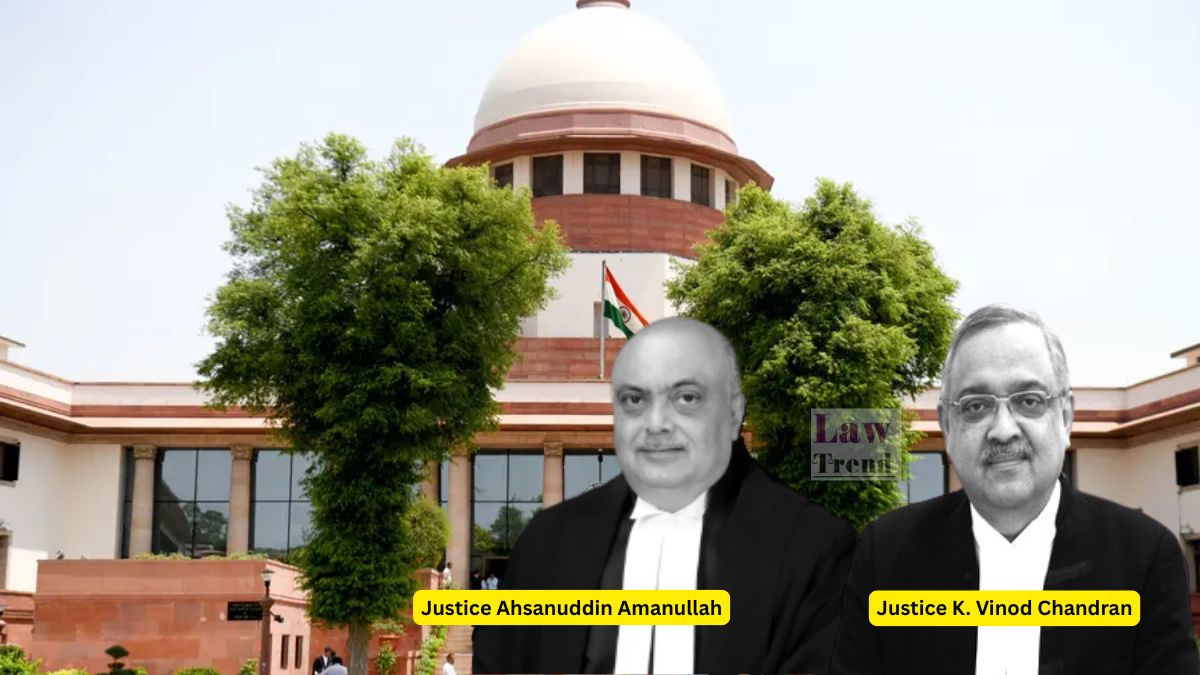
The Supreme Court of India has set aside the orders of the High Court and Labour Court granting reinstatement and back wages to a workman, citing a “gross delay” of approximately 16 years in raising the industrial dispute. The Bench comprising Justice Ahsanuddin Amanullah and Justice K. Vinod Chandran modified the relief to a lump sum compensation of Rs. 2,50,000, observing that delay in raising a dispute is a crucial circumstance to be reckoned with while moulding relief.
Background of the Case
The appeal was filed by the State of Uttar Pradesh against a judgment of the High Court, which had upheld the order of the Labour Court. The Labour Court had found the termination of the respondent-workman, Krishna Murari Sharma, to be illegal. Consequently, the Labour Court directed the employer to pay back wages for the period from May 31, 2006, to April 1, 2015. The commencement date for back wages was fixed as the date of reference, noting that a delay of 15 years had occurred.
The State challenged the award primarily on the ground that the “gross delay” occasioned in raising the dispute disentitled the workman from challenging the order of termination and claiming back wages.
Arguments of the Parties
Mr. Rana Mukherjee, learned Senior Counsel appearing for the State, submitted that the gross delay disentitles the order of back wages. However, he stated that the State was “not averse to a compensation, as declared by this Court in a series of decisions.” The State expressed willingness to concede to a payment of Rs. 99,000.
On the other hand, Mr. Sukumar Patjoshi, learned Senior Counsel appearing for the respondent-workman, vehemently opposed the State’s submission. He argued that the back wages would amount to at least Rs. 15,00,000 and asserted that there could be “no interference caused to the award on the ground of delay.” Reliance was placed on the decisions in Shahaji v. Executive Engineer, PWD (2005) and U.P. State Electricity Board v. Rajesh Kumar (2003). The respondent contended that since the reference itself was not questioned, the contention on delay could not be taken at this stage.
Court’s Observations and Analysis
The Supreme Court first addressed the respondent’s plea that the delay was not raised earlier. The Bench noted that “though the reference as such was not challenged, the State had raised a contention of delay in its written submissions filed at the first instance before the Labour Court.” The State had specifically contended that the workman was engaged only till October 1990 and had not submitted any application seeking reinstatement for more than 15 years.
The Court distinguished between two legal aspects regarding delay:
- Challenge against a reference order: The validity of a stale reference can be examined by the High Court under Article 226 of the Constitution (National Engineering Industry v. State of Rajasthan and Nedungadi Bank Ltd. v. K.P. Madhavankutty and Ors.).
- Consequences of delay in adjudication: The Labour Court has the discretion to mould relief based on delay.
The Bench observed:
“We cannot but observe that the mere failure, or a conscious decision not to challenge, the reference under Article 226 of the Constitution of India before the High Court, on the ground of delay, can neither result in the contention being frustrated in every manner nor can there be a ground of acquiescence taken against such plea.”
The Court relied on the judgment in Ajaib Singh v. Sirhind Coop. Marketing-cum-Processing Service Society Ltd., where it was held that even in cases of proved delay, relief can be moulded by declining whole or part of back wages. Further reference was made to Assistant Engineer Rajasthan State Agricultural Marketing Board v. Mohan Lal, which established that “delay in raising an industrial dispute is definitely a circumstance to be reckoned by the Labour Court.”
Regarding the precedents cited by the respondent, the Court noted that even Shahaji accepted the principle that the Labour Court “could suitably mould the relief to be granted to the workman in view of the delay.”
The Decision
The Supreme Court allowed the appeal and modified the relief granted by the lower courts. The Bench held:
“Taking the entire circumstances into account, especially the fact that there was a 16 year delay in seeking a reference, we are of the opinion that a lumpsum compensation of Rs.2,50,000/- (Rupees Two Lakhs and fifty thousand) would suffice.”
The Court set aside the order of the Labour Court and the High Court “to the extent of reinstatement and award of back wages.” While upholding the finding on the illegality of the termination, the Court directed the State to pay the lump sum compensation of Rs. 2,50,000 to the respondent-workman within two months.
If the payment is not made within the stipulated period, the State shall be liable to pay interest at the rate of 7% per annum.
Case Details:
- Case Title: State of Uttar Pradesh vs Krishna Murari Sharma
- Case Number: Civil Appeal No. of 2025 (@ SLP (C) No.444 of 2024)
- Citation: 2025 INSC 1500
- Coram: Justice Ahsanuddin Amanullah and Justice K. Vinod Chandran