

Allahabad HC Acquits Two in 1984 Train Robbery Case; Cites Improbable Police Version and Lack of Medical Evidence
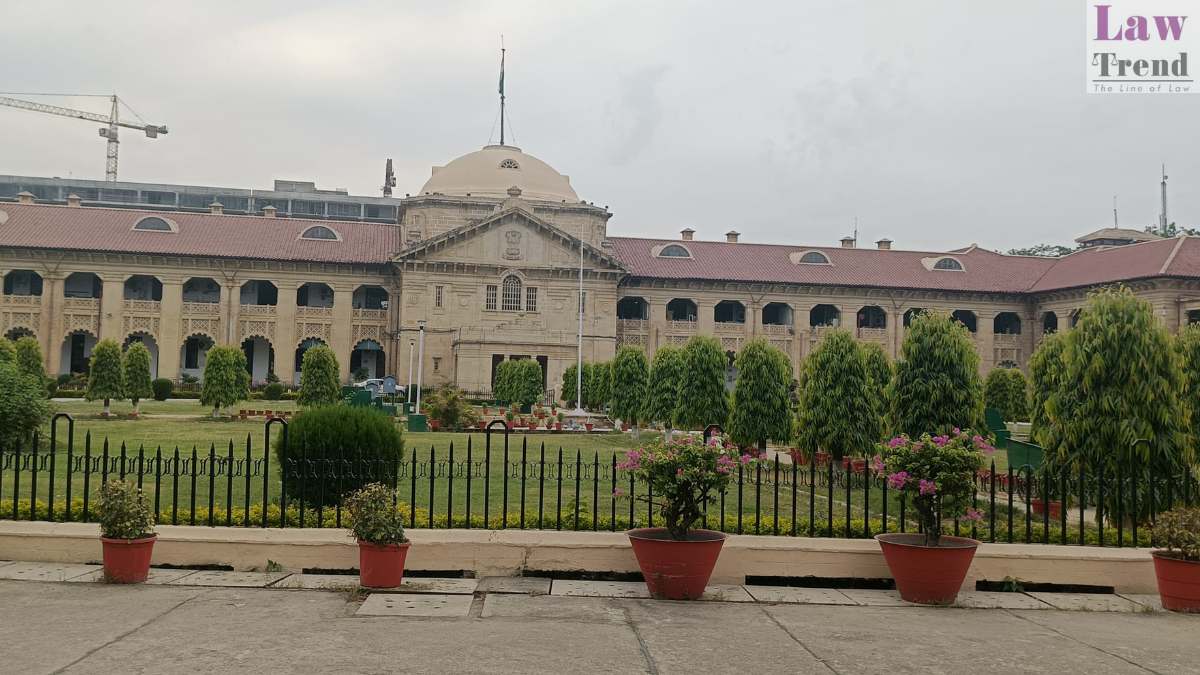

The Allahabad High Court has set aside the conviction of two men accused in a 1984 train robbery case, citing serious doubts regarding the manner of their arrest and the prosecution’s failure to recover the looted articles.

Justice Madan Pal Singh allowed the criminal appeal filed by Lakhan Singh and Ramesh, overturning the 1987 judgment of the Special Judge (D.A.A.), Agra, which had sentenced them to three years of rigorous imprisonment under Section 392 of the Indian Penal Code (IPC).

Background of the Case

The prosecution’s case dates back to February 12, 1984. The complainant, Jitendra Kumar, boarded a train from Agra Cantt. to Tundla at around 8:15 A.M. He alleged that while the train was moving between Agra Cantt. and Raja Ki Mandi Railway Station, the two accused looted his H.M.T. watch and Rs. 125 in cash at knifepoint.

The complainant further alleged that one of the accused struck him on the nose, causing bleeding, after which both accused jumped from the running train. Upon reaching Raja Ki Mandi Railway Station, the complainant reported the matter to the guard and G.R.P. constables.

The prosecution claimed that the constables, accompanied by the complainant, went to the spot where the accused had allegedly jumped. The complainant identified the accused near a “Sweeper Colony,” and they were apprehended at 9:00 A.M. While the police recovered a knife from each accused, the looted watch and cash were not found.

READ ALSO  Allahabad HC grants bail to a person who threatened to kill the PM Modi and UP CM

Arguments

The counsel for the appellants, Sri Alok Kumar Singh, challenged the prosecution’s narrative on several grounds:

  • Improbable Timeline: It was argued that the incident occurred at 8:00 A.M., and the arrest was shown at 9:00 A.M. The distance between the train station and the place of arrest was over 3 kilometers. The counsel submitted, “It is highly improbable and practically impossible for the police to have arrested the accused within such a short period of one hour,” especially since they traveled on foot.
  • Selective Recovery: The defense highlighted that while knives were allegedly recovered, the stolen cash and watch were missing. They argued that if the accused had time to dispose of the loot, they would have disposed of the knives as well.
  • Lack of Medical Evidence: Despite the allegation of a nose injury causing bleeding, no medical examination of the complainant was conducted.

The learned A.G.A. for the State opposed the appeal, arguing that the identification by the complainant was reliable and the non-recovery of looted articles was due to the accused disposing of them after jumping from the train.

READ ALSO  इलाहाबाद हाई कोर्ट का निचली अदालतों को निर्देश- एक ही दिन में गवाहों की चीफ़ और क्रॉस पूरा करने का करे प्रयास

Court’s Analysis and Observations

The High Court meticulously examined the evidence and found significant gaps in the prosecution’s version.

1. Doubtful Manner of Arrest The Court observed that the distance between Raja Ki Mandi station and the arrest spot was approximately 4-5 kilometers. Noting that the police and complainant traveled on foot, the Court stated:

“It is highly improbable that the police could have arrested the accused-appellants within 45 minutes of the incident.”

The Court also found the location of the arrest contradictory to the site plan, which showed the accused in an open place near the railway line rather than the colony they supposedly ran towards.

2. Non-Recovery of Looted Articles The Court rejected the trial court’s finding that the accused had disposed of the loot but kept the weapons. Justice Singh observed:

“If the accused-appellants had ample opportunity to dispose of the looted articles, they would also have had the same opportunity to dispose of the knives allegedly recovered from their possession. Therefore, the recovery of the knives only, without the recovery of the looted articles, raises a serious doubt in the mind of the Court.”

3. Lack of Medical Corroboration Addressing the alleged assault, the Court noted the absence of any medical report:

“However, no medical examination of the complainant was conducted, and no medical report is available on record.”

The Court further remarked on the possibility of police influence on the complainant’s identification of the accused, stating, “The possibility that such identification was influenced or induced by the police cannot be ruled out.”

Decision

The High Court concluded that the prosecution failed to prove its case beyond a reasonable doubt. The Court held:

READ ALSO  Delhi High Court Orders Framing of Rape Charges Against a Man Who Broke a Promise to a Woman, Her Ex-husband That He Would Marry Her

“Mere proof of robbery is not sufficient to hold that the accused persons who were put to trial were the ones who committed the offence.”

Consequently, the Court set aside the judgment and order dated February 21, 1987. The appellants, Lakhan Singh and Ramesh, were acquitted of the charges under Section 392 IPC. Their bail bonds were cancelled and sureties discharged.

Case Details:

  • Case Title: Lakhan Singh and another v. State
  • Case No.: Criminal Appeal No. 652 of 1987
  • Coram: Justice Madan Pal Singh
  • Counsel for Appellants: Brij Gopal, Devashish Tripathi, K.S. Chahar, V.S. Choudhary, Alok Kumar Singh
  • Counsel for Respondent: A.G.A.
  • Citation: 2025:AHC:226716

Law Trend
Law Trendhttps://lawtrend.in/
Legal News Website Providing Latest Judgments of Supreme Court and High Court

Related Articles

Latest Articles

