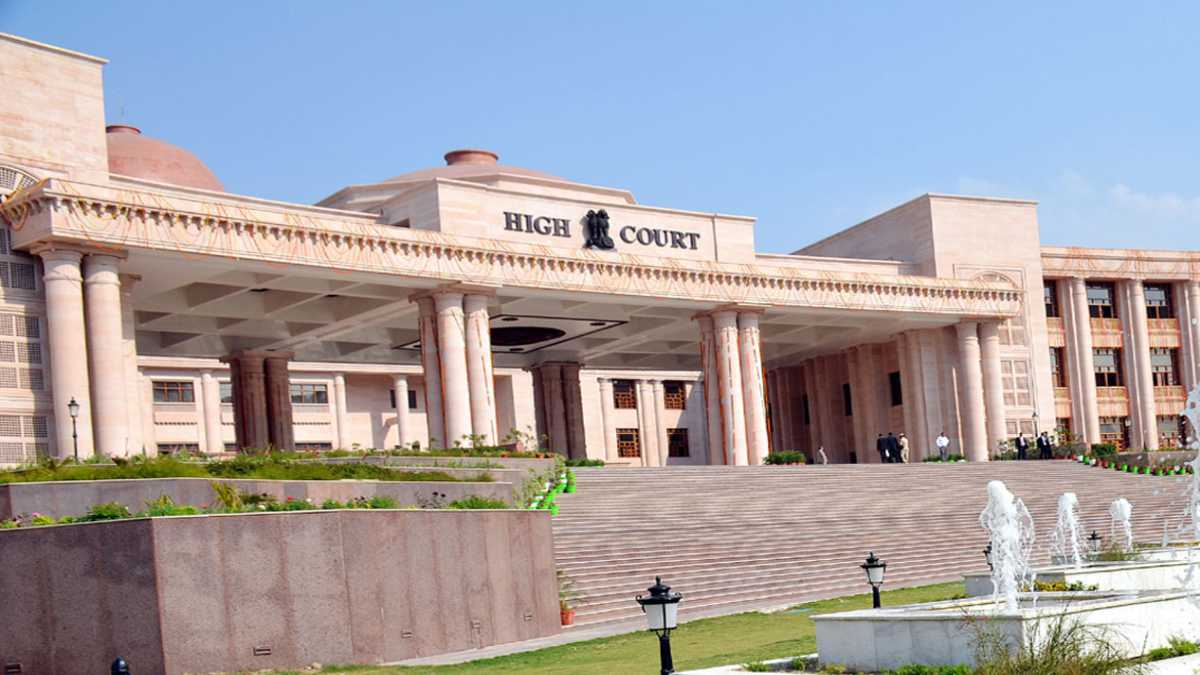
The Allahabad High Court (Lucknow Bench) has disposed of two criminal writ petitions seeking the transfer of investigation to the Central Bureau of Investigation (CBI) in a high-profile murder case. The Division Bench, comprising Justice Rajesh Singh Chauhan and Justice Abdhesh Kumar Chaudhary, ruled that the petitioner, who is the uncle of the deceased, lacks the locus standi to seek such relief when the victim’s wife—the closest legal heir—has already withdrawn similar petitions.
In a significant legal observation, the Court devised a “Closest Legal Heir Test” to interpret the definition of a “victim” under Section 2(wa) of the Code of Criminal Procedure (Cr.P.C.), holding that a distant relative cannot supersede the rights of a proximate legal heir.
Background of the Case
The matter pertains to a murder on January 6, 2021, in Lucknow. An FIR (Case Crime No. 0015 of 2021) was registered under Sections 120-B, 302, 307, and 34 of the Indian Penal Code (IPC) at Police Station Vibhuti Khand. A second FIR (Case Crime No. 445 of 2020) was registered under the Official Secrets Act regarding the alleged possession of confidential documents by the accused.
The investigation was conducted by the Special Task Force (STF), which filed charge sheets against 13 accused persons, including a former Member of Parliament. The former MP was charge-sheeted under Sections 212 (harbouring offender) and 176 (omission to give notice) of the IPC.
Previously, the deceased’s wife had filed multiple writ petitions seeking a transfer of the investigation to the CBI, alleging that the STF was shielding the main accused. However, on April 23, 2025, she withdrew all her petitions. Subsequently, the uncle of the deceased filed the present petitions (Criminal Misc. Writ Petition No. 4791 of 2025 and No. 6047 of 2025) praying for a CBI probe, claiming the STF investigation was compromised.
Arguments of the Parties
Sri Kapil Misra, learned counsel for the petitioner, argued that the main accused holds significant influence and had obtained secret documents from the STF to manipulate the probe. He contended that the STF deliberately filed charge sheets against the main accused under minor, bailable sections, whereas he was the alleged mastermind behind the conspiracy. The counsel submitted that a fair investigation was only possible through an independent agency like the CBI.
Sri V.K. Singh, learned Government Advocate for the State, raised a preliminary objection regarding the maintainability of the petition. He argued that the petitioner, being the uncle of the deceased, does not fall within the definition of “victim” under Section 2(wa) of the Cr.P.C. He further submitted that the investigation had concluded, charge sheets were filed in 2021 and 2022, and the trial was already underway with witnesses being examined. He asserted that the petition was misconceived and “stale.”
Court’s Analysis and The ‘Closest Legal Heir Test’
The primary legal issue before the Court was whether the petitioner (uncle) had the locus standi to file the writ petitions.
On Definition of Victim and Legal Heir: The Court examined Section 2(wa) of the Cr.P.C., which defines a victim as someone who has suffered loss or injury and includes their “guardian or legal heir.” The Bench noted that while “legal heir” is not defined in the Cr.P.C., it must be interpreted to ensure the spirit of justice prevails.
To resolve the ambiguity, the Court introduced the “Closest Legal Heir Test.” The Bench observed:
“According to the ‘closest legal heir test’, the closest or the proximate legal heir of the victim must outshine the next closer legal heir because the administration of justice does not warrant any dispute even on determining as to who would be the ‘legal heir’ to pursue the grievance of a victim…”
Applying this test, the Court held:
“The right of a wife to be a legal heir of the victim is at a higher pedestal than an uncle. The wife has admittedly withdrawn her all writ petitions seeking CBI investigation, therefore, the same relief now being sought by a far away legal heir i.e. uncle has to be seen with some circumspection…”
On Third-Party Intervention: The Court relied on the Supreme Court’s judgment in Sanjai Tiwari Vs. State of U.P. (2020) and the Madras High Court’s ruling in All India Democratic Women’s Association Vs. State (1998), reiterating that strangers to criminal proceedings have no locus standi to interfere.
The Court stated:
“The petitioner is not even a private party. The main victim of the case has withdrawn herself from the proceedings and a new face in the name of the petitioner has come up for the first time to thwart the criminal proceedings/trial, which is in advance stage.”
Decision
The High Court declined to issue a writ of mandamus for transferring the investigation to the CBI. The Bench noted that the relief sought was “stale and technically infructuous” as the investigation had already culminated in the filing of charge sheets and the trial had commenced.
However, the Court clarified that the dismissal does not leave the parties without remedy. The Bench granted liberty to the parties to approach the Trial Court under the relevant provisions of the Code of Criminal Procedure (now BNSS) if there is any “evidence of sterling nature” that warrants an alteration or addition of charges.
The Court disposed of both writ petitions with the observation:
“It is needless to say that if any appropriate application is filed before the learned Trial Court… learned Trial Court shall consider and dispose of those applications without being influenced from any observation made by this Court in the present order.”
Case Details:
Case Title: Rajesh Singh Versus State of U.P. Thru. Addl. Chief Secy. Home Lko. and others
Case No.: Criminal Misc. Writ Petition No. 4791 of 2025 (Connected with No. 6047 of 2025)
Bench: Justice Rajesh Singh Chauhan and Justice Abdhesh Kumar Chaudhary
Counsel for Petitioner: Sri Kapil Misra, Sri Ashish Kumar Singh
Counsel for Respondents: Sri V.K. Singh (G.A.), Sri Anurag Kumar Singh, Sri Naved Ali, Sri Rao Narendra Singh