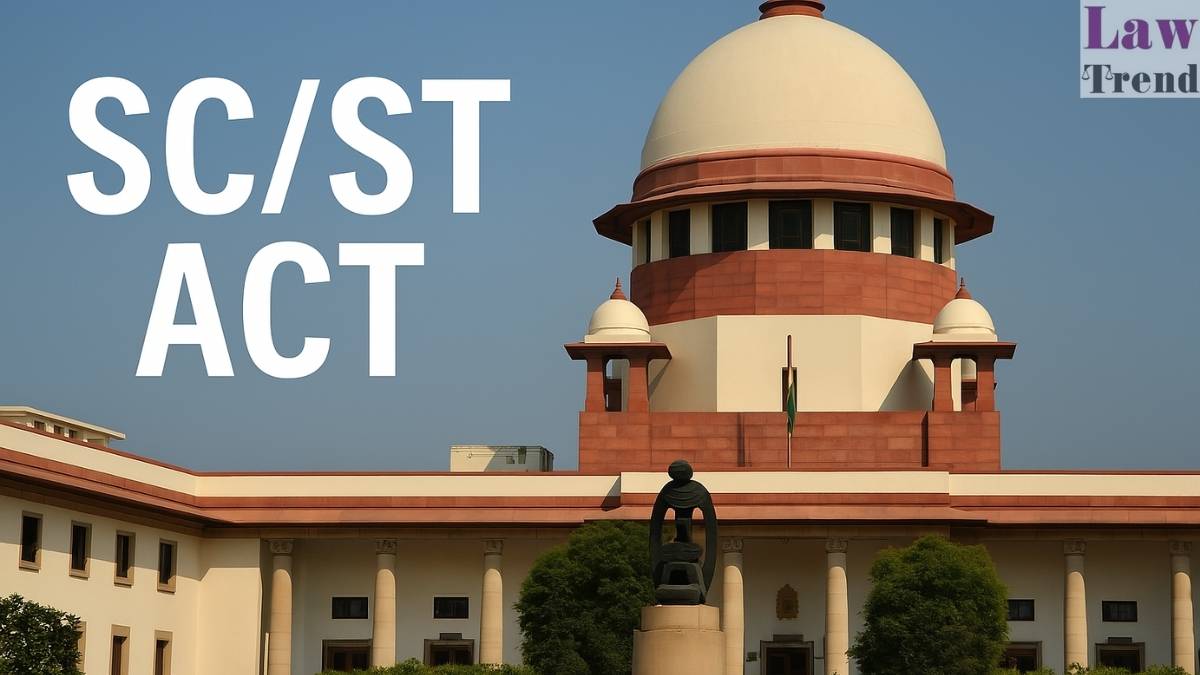
The Supreme Court has clarified the scope of the victim’s right to be heard under the Scheduled Castes and Scheduled Tribes (Prevention of Atrocities) Act, 1989 (SC/ST Act). The Court held that while Section 15A(5) mandates a fair opportunity for the victim to be heard in bail proceedings, it does not require the Court to provide a detailed adjudication or express rejection of every objection raised by the victim.
While the Bench comprising Justice B.V. Nagarathna and Justice R. Mahadevan found no procedural violation of the victim’s right to be heard in the instant case, it proceeded to cancel the bail granted to the accused on the merits. The Court termed the High Court’s order “manifestly perverse” for failing to consider that the accused had allegedly murdered a key witness while on bail.
Clarification on Section 15A(5) of the SC/ST Act
The appellant had argued that the High Court violated Section 15A(5) of the SC/ST (POA) Act by not engaging with the “specific, detailed, and reasoned objections” raised against the grant of bail.
Addressing this contention, the Supreme Court referred to its earlier decision in Hariram Bhambhi v. Satyanarayan, which established that the right to be heard is mandatory. However, the Bench distinguished between the opportunity to be heard and the outcome of that hearing.
Key Observations:
- Scope of the Right: The Court observed, “The provision guarantees an opportunity to be heard, not a right to a favourable outcome or to a detailed adjudication of every objection raised by the victim. Once the victim has been notified, permitted to participate, and allowed to place objections on record, the statutory mandate stands satisfied.”
- No Detailed Analysis Required: The Bench further clarified, “Bail cannot be cancelled merely because the court did not accept the victim’s submissions… Section 15A(5) does not mandate a detailed analysis or express rejection of every submission advanced by the victim.”
Since the appellant was admittedly notified and heard by the High Court, the Supreme Court ruled that there was no violation of the statutory requirement under Section 15A(5).
Bail Cancelled on Merits: “Manifestly Perverse” Order
Despite rejecting the argument regarding the procedural violation of the SC/ST Act, the Supreme Court set aside the High Court’s bail order on the grounds of perversity and non-application of mind.
Factual Matrix: The case involved an assault on the appellant and his friend, Suresh, in 2020 (Crime No. 39 of 2020). The accused were granted bail in September 2020. However, on December 18, 2022, while on bail, the accused allegedly murdered Suresh, the prime injured eyewitness. Following this, their bail was cancelled in March 2023. Subsequently, in April 2025, the High Court again granted them bail, which was challenged before the Supreme Court.
Court’s Reasoning: The Apex Court criticised the High Court for ignoring the “grave supervening circumstances,” specifically the murder of the material witness. Justice Mahadevan, writing for the Bench, noted: “The omission to consider prior cancellation of bail and demonstrated abuse of liberty renders the impugned judgment manifestly perverse.”
The Court also observed that recording criminal antecedents without evaluating their impact amounts to an “empty formality.” It held that the High Court’s reliance on pending civil disputes to grant bail in such serious offences constituted a “misdirection in law.”
Joint Trial Direction Set Aside
The Supreme Court also examined the High Court’s direction to conduct a joint trial of the 2020 attempted murder case and the 2022 murder case.
Citing the precedent in Mamman Khan v. State of Haryana, the Court reiterated that separate trial is the rule and joint trial is the exception. The Bench noted that the two crimes involved distinct occurrences, different years, and different factual allegations.
The Court held: “The High Court could not have directed a joint trial of two distinct cases without following due process of law or recording cogent reasons… The direction issued by the High Court for joint trial… is legally unsustainable.”
Decision
The Supreme Court allowed the appeals with the following directions:
- Bail Cancelled: The impugned judgment granting bail was set aside. The respondents/accused were directed to surrender before the trial court within two weeks.
- Joint Trial Quashed: The direction to club the trials of Crime No. 39 of 2020 and Crime No. 202 of 2022 was set aside.
- Independent Trial: The trial court was directed to conduct the trial independently and purely on merits.
Case Details
- Case Title: Lakshmanan v. State through the Deputy Superintendent of Police & Ors.
- Case Number: Criminal Appeal Nos. of 2025 [Arising out of SLP (Crl.) Nos. 6647-6650 of 2025]
- Citation: 2025 INSC 1483
- Bench: Justice B.V. Nagarathna and Justice R. Mahadevan