

Husband Asking Wife to Maintain Household Accounts is Not Cruelty: Supreme Court Quashes 498A Case
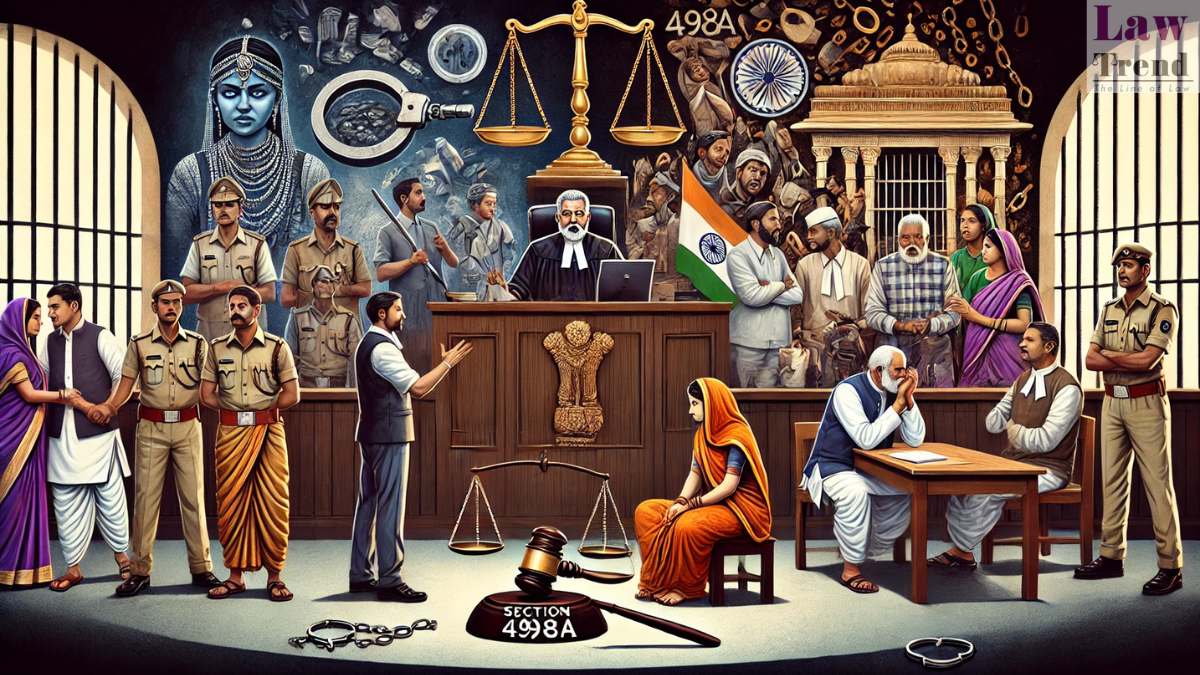

Some allegations reflect the “daily wear and tear of marriage” and cannot be categorized as cruelty under Section 498A of the IPC, the Supreme Court has held while quashing a dowry harassment case against a husband.

The Bench of Justice B.V. Nagarathna and Justice R. Mahadevan observed that a husband asking his wife to maintain household accounts in an excel sheet or sending money to his own parents does not constitute “cruelty” to warrant criminal prosecution.

Case Background

The appeal was filed by the husband (accused-appellant) challenging an order dated April 27, 2023, passed by the High Court for the State of Telangana. The High Court had dismissed his petition under Section 482 of the Code of Criminal Procedure (CrPC), refusing to quash the proceedings arising out of FIR No. 29 of 2022 registered under Section 498A of the Indian Penal Code (IPC) and Sections 3 and 4 of the Dowry Prohibition Act, 1961.

The complainant-wife and the appellant-husband were both software engineers working in the USA. They married on December 4, 2016, and lived in Michigan. Due to matrimonial discord, the wife returned to India on August 5, 2019. On January 11, 2022, the husband sent a legal notice seeking restitution of conjugal rights. Shortly thereafter, on January 24, 2022, the wife filed a complaint alleging harassment, leading to the registration of the FIR.

READ ALSO  Supreme Court Seeks Strict Compliance with Toilet Construction Directions in All Courts, Tribunals

It is pertinent to note that the proceedings against the husband’s family members (parents-in-law and siblings) had already been quashed by the High Court in a separate order.

Arguments of the Parties

The counsel for the appellant-husband argued that the allegations in the FIR were general, unsubstantiated, and frivolous, pertaining to the “general wear and tear of the marriage.” It was contended that the complaint was a “counterblast” to the legal notice for restitution of conjugal rights sent by the husband, motivated by vengeance.

Conversely, the counsel for the complainant-wife argued that the FIR stemmed from actual atrocities. Specifically, it was alleged that:

  • The husband exercised full monetary control, requiring her to maintain complete account details in an excel sheet.
  • The husband transferred money to his parents and brothers while she had to “beg for money to meet her daily needs.”
  • The husband failed to support her during pregnancy and insulted her regarding her weight after childbirth.
  • There were demands for dowry to repay family loans.

Court’s Analysis

The Supreme Court examined the allegations and found them insufficient to constitute “cruelty” as defined under Section 498A IPC.

  • Financial Control and Household Accounts: Addressing the wife’s grievance regarding financial monitoring, the Court observed:
    “The allegation that the accused-appellant forced the complainant-respondent No.2 to maintain an excel sheet of all the expenses, even if taken on the face value, cannot come under the definition of cruelty.”
  • Financial Dominance: The Bench acknowledged societal realities but drew a line regarding criminal liability:
    “The monetary and financial dominance of the accused-appellant, as alleged by the complainant-respondent No.2, cannot qualify as an instance of cruelty… The said situation is a mirror reflection of the Indian society where men of the households often try to dominate and take charge of the finances of the women but criminal litigation cannot become a gateway or a tool to settle scores and pursue personal vendettas.”
  • Sending Money to Parents: The Court categorically stated:
    “The act of the accused-appellant of sending money back to his family members cannot be misconstrued in a way that leads to a criminal prosecution.”
  • Body Shaming Allegations: Regarding the allegations of insults about postpartum weight, the Court remarked:
    “Furthermore, the other allegations… lack of care… and constant taunts about her after-birth weight, if accepted prima facie, at best reflect poorly upon the character of the accused-appellant but the same cannot amount to cruelty so as to make him suffer through the process of litigation.”
READ ALSO  बड़ी बहन को संरक्षकता निभाने का कानूनी अधिकार नहीं है, सिवाय इसके कि जब सक्षम न्यायालय ने कोई आदेश दिया हो: सुप्रीम कोर्ट

The Court found the allegations to be “vague and omnibus,” noting that the complainant failed to provide specific instances of harassment or demonstrate how she suffered any grave injury.

Citing the landmark judgment in State of Haryana vs. Bhajan Lal (1992), the Court held that the case fell under categories (1) and (7), where allegations do not prima facie constitute an offence or are maliciously instituted with an ulterior motive.

READ ALSO  P&H HC Grants Bail to 23-Year-Old Accused of Supplying Arms to Separatist at ISI's Instance

The Court also relied on the recent decision in Dara Lakshmi Narayana vs. State of Telangana (2025), which cautioned against the misuse of Section 498A IPC as a tool for personal vendetta, particularly as a counterblast to matrimonial proceedings initiated by the husband.

Decision

The Supreme Court allowed the appeal and set aside the High Court’s order. Consequently, FIR No. 29 of 2022 and the consequent Complaint Case No. 1067 of 2022 were quashed.

The Court clarified that this judgment would not affect other pending matrimonial proceedings between the parties, which are to be decided on their own merits.

Case Details:

  • Case Title: Belide Swagath Kumar v. State of Telangana & Another
  • Case Number: Criminal Appeal arising out of SLP (Crl.) arising out of Diary No. 47072 of 2023
  • Citation: 2025 INSC 1471
  • Coram: Justice B.V. Nagarathna and Justice R. Mahadevan

Law Trend
Law Trendhttps://lawtrend.in/
Legal News Website Providing Latest Judgments of Supreme Court and High Court

Related Articles

Latest Articles

