

DIOS Must Afford Opportunity of Hearing to Committee of Management Before Disapproving Proposal for Punishment: Allahabad HC
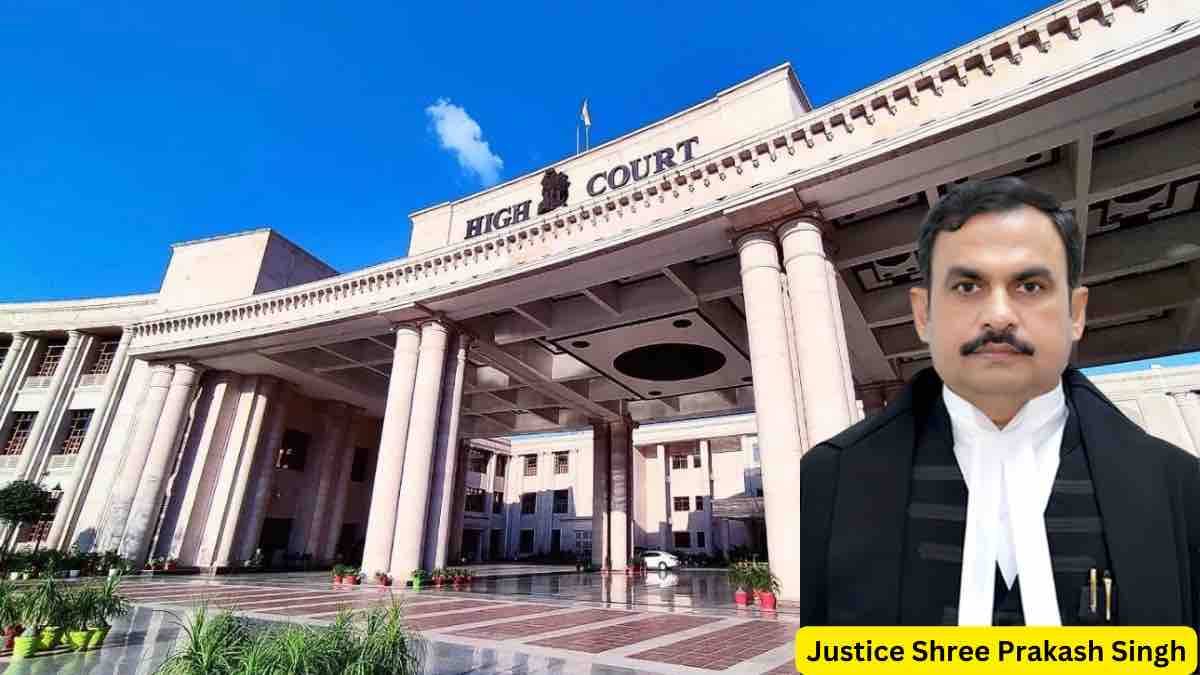

The Allahabad High Court, Lucknow Bench, has held that the District Inspector of Schools (DIOS) is legally obligated to provide an opportunity of hearing to the Committee of Management before disapproving a recommendation for the dismissal or punishment of an employee. Justice Shree Prakash Singh quashed the order of the DIOS-II, Lucknow, which had disapproved the proposal to dismiss an officiating principal without hearing the management, and remitted the matter back for a fresh decision.

The legal issue before the Court was whether it is incumbent upon the District Inspector of Schools to issue a notice to the Committee of Management before disapproving a proposal for the dismissal of an employee under Section 16-G(3)(b) of the U.P. Intermediate Education Act, 1921. The Court held that although the statutory provision does not explicitly mandate a hearing for the management in case of disapproval, the principles of natural justice require it. Consequently, the writ petition filed by the Committee of Management was allowed.

Background of the Case

The case pertains to Chutki Bhandar Girls Intermediate College, Lucknow, an institution recognized by the U.P. Intermediate Education Board and receiving grant-in-aid from the State Government. Following the voluntary retirement of the ad-hoc principal, Dr. Suman Shukla (Opposite Party No. 6), a Lecturer in Civics, was given the charge of Officiating Principal on March 1, 2024.

According to the judgment, the Committee of Management observed that Dr. Shukla’s behavior was “rude and uncalled for” and that she disobeyed instructions. Consequently, on July 13, 2024, the Committee resolved to hand over the charge to another senior teacher, Smt. Sunita. Dr. Shukla allegedly declined to hand over the charge. Under these circumstances, the Committee suspended her. The DIOS disapproved this suspension on July 9, 2025. This disapproval was challenged in a separate petition (Writ A No. 8442 of 2025), where the High Court, on November 21, 2025, quashed the disapproval and remitted the matter back to the DIOS.

READ ALSO  No Protection Should be Given to Persons Who Secure Public Employment Through False Caste Certificate: SC 

Meanwhile, an inquiry committee constituted by the Management completed its proceedings against Dr. Shukla. Based on the inquiry report, the Committee of Management took a decision on July 27, 2025, recommending her dismissal from service and forwarded the proposal to the DIOS for approval.

On September 26, 2025, the DIOS-II, Lucknow, passed the impugned order disapproving the recommendation for dismissal and remitting the matter back to the college. The petitioners challenged this order, arguing that it was passed without affording them an opportunity of hearing.

Arguments of the Parties

Petitioners’ Submissions: Learned counsels for the petitioners, Mr. M.B. Singh and Mr. Vikas Singh, contended that the Committee of Management had recommended the dismissal of Dr. Shukla after thoroughly considering the inquiry report. They argued that the DIOS-II, Lucknow, remitted the matter back and disapproved the proposal “without hearing the Committee of Management,” which caused great prejudice to their rights. They asserted that the order dated September 26, 2025, was against the “principles of natural justice” and liable to be quashed.

Respondents’ Submissions: On behalf of the State and the Opposite Party No. 6, counsels Mr. Brijendra Singh and Mr. Indra Pratap Singh refuted the contentions. They argued that since the High Court had earlier directed the DIOS to take a fresh decision on the suspension matter (in Writ A No. 8442 of 2025), “no further proceeding can go on regarding any recommendation/proposal made by the Committee of Management” until that decision is taken. They maintained that there was no ambiguity in the impugned order.

READ ALSO  Allahabad HC Explains Term "Normally Resides" Qua Territorial Jurisdiction of Railway Claim Tribunals

Court’s Analysis

Justice Shree Prakash Singh rejected the respondents’ argument that the pending decision on suspension barred proceedings on the dismissal recommendation. The Court clarified that the disapproval of suspension and the recommendation for dismissal are “altogether different stage[s],” and there is no restriction preventing the inquiry or subsequent proceedings from continuing.

On Section 16-G(3)(b) of the Act, 1921: The Court examined Section 16-G(3)(b), which empowers the Inspector to approve, disapprove, reduce, or enhance punishment. The provision explicitly states that in cases of punishment, the Inspector shall give an opportunity to the Principal, Headmaster, or teacher to show cause. However, the Court noted:

“…there is no provision has been prescribed in the event of the disapproval of the proposal of punishment of the Committee of Management for issuing notice or preceding opportunity to be heard.”

On Principles of Natural Justice: Despite the lack of an explicit statutory mandate, the Court invoked the principle of Audi alteram partem (no one should be unheard). The Court observed:

“It is trite law that there is implied applicability to the rules of natural justice unless statutory provision either specifically or by necessary implication excludes application of such rules, in any exercise of power prejudicially affecting another.”

The Court relied on several precedents, including:

  • Cooper Vs Wandswords Board of Works (1863): Quoting the principle that “Even God himself did not pass sentence upon Adam before he was called upon to make his defence.”
  • Gorkha Security Services Vs Government (NCT of Delhi) (2014): Emphasizing that decisions with civil consequences must be preceded by a show-cause notice.
  • Raghunath Thakur v. State of Bihar (1989): Reiterating that even if rules do not express so, parties affected by an order having civil consequences have a right of being heard.
  • UMC Technologies Private Ltd. Vs Food Corporation of India (2021): Holding that an authority must give notice before adjudication starts so the affected party can defend itself.
READ ALSO  Section 37 of Arbitration and Conciliation Act | HC Cannot Enter into Factual Methodology for Computing Compensation nor Can It Correct Award: Allahabad HC

Findings: The Court reasoned that the Committee of Management plays a key role in the administration of an institution. If a proposal for punishment, made after thorough consideration, is disapproved without hearing the Management, it causes prejudice. The Court stated:

“In fact, in the present case, there was complaint regarding the rude and unruly behaviour of the opposite party no. 6 and if the Committee of Management is not given the proper opportunity of hearing so as to defend it’s proposal/recommendation, which was infact passed/given after a thorough consideration, essentially, the prejudice would be caused to the Committee of Management.”

The Court concluded that in cases where the Committee of Management recommends discharge, removal, dismissal, or reduction in rank under Section 16-G(3)(a), “prior passing the order of disapproval, such Committee of Management, shall be heard with preceding notice. The hearing should not be formal, but, it must be substantive.”

Decision

The High Court held that the impugned order was against the “first principle of law i.e. the ‘principle of natural justice’.”

“Ergo, the order impugned dated 26-09-2025 is hereby quashed.”

The Court remitted the matter back to the District Inspector of Schools-II, Lucknow, to take a fresh decision on the proposal/recommendation of the Committee of Management strictly adhering to the provisions of law and “affording opportunity of hearing to Committee of Management” within six weeks.

Law Trend
Law Trendhttps://lawtrend.in/
Legal News Website Providing Latest Judgments of Supreme Court and High Court

Related Articles

Latest Articles

