

Section 5A Objections Limited to Acquisition Challenge, Not Compensation; Chhattisgarh HC Upholds Adani Power Land Acquisition
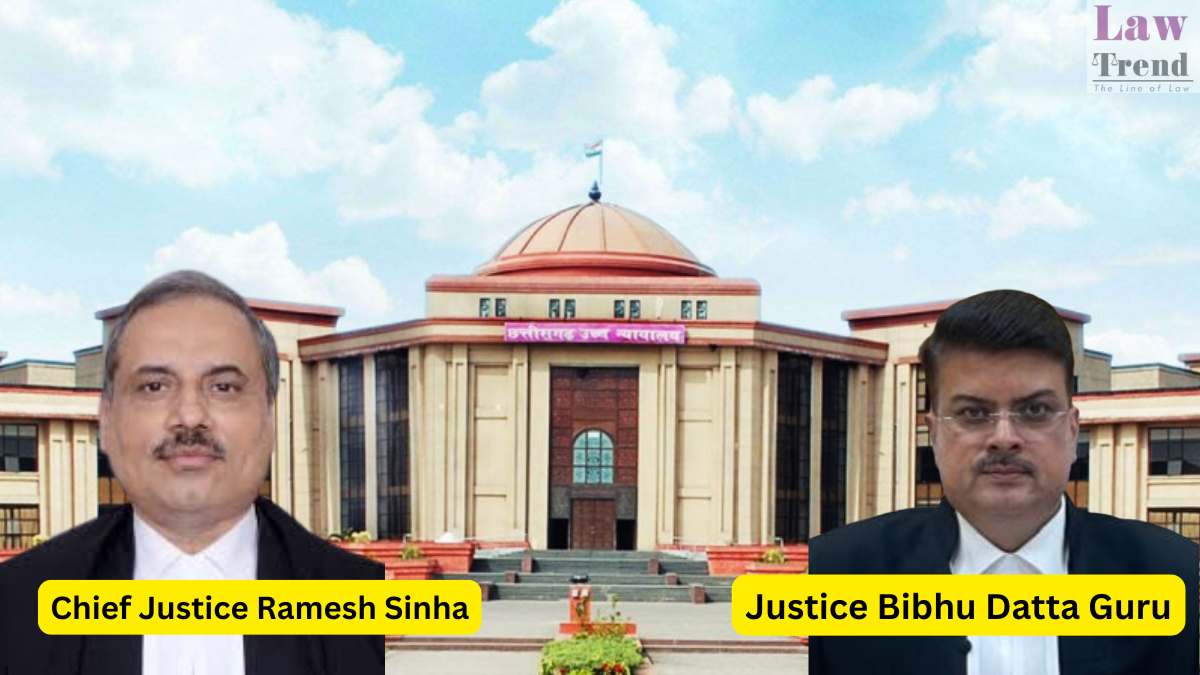

The High Court of Chhattisgarh has set aside a Single Judge’s order that had quashed land acquisition proceedings initiated in 2010 for a power project now operated by Adani Power Limited. The Division Bench, comprising Chief Justice Ramesh Sinha and Justice Bibhu Datta Guru, ruled that objections filed under Section 5A of the Land Acquisition Act, 1894, must strictly pertain to the acquisition of land itself. The Court held that grievances confined to the rate of compensation, employment, or rehabilitation do not attract the mandate of Section 5A and must be addressed through separate statutory remedies.

The judgment, delivered on December 15, 2025, allowed three writ appeals filed by Adani Power Limited, the State of Chhattisgarh, and the Chhattisgarh State Industrial Development Corporation (CSIDC).

Background of the Case

The dispute traces back to a notification issued by the State Government on July 3, 2010, under Section 4(1) of the Land Acquisition Act, 1894. The notification proposed the acquisition of land in Village Badebhandar, District Raigarh, for industrial development—specifically for a thermal power project.

Respondent No. 1, Panchanand Gupta, a landowner, filed objections on August 2, 2010. The Sub-Divisional Officer (SDO) heard the objections and passed an order on August 26, 2010. Subsequently, a declaration under Section 6 was issued, and a final award was passed on January 14, 2011. Possession was taken, and the power project has been operational since 2013.

However, the landowner challenged the proceedings, alleging non-compliance with the mandatory procedure under Section 5A of the Act. On August 14, 2025, the learned Single Judge allowed the writ petition and quashed the acquisition proceedings qua the respondent’s land, holding that the objections were not decided in accordance with the law. Aggrieved by this decision, Adani Power Limited and the State authorities preferred appeals before the Division Bench.

READ ALSO  High Court Discharges Person Booked in Child Trafficking Due to Insufficient Evidence 

Arguments of the Parties

The Appellants (Adani Power, State, CSIDC): Senior Advocate Rajeev Shrivastava and Senior Advocate Prafull N. Bharat, appearing for the appellants, argued that the respondent never objected to the “public purpose” or the necessity of the acquisition. It was submitted that the respondent’s objections were “confined exclusively to the rate of compensation, employment to a family member, health safeguards and environmental protection measures.”

The appellants contended that since there was no challenge to the acquisition itself, the rigorous provisions of Section 5A were not attracted. They further argued that the project had been operational for nearly 15 years with substantial investment, and the Single Judge erred in unsettling a concluded acquisition based on procedural grounds raised by a solitary landowner.

The Respondent (Landowner): Counsel for the respondent supported the Single Judge’s order, arguing that the “mandatory procedure prescribed under Section 5A of the Act of 1894 was not followed in its true letter and spirit.” It was contended that the SDO summarily dealt with the objections without conducting a meaningful enquiry under Section 5A(2) and that the Collector acted merely as a “rubber stamp” while issuing the declaration under Section 6.

Court’s Analysis and Observations

The Division Bench examined the nature of the objections filed by the respondent and noted that there was “no objection whatsoever to the public purpose, the necessity of acquisition, the suitability of the land, or the competence of the acquiring authority.”

READ ALSO  छत्तीसगढ़ हाईकोर्ट ने हाईवे पर स्टंट करने वाले युवकों के मामले में स्वतः संज्ञान लिया, मुख्य सचिव से व्यक्तिगत हलफनामा तलब

On the Scope of Section 5A: The Court observed that Section 5A(1) enables a person to object to the acquisition of land, but it does not contemplate the adjudication of claims relating to compensation or ancillary benefits. The Bench stated:

“Objections of this nature do not strike at the root of acquisition. They are collateral demands which, even if otherwise legitimate, fall outside the scope of Section 5A and are required to be addressed either at the stage of determination of compensation under Section 11, by seeking a reference under Section 18, or under the applicable rehabilitation or environmental frameworks.”

The Court held that permitting the invocation of Section 5A to indirectly challenge compensation would “obliterate this statutory distinction and render Sections 11 and 18 pointless.”

On the “Further Inquiry” Requirement: Addressing the respondent’s claim regarding the lack of a detailed enquiry, the Court clarified:

“The expression ‘after making such further inquiry, if any, as he thinks necessary’ occurring in Section 5A(2) is discretionary and enabling, not mandatory in every case. Where objections do not question acquisition itself but raise issues beyond the statutory remit of Section 5A, the absence of a detailed inquiry or elaborate recommendations does not vitiate the proceedings.”

Distinguishing Precedents: The Court distinguished the judgments relied upon by the Single Judge, including Union of India v. Shiv Raj (2014) and Kedar Nath Yadav v. State of W.B. (2017). The Bench noted that in those cases, the landowners had directly assailed the acquisition itself. In contrast, the respondent in the present case accepted the acquisition and disputed only the compensation.

READ ALSO  Chhattisgarh HC Chief Justice Virtually Lays Foundation Stone for Family Court at Jashpur, Judges’ Quarters in Dantewada & Sukma

On Concluded Acquisitions: The Court emphasized the significance of the passage of time, noting that the project has been serving public interest for over a decade. Relying on the Supreme Court’s decision in New Okhla Industrial Development Authority v. Darshan Lal Bohra (2024), the Bench remarked:

“The Courts must be slow in unsettling concluded acquisitions, particularly where large public or infrastructure projects have come into existence and third-party rights have intervened… the clock ought not to be turned back on tenuous procedural grounds raised by a solitary landowner.”

Decision

The High Court concluded that the objections raised by the respondent did not attract the scope of Section 5A in its true sense and that there was no illegality vitiating the proceedings. The Court held:

“The learned Single Judge erred in quashing the notification under Section 6, the order dated 26.08.2010 and the award dated 14.01.2011 qua the land of respondent No. 1.”

Consequently, the appeals were allowed, and the Single Judge’s order dated August 14, 2025, was set aside. The acquisition proceedings were upheld in their entirety. The Court reserved liberty for the respondent to seek enhancement of compensation by availing the statutory remedy under Section 18 of the Act, if not already exhausted.

Law Trend
Law Trendhttps://lawtrend.in/
Legal News Website Providing Latest Judgments of Supreme Court and High Court

Related Articles

Latest Articles

