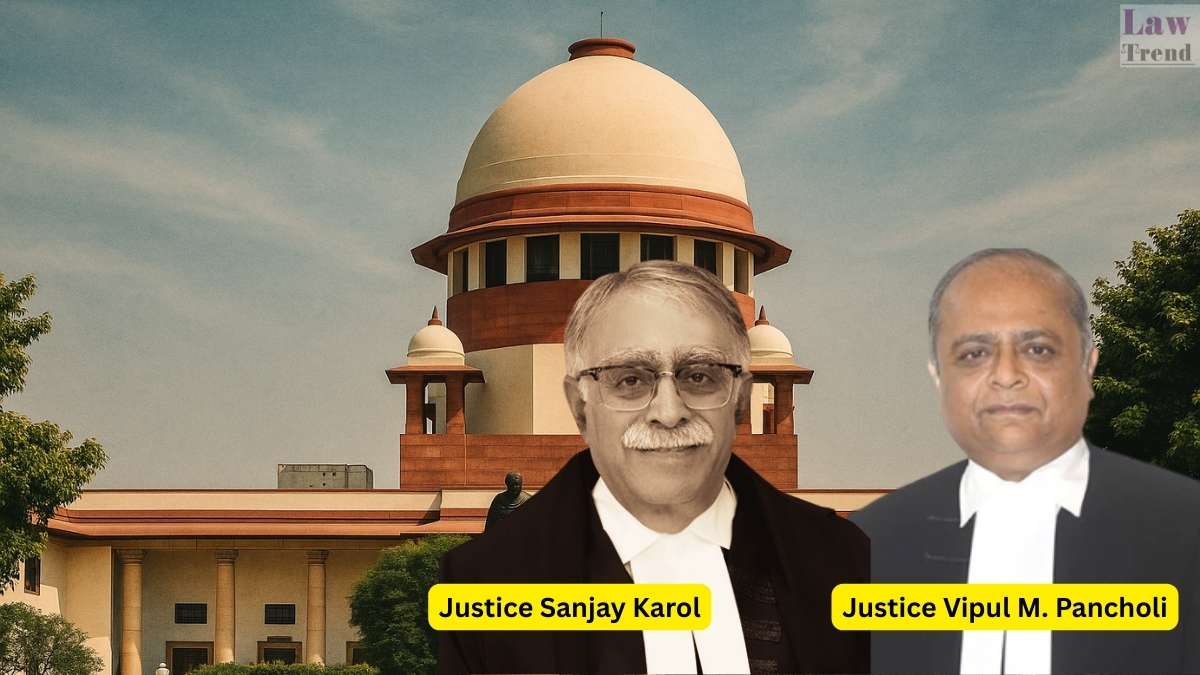
The Supreme Court has set aside the conviction of a doctor accused of rape, ruling that allegations levelled in a First Information Report (FIR) cannot be presumed to be true unless proved during the trial by leading cogent evidence. The bench, comprising Justice Sanjay Karol and Justice Vipul M. Pancholi, observed that the Trial Court and the Gujarat High Court committed an error in recording the conviction when the victim herself had turned hostile and the medical evidence did not support the prosecution’s case.
The Apex Court allowed the appeals filed by the appellant, Jayantibhai Chaturbhai Patel, challenging the Gujarat High Court’s order which had not only upheld his conviction but also enhanced his sentence from six years to ten years of rigorous imprisonment.
Background of the Case
The prosecution’s case was that the appellant was a doctor practicing in Himmatnagar, Gujarat. On May 8, 2001, the informant (victim) visited the appellant’s dispensary with her husband for treatment of stomach pain. It was alleged that the appellant took the victim into an operation room for examination, where he forcibly committed sexual intercourse with her. The prosecution alleged that the victim suffered scratches and bruises on her neck due to resistance.
Based on the FIR lodged by the victim, an investigation was carried out, and a charge-sheet was filed. The Trial Court convicted the appellant under Section 376(2)(d) of the Indian Penal Code (IPC) and sentenced him to six years of rigorous imprisonment.
Subsequently, the appellant appealed against the conviction, while the State preferred an appeal seeking enhancement of the sentence. The Gujarat High Court dismissed the appellant’s appeal and allowed the State’s appeal, enhancing the sentence to ten years.
Arguments of the Parties
The counsel for the appellant contended that the conviction was unsustainable as the victim (PW-1) and her husband (PW-2) had not supported the prosecution’s case and were declared hostile. It was argued that the High Court erred in converting a case of direct evidence into one of circumstantial evidence and wrongly presumed that the witnesses had been “won over.”
The appellant’s counsel relied on several precedents, including Lalita Vs. Vishwanath and Ors. [2025 SCC Online SC 370] and Renuka Prasad Vs. State [2025 SCC Online SC 1074], to argue that the Investigating Officer cannot indirectly prove what witnesses failed to prove. It was further submitted that independent witnesses, including panch witnesses of recovery, had turned hostile, and material independent witnesses present at the clinic were not examined.
On the other hand, the learned Additional Solicitor General (ASG) appearing for the State opposed the appeals. He argued that the victim had initially deposed about visiting the clinic and the treatment. He relied on the medical evidence, stating that Dr. Vinod Kavjibhai Varsat (PW-7) had noticed scratch marks on the victim’s neck.
The ASG further emphasized the forensic evidence, pointing out that semen stains found on the victim’s petticoat and the appellant’s clothes were of ‘Group B’, which matched the appellant’s blood group. The State contended that despite the hostile witnesses, the other evidence proved the case beyond reasonable doubt.
Court’s Analysis
The Supreme Court meticulously examined the evidence and the reasoning of the lower courts. The Bench referred to the decision in State of Rajasthan v. Bhawani (2003) and Paramjeet Singh v. State of Uttarakhand (2010), reiterating that while the testimony of a hostile witness should not be rejected en bloc, the court must be “slow to act on the testimony of such a witness” and should look for corroboration.
Scrutiny of Forensic and Medical Evidence
The Court observed that the High Court had placed heavy reliance on the recovery of clothes and the Forensic Science Laboratory (FSL) report. However, upon examining the deposition of the panch witnesses (PW-3 and PW-4), the Supreme Court noted that they had stated their signatures were obtained on written papers at the instance of the police and they were unaware of the contents.
“Thus, the High Court has committed an error while placing reliance upon the stains of semen found on the clothes of the victim as well as the appellant-accused while passing the impugned judgment and order,” the Bench stated.
Regarding medical evidence, the Court noted that PW-6, Dr. Rita Sinha, testified that the appellant could not provide a semen sample despite trying. Furthermore, PW-7, Dr. Vinod Kavjibhai Varsat, deposed that there were no injuries on the victim’s private parts and no signs of semen or blood were found. While abrasions were noted on the neck, the doctor admitted in cross-examination that “no sign of having physical intercourse in the recent time has appeared.”
On Hostile Witnesses and Presumptions
The Court criticized the High Court’s presumption that the victim did not support the prosecution because she had been won over. The Bench held:
“We are of the view that when the main witness of the prosecution, i.e. the victim herself, has not supported the case of the prosecution, it is not open for the Court to presume that she did not support the case of the prosecution because the appellant-accused has won over the said witness.”
The Court further remarked that merely because allegations are levelled in an FIR and the Investigating Officer deposes regarding them, it cannot be presumed they are true.
“Merely because the victim has levelled allegations against the appellant-accused in the FIR… it cannot be presumed that the allegations levelled in the FIR are true and correct unless the same is proved during the course of trial by leading cogent evidence.”
Decision
The Supreme Court held that the prosecution failed to prove the case beyond reasonable doubt. The Court observed that the Trial Court and the High Court committed an error by recording the order of conviction.
Accordingly, the appeals were allowed. The judgment and order of the Trial Court dated February 3, 2003, and the common impugned judgment of the Gujarat High Court dated November 28/29, 2016, were set aside. The appellant was acquitted, and his bail bonds were discharged.
Case Details
Case Title: Jayantibhai Chaturbhai Patel v. State of Gujarat
Case No.: Criminal Appeal No. 890-891 of 2017
Quorum: Justice Sanjay Karol and Justice Vipul M. Pancholi
Citation: 2025 INSC 1443