

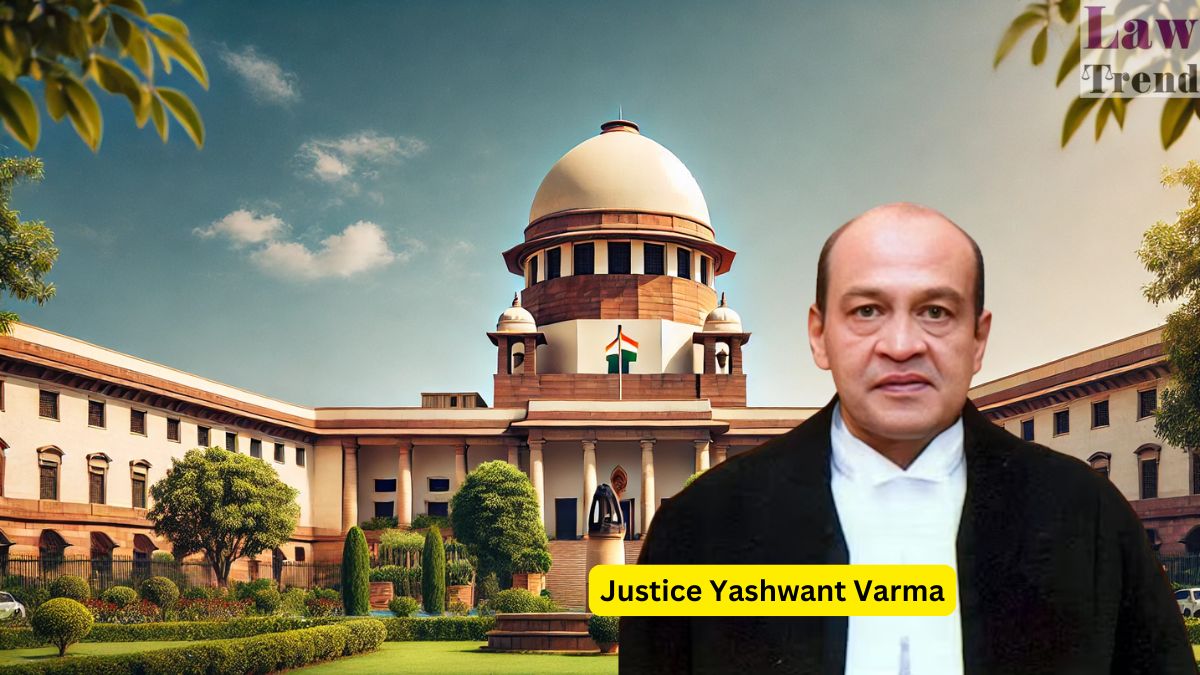
The Supreme Court on Tuesday intervened in a high-profile legal battle involving the judiciary and parliamentary procedure, agreeing to hear a plea filed by Allahabad High Court judge, Justice Yashwant Varma. The petition challenges the constitution of an inquiry committee appointed by the Lok Sabha Speaker to probe corruption charges against him.
A bench comprising Justice Dipankar Datta and Justice Augustine George Masih issued notices to the office of the Lok Sabha Speaker and the Secretaries-General of both Houses of Parliament, seeking their responses on the procedural validity of the committee. The matter has been listed for the next hearing on January 7, 2026.
The Controversy: Burnt Cash and Corruption Charges
The genesis of the inquiry lies in a startling incident reported earlier this year. On March 14, authorities discovered wads of burnt currency notes following a fire in the storeroom of Justice Varma’s official residence in the national capital. The recovery of the charred cash led to serious allegations of corruption, subsequently triggering motions for his removal in Parliament.
To investigate these grounds, the Lok Sabha Speaker constituted a three-member inquiry committee comprising:
- Justice Aravind Kumar, Judge, Supreme Court of India
- Justice Manindra Mohan Shrivastava, Chief Justice, Madras High Court
- Mr. B.V. Acharya, Senior Advocate, Karnataka High Court
The Legal Challenge: Unilateral vs. Joint Constitution
Justice Varma has moved the Apex Court challenging the legality of this specific committee, formed via an order dated August 12, 2025.
The crux of the legal argument presented by the counsel for Justice Varma rests on the interpretation of the Judges (Inquiry) Act, 1968. The plea contends that since the motion regarding his removal was introduced in both Houses of Parliament, the inquiry committee could not be constituted unilaterally by the Speaker of the Lok Sabha.
The counsel submitted that the law mandates a committee formed jointly by the presiding officers of both the Lok Sabha and the Rajya Sabha when motions are admitted in both Houses. The petition argues that the current committee’s formation is “contrary to the procedure established by law.”
Constitutional Violations Alleged
The plea seeks a writ declaring the Speaker’s action unconstitutional. It asserts that the unilateral constitution of the panel violates Articles 124, 217, and 218 of the Constitution of India, in addition to Section 3 of the Judges Act, 1968.
Under the Judges Act, once a motion to remove a judge is admitted, the Speaker or the Chairman is empowered to constitute a committee to investigate the misbehaviour or incapacity. However, Justice Varma’s plea highlights the procedural nuance required when both Houses are seized of the matter.
The Supreme Court will now examine whether the procedure adopted by the Lok Sabha Speaker stands the test of the Judges (Inquiry) Act during the hearing in January 2026.




