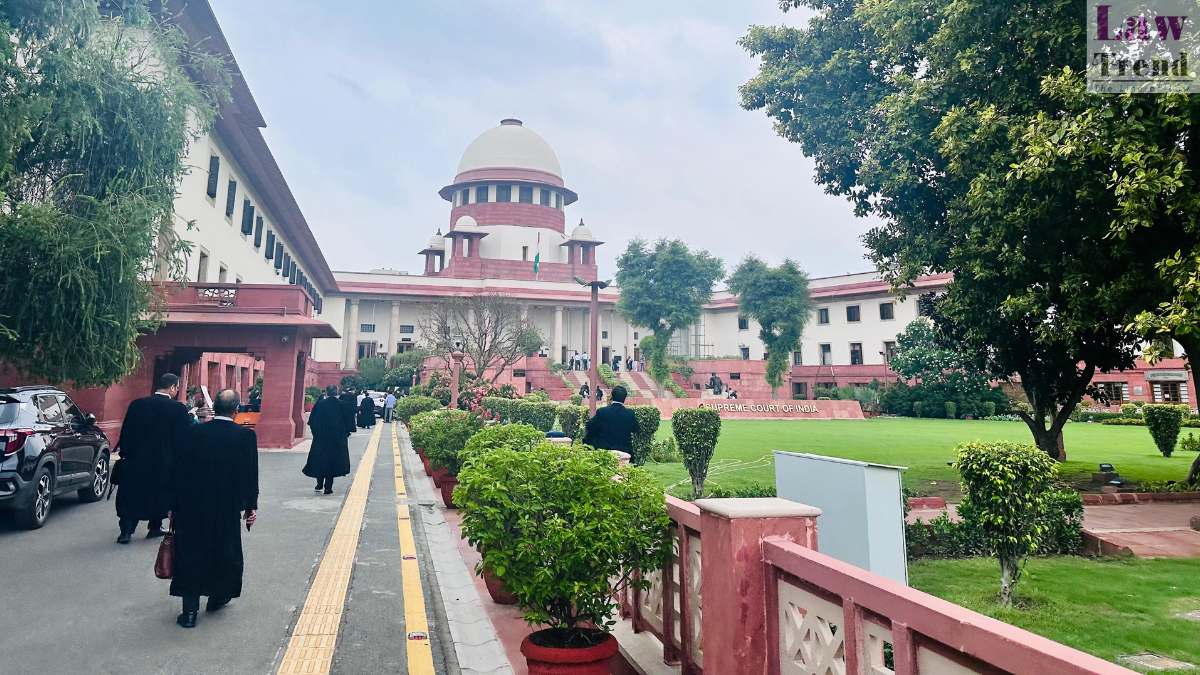
The Supreme Court has authoritatively ruled that once a premise falls within the definition of “public premises” under Section 2(e) of the Public Premises (Eviction of Unauthorised Occupants) Act, 1971 (PP Act 1971), the provisions of the said Act govern the eviction of unauthorised occupants, overriding State Rent Control Legislations. The Court held that the PP Act 1971 applies retrospectively to tenancies created even before the commencement of the Act or before the premises acquired the character of “public premises.”
In a significant judgment delivered on December 11, 2025, a three-judge Bench comprising Justice Vikram Nath, Justice Sandeep Mehta, and Justice N.V. Anjaria overruled the 2014 two-judge Bench decision in Suhas H. Pophale vs. Oriental Insurance Company Limited, declaring it “palpably incorrect” and in violation of the doctrine of stare decisis.
Legal Issue and Outcome
The primary issue referred to the three-judge Bench was whether the provisions of the PP Act 1971 prevail over State Rent Control Legislations regarding premises let out prior to the commencement of the Act. The Court had to determine if a distinction could be drawn between tenants who entered occupation before the Act’s enforcement (or before the premises became public premises) and those who entered subsequently.
Resolving the conflict between Suhas H. Pophale (2014) and the Constitution Bench decision in Ashoka Marketing Ltd. vs. Punjab National Bank (1990), the Supreme Court held that the PP Act 1971 overrides Rent Control Acts. The Court clarified that the invocation of the PP Act is not dependent on the date of possession but on the fact of unauthorised occupation.
Background of the Case
The lead appeal, Life Insurance Corporation of India vs. Vita Pvt. Ltd., involved premises owned by the Life Insurance Corporation of India (LIC) in Mumbai. The tenancy was created in 1957. The PP Act 1971 came into force on August 23, 1971, with retrospective effect from September 16, 1958.
LIC terminated the tenancy by issuing a notice under Section 106 of the Transfer of Property Act, 1882, in 2009, and subsequently initiated eviction proceedings under the PP Act 1971. The Estate Officer ordered eviction, which was upheld by the City Civil Court. However, the Bombay High Court, relying on the decision in Suhas H. Pophale, quashed the eviction order. The High Court reasoned that since the tenancy was created prior to September 16, 1958, it was protected under the Bombay Rent Act, 1947, and remained beyond the application of the PP Act 1971.
Arguments of the Parties
The appellants (LIC and other Insurance Companies), led by the learned Attorney General for India, argued that Suhas H. Pophale created an “artificial” distinction between pre-Act and post-Act tenants, which was in clear conflict with the ratio of the five-judge Bench decision in Ashoka Marketing. They contended that the PP Act 1971, being a special statute enacted to facilitate speedy eviction, must override Rent Control Acts regardless of when the tenancy commenced.
The respondents (tenants) argued that they were protected under the State Rent Control Acts (specifically the Maharashtra Rent Control Act, 1999) and could not be termed “unauthorised occupants.” Relying on Suhas H. Pophale, they contended that their vested rights under the Rent Acts could not be taken away retrospectively and that the PP Act 1971 applies only prospectively.
Court’s Analysis
Justice N.V. Anjaria, authoring the judgment, conducted a comprehensive review of the precedents.
Conflict with Ashoka Marketing: The Court observed that the Constitution Bench in Ashoka Marketing (1990) had explicitly held that the PP Act 1971 is a special statute that overrides the Rent Control Act. The Bench quoted Ashoka Marketing:
“The provisions of the Public Premises Act, 1971, to the extent they cover premises falling within the ambit of the Rent Control Act, override the provisions of the Rent Control Act and a person in unauthorised occupation of public premises under Section 2(e) of the Act cannot invoke the protection of the Rent Control Act.”
Rejection of Suhas H. Pophale: The Bench criticized the Suhas H. Pophale decision for carving out categories of occupants excluded from the PP Act based on dates. The Court noted that Suhas H. Pophale “contradicted and disregarded what was laid down in the earlier decisions of the Bench of larger strength,” specifically Ashoka Marketing and the three-judge Bench decision in M/s. Jain Ink Manufacturing Company vs. Life Insurance Corporation of India (1980).
Judicial Discipline: The Court strongly remarked on the violation of judicial discipline in Suhas H. Pophale, stating:
“The mandate of law of precedent was completely disregarded by the two-Judge Bench in Suhas H. Pophale. It could be viewed as judicial indiscipline, if not judicial impropriety.”
The Court emphasized that a Bench of lesser strength cannot take a view contrary to a larger Bench under the guise of “clarifying” the law.
Decision
The Supreme Court overruled Suhas H. Pophale and answered the reference with the following key conclusions:
- Overriding Effect: The PP Act 1971 overrides State Rent Control Acts. “A person in unauthorised occupation of ‘Public Premises’ under Section 2(e) of the Act cannot invoke the protection of the Rent Control Act.”
- Applicability to Pre-Existing Tenancies: The PP Act 1971 applies to tenancies created either before or after the coming into force of the Act.
- Two Conditions for Applicability: The Court laid down that two conditions must be satisfied:
- Firstly, the tenanted premises must fall within the purview of the definition under Section 2(e) of the PP Act 1971.
- Secondly, the premises should be in unauthorised occupation.
- Unauthorised Occupation: Termination of tenancy by issuing a notice under Section 106 of the Transfer of Property Act, 1882, renders the occupation unauthorised. This applies to tenancies created before or after the Act.
- Possession Irrelevant: Invocation of the PP Act is not dependent on the date of entry into possession but on the fact of unauthorised occupation, which is a continuous concept.
The Court concluded:
“The propositions enunciated in Suhas H. Pophale… do not, in our considered view, state the correct position of law… and stand overruled to that extent.”
Case Details:
- Case Title: Life Insurance Corporation of India & Anr. v. Vita Pvt. Ltd. & Anr. (With connected matters)
- Case No.: Civil Appeal No(s). 2638 of 2023
- Date of Judgment: December 11, 2025
- Coram: Justice Vikram Nath, Justice Sandeep Mehta, and Justice N.V. Anjaria
- Citation: 2025 INSC 1419