

Non-Signatory Sub-Contractor Cannot Invoke Arbitration Against Principal Employer; Supreme Court Sets Aside Bombay HC Referral Order
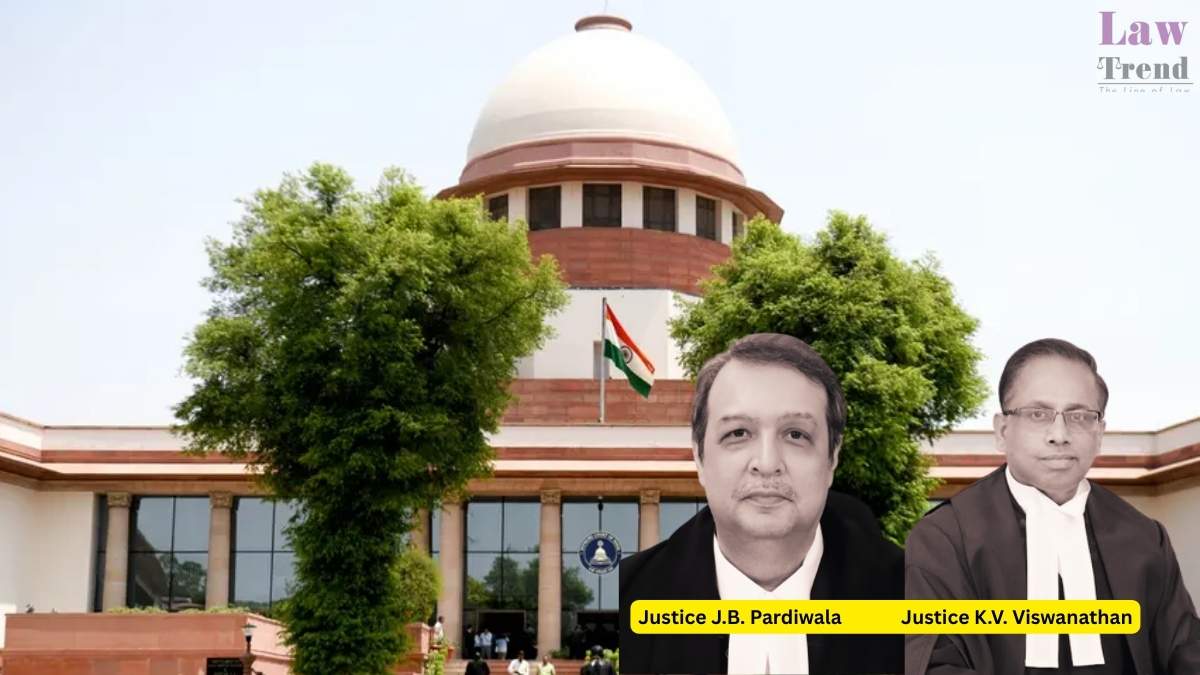

The Supreme Court of India has set aside a Bombay High Court order that appointed an arbitrator to adjudicate disputes between Hindustan Petroleum Corporation Ltd. (HPCL) and BCL Secure Premises Pvt. Ltd. (BCL), a sub-contractor with whom HPCL had no direct contract.

The Bench, comprising Justice J.B. Pardiwala and Justice K.V. Viswanathan, ruled that a non-signatory to an arbitration agreement cannot invoke arbitration against a principal party unless it is prima facie established that the non-signatory is a “veritable party” to the contract. The Court held that HPCL and BCL were operating on “separate orbits,” and there was no privity of contract between them.

The central legal issue before the Apex Court was whether the High Court was justified in referring the parties to arbitration under Section 11(4) of the Arbitration and Conciliation Act, 1996 (“A&C Act”), despite HPCL’s objection that it had no arbitration agreement with BCL.

The Supreme Court allowed the appeal filed by HPCL, setting aside the judgment dated April 7, 2025, passed by the learned Single Judge of the Bombay High Court. The Court dismissed the arbitration application filed by BCL, granting liberty to the respondent to pursue other remedies available in law.

Background of the Case

The dispute originated from a tender floated by HPCL for the design and installation of a Tank Truck Locking System (TTLS). The tender conditions explicitly stated that the contractor “shall not be entitled to sublet, transfer or assign, the work under the contract without the prior consent of the owner obtained in writing.”

READ ALSO  Allahabad HC Affirms Criminal Proceedings Not Quashable Merely Due to Underlying Civil Dispute

On August 20, 2013, HPCL issued a purchase order to the successful tenderer, M/s AGC Networks Ltd. (AGC) (now known as Black Box Limited). Subsequently, on January 15, 2014, AGC entered into a back-to-back agreement with the respondent, BCL, wherein BCL was to undertake the entire performance of the contract.

Disputes arose regarding the performance of the system. While BCL engaged in litigation and arbitration proceedings against AGC for outstanding dues, it eventually reached a settlement with AGC on October 31, 2023. Under this “Settlement-cum-Assignment Agreement,” AGC assigned its receivables against HPCL to BCL.

On August 28, 2024, BCL issued a notice to HPCL invoking arbitration under Section 21 of the A&C Act, claiming it had stepped into the shoes of AGC. When HPCL denied the existence of any contract, BCL approached the Bombay High Court. The High Court allowed the application, directing that the issue of arbitrability be decided by the Arbitral Tribunal as a preliminary issue.

Arguments of the Parties

For the Appellant (HPCL): Solicitor General Tushar Mehta, appearing for HPCL, argued that there was no legal relationship or privity of contract between the Corporation and BCL. He contended that BCL was never involved in negotiations with HPCL, and the Corporation had no knowledge of BCL’s participation. He heavily relied on Clauses 3.17 and 5 of the General Terms and Conditions, which expressly prohibited sub-letting or assignment without prior written consent.

For the Respondent (BCL): Senior Advocate Nalin Kohli, appearing for BCL, argued that the test for binding a non-signatory involves a fact-intensive inquiry best suited for the Arbitral Tribunal. He invoked the “veritable party” doctrine, citing the back-to-back agreement with AGC, purchase orders, and the assignment agreement where AGC relinquished its rights in favor of BCL.

READ ALSO  Telangana HC's bail to accused in ex-Andhra minister's murder inherently contradictory: CBI to SC

Court’s Analysis and Observations

The Supreme Court examined the jurisdiction of a referral court under Section 11 of the A&C Act in the context of the recent Constitution Bench judgment in Cox and Kings Limited v. Sap India Private Limited and Another (2024).

1. Duty of the Referral Court The Court clarified that while the Arbitral Tribunal has the power to rule on its own jurisdiction (Competence-Competence), the referral court must first be “prima facie satisfied that there exists an arbitration agreement and as to whether the non-signatory is a veritable party.”

Justice Viswanathan, writing for the Bench, observed:

“The referral court under Section 11 is not deprived of its jurisdiction from examining whether the non-signatory is in the real sense a party to the arbitration agreement.”

2. The “Veritable Party” Test Applying the law to the facts, the Court found that BCL failed to establish itself as a “veritable party.” The Bench noted that the agreement between AGC and BCL expressly prohibited BCL’s Project Manager from communicating with HPCL without AGC’s prior written approval.

The Court observed:

“On the facts of this case, it is clear that the appellant and the respondent have been operating on separate orbits. It has not been established even prima facie that there was any intention to bind BCL to the contract between HPCL and AGC.”

READ ALSO  Supreme Court Publishes Full Appointment Procedure for Judges to the Supreme Court and High Courts

3. Rejection of the Assignment Argument The Court rejected the argument that BCL could claim through AGC via the assignment agreement. Referencing Khardah Company Limited v. Raymon & Co. (1963), the Bench reiterated that obligations under a contract cannot be assigned without the consent of the promisee.

The judgment stated:

“Apart from the above, not only has the respondent not shown any consent for assignment as required under clause 3.17 of the tender document, nothing even prima facie has been shown to establish that there was any semblance of an intent to effect legal relationship between the respondent and the party originally granting the contract…”

4. On Referral to Tribunal The Court disagreed with the High Court’s approach of leaving the decision entirely to the Tribunal when the prima facie case was absent. The Bench noted that doing so would reduce the referral court to a “monotonous automation” and could lead to “disastrous consequences where absolute strangers could walk into the Referral Court.”

Decision

The Supreme Court held that the respondent failed to satisfy the prima facie test of being a veritable party to the arbitration agreement. Consequently, the Court allowed the appeal and dismissed the arbitration application filed by BCL.

Case Details:

  • Case Title: Hindustan Petroleum Corporation Ltd. v. BCL Secure Premises Pvt. Ltd.
  • Citation: 2025 INSC 1401
  • Coram: Justice J.B. Pardiwala and Justice K.V. Viswanathan

Law Trend
Law Trendhttps://lawtrend.in/
Legal News Website Providing Latest Judgments of Supreme Court and High Court

Related Articles

Latest Articles

