

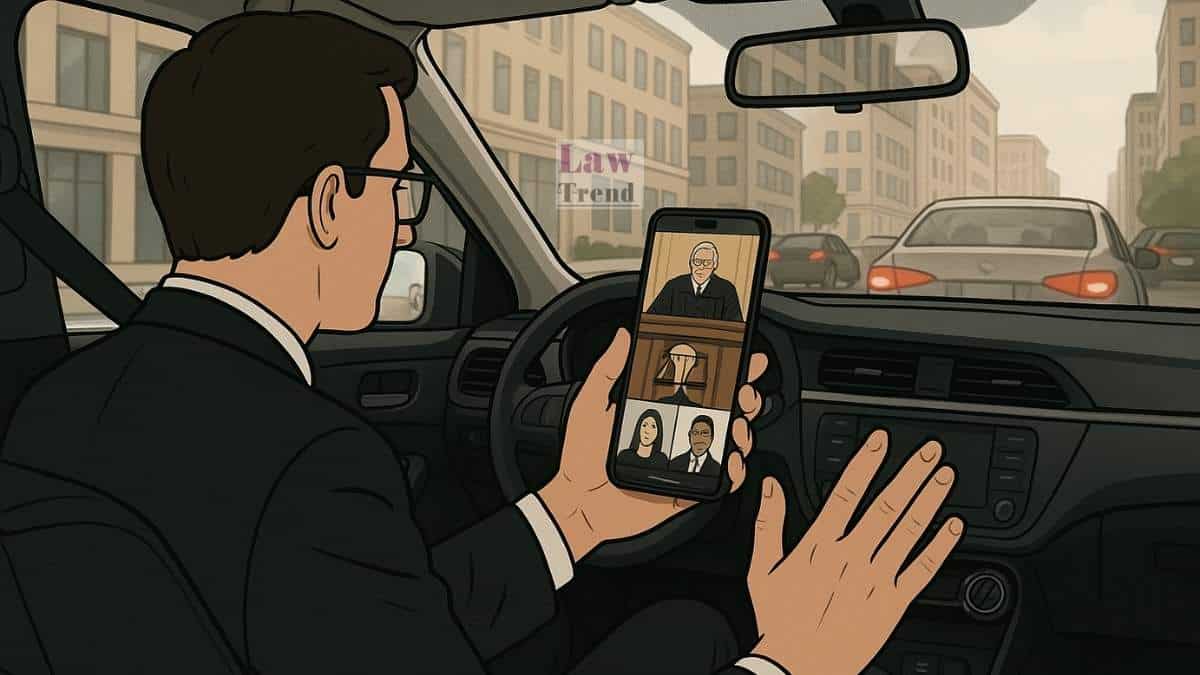
The Bombay High Court on Monday (December 8) directed the Maharashtra State Government to allocate dedicated space or “cubicles” within or near court premises to facilitate lawyers appearing in virtual hearings. The direction came after the Division Bench expressed strong disapproval regarding lawyers addressing the Court while sitting in their parked vehicles.
A Division Bench comprising Chief Justice Shree Chandrashekhar and Justice Gautam A. Ankhad was hearing a batch of election petitions when the issue of proper infrastructure for hybrid hearings arose. Observing that addressing the judiciary from a car undermines the dignity of the court proceedings, the Bench ordered the State to ensure adequate facilities are provided for advocates to join video conferencing (VC) proceedings in a professional environment.
Background of the Case
The development occurred while the High Court was hearing over 100 petitions related to the local body election process in Maharashtra. To ensure consistency in judicial orders and prevent conflicting rulings from different benches, all such petitions from across the state were clubbed together and listed before the Principal Seat of the Bombay High Court in Mumbai.
Given the statewide nature of the litigation, lawyers from various districts, including those practicing at the Nagpur and Aurangabad benches, were required to appear before the Chief Justice’s bench. Consequently, many advocates opted to join the proceedings through video conferencing.
The Incident and Arguments
During the session, the Bench noticed a lawyer appearing on the screen while sitting in a car. Taking note of the inappropriate setting, Chief Justice Chandrashekhar asked, “Who is this sitting in the car? Please log off.” The lawyer immediately disconnected.
Shortly thereafter, another lawyer, practicing at the Nagpur Bench, also joined the proceedings from her car. When questioned by the Bench, the lawyer explained her predicament: she had to attend physical hearings at the Nagpur Bench and subsequently join the Mumbai proceedings online. Due to the lack of dedicated infrastructure for virtual appearances at the court complex, she was forced to log in from her vehicle.
Addressing the State, the Court inquired whether there were any designated cubicles or spaces for lawyers to attend online hearings.
Additional Public Prosecutor Neha Bhide, appearing for the State of Maharashtra, informed the Court that there was currently no separate space available within the Mumbai High Court premises. She submitted that the situation regarding space constraints might persist until the new High Court building is constructed.
Court’s Observations and Analysis
The Bench took a grim view of lawyers arguing cases from vehicles but acknowledged the infrastructural deficit. The Chief Justice remarked, “You cannot address the Court sitting in a car.”
However, emphasizing the necessity of digital infrastructure in modern legal practice, the Court rejected the State’s submission regarding the new building as a reason for delay. The Bench observed that lawyers cannot be expected to function effectively without logistical support, especially when they are required to switch between physical and virtual courts.
“There must be some place. Usually, the Bar Association provides this facility. There should be some cubicles,” the Court noted.
Decision and Directions
The Bombay High Court directed the State Government to immediately identify and allocate space for virtual hearing facilities.
- Infrastructure: The Court ordered the State to find space, either within the existing High Court building or in a nearby building, to set up cubicles where lawyers can appear for online hearings with proper decorum.
- Election Petitions: Regarding the merits of the listed cases, the Court dismissed three petitions—one related to voter lists and two concerning nomination disputes. Six other petitions were permitted to be withdrawn with the liberty to file fresh election petitions after the conclusion of the polls.
- Adjournment: Matters specifically challenging the postponement of elections in certain wards of Nagpur were adjourned until December 22, noting that the Nagpur Bench had already granted interim relief on December 2.
The Court reiterated that until the new court complex is ready, interim arrangements must be made to uphold the dignity of judicial proceedings while accommodating technological needs.


