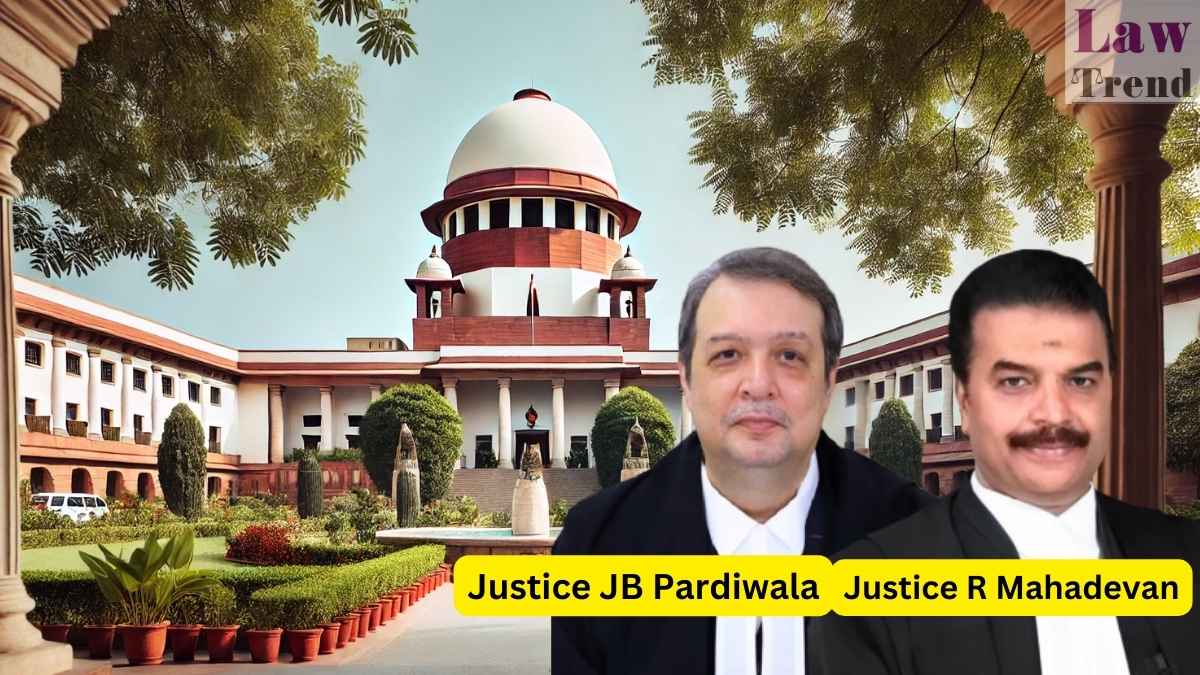
In a significant judgment settling the law regarding the termination of arbitral proceedings and the remedies available against such orders, the Supreme Court has held that an order terminating proceedings for non-payment of fees under Section 38 of the Arbitration and Conciliation Act, 1996 (“Act, 1996”) is essentially an order under Section 32(2)(c). A Bench comprising Justice J.B. Pardiwala and Justice R. Mahadevan ruled that the appropriate remedy for a party aggrieved by such termination is to first file an application for recall before the Arbitral Tribunal, and if rejected, to approach the Court under Section 14(2) of the Act. The Bench explicitly barred the filing of fresh applications under Section 11 to initiate a second round of arbitration.
Background of the Case
The appeal arose from a partnership dispute involving ‘M/s Amritsar Health & Hospitality Services’. Following disputes over capital contributions and management, the appellants invoked the arbitration clause. The Punjab and Haryana High Court appointed a Sole Arbitrator in March 2020, directing fees to be determined per the Fourth Schedule of the Act.
The Sole Arbitrator initially fixed the fee based on the Statement of Claim. However, after the respondent filed a counter-claim of over Rs. 82 Crores, the Arbitrator revised the fee to Rs. 37,50,000/-. The appellants expressed inability to pay the enhanced fee for both the claim and counter-claim. Since neither party was willing to pay the requisite fees, the Sole Arbitrator terminated the proceedings on March 28, 2022, invoking Section 38 of the Act.
The appellants challenged this termination via a Writ Petition, which was dismissed. Subsequently, they filed a fresh petition under Section 11(6) for the appointment of a new arbitrator, which the High Court rejected as not maintainable. The appellants then approached the Supreme Court.
Legal Issues
The Supreme Court addressed three core questions:
- The meaning of “termination of arbitral proceedings” under various provisions of the Act.
- Whether termination under Section 38 (non-payment of costs) is the same as termination under Section 32.
- The remedy available to a party aggrieved by an order terminating proceedings.
The Court’s Analysis
1. Source of Power to Terminate Proceedings The Court analyzed Sections 25 (default of party), 30 (settlement), 38 (deposits), and 32 (termination) of the Act. The Bench held that Section 32 is exhaustive and is the sole repository of the Tribunal’s power to terminate proceedings.
Justice Pardiwala, authoring the judgment, observed:
“The power of the arbitral tribunal to terminate the proceedings under the scheme of the Act, 1996 lies only in Section 32(2). The other provisions, namely, Section(s) 25, 30 and 38 of the Act, 1996, only denote the circumstances in which the tribunal would be empowered to take recourse of Section 32(2) and thereby, terminate the proceedings.”
The Court clarified that the phrase “the mandate of the Arbitral Tribunal shall terminate” in Section 32(3) applies to all forms of termination, rejecting previous distinctions made in SREI Infrastructure Finance Ltd. v. Tuff Drilling regarding Section 25(a). The Court stated:
“Irrespective of whether the proceedings are terminated on account of the rendition of a final award, or by the withdrawal of claims, or on account of default by the claimant… the legal effect remains the same, inasmuch as the arbitral tribunal thereafter stands divested of authority to act in the reference.”
2. Procedural Review and Recall Application The Court held that Arbitral Tribunals possess an inherent power of “procedural review” to recall an order terminating proceedings. This is distinct from a review on merits.
“The arbitral tribunal possesses the inherent procedural power to recall an order terminating the proceedings as such power is merely to correct an error apparent on the face of the record or to address a material fact that was overlooked.”
3. The Remedy: Section 14(2) Acknowledging a legislative gap regarding remedies against termination orders, the Court adopted a purposive interpretation of Section 14(2) of the Act. The Court held:
“We are of the considered opinion that Section 14 sub-section (2), particularly the expression ‘the Court to decide on the termination of the mandate’ should be given an expansive meaning to include any challenge to an order for termination of proceedings simpliciter.”
The prescribed procedure is:
- Recall Application: Move the Tribunal itself to recall the termination order.
- Section 14(2) Petition: If the recall is dismissed, approach the Court under Section 14(2).
- No Fresh Section 11: Parties cannot file a fresh Section 11 application.
The Court reasoned that allowing fresh arbitration after termination due to default would encourage “Tribunal Hopping” and defeat the principle of procedural self-responsibility.
Decision and Directions
On Arbitral Fees: The Court referred to ONGC Ltd. v. Afcons Gunanusa JV (2022), reiterating that while consent is required for fee fixation, if consensus fails, the Arbitrator may fix fees per the Fourth Schedule, which binds the parties. In this case, since the fees were fixed under the Fourth Schedule, the appellants could not object. The Court found no infirmity in the Arbitrator’s decision to terminate proceedings under Section 38 due to non-payment.
Final Order: However, noting that the law regarding termination and remedies was in a “state of flux and uncertainty” when the proceedings were terminated in 2022, the Court granted relief to the appellants.
“In view of the peculiar facts and circumstances of this case, and in order to ensure that the parties are not deprived of any means of adjudication of their dispute, we are inclined to extend one last opportunity to the appellants herein to resolve the same through one another round of arbitration.”
The appeal was partly allowed, and the matter was remanded to the High Court for the appointment of a substitute arbitrator.
Suggestions for Law Ministry: The Court concluded with meaningful suggestions for the pending Arbitration and Conciliation Bill, 2024, urging the Department of Legal Affairs to:
- Consolidate termination powers into a single provision (similar to SIAC/LCIA Rules).
- Explicitly provide for the Tribunal’s power to review/recall orders.
- Consider providing a statutory appeal under Section 37 against termination orders.
- Clarify whether a party allowing proceedings to terminate due to default can re-initiate arbitration.