

Hostile Witness Testimony Not to Be Rejected in Toto; Credible Parts Can Be Relied On: SC Sets Aside Conviction in SC/ST Act Case
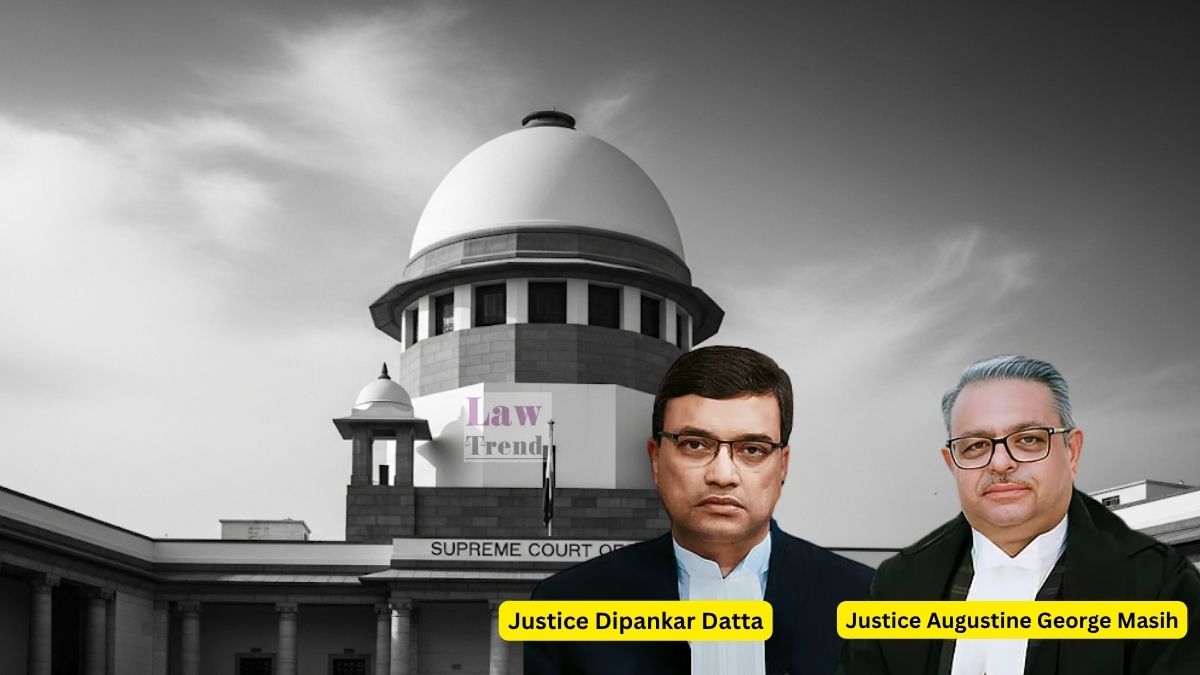

The Supreme Court has set aside the conviction of two individuals accused of assault and offences under the Scheduled Castes and Scheduled Tribes (Prevention of Atrocities) Act, 1989, establishing that the testimony of a hostile witness cannot be rejected in toto and can be relied upon if it supports the prosecution or the defence.

A Division Bench comprising Justice Dipankar Datta and Justice Augustine George Masih allowed the appeal filed by Dadu @ Ankush and Ankit, overturning the judgment of the Madhya Pradesh High Court dated January 18, 2024.

The primary legal issue before the Apex Court was whether the High Court erred in ignoring the testimony of a hostile witness that supported the defence’s version of events. The Court also examined the sustainability of a conviction based on the testimony of interested witnesses which was at variance with medical evidence. The Court acquitted the appellants, holding that the prosecution failed to prove its case beyond reasonable doubt and that the High Court’s findings were “perverse.”

Background of the Case

The case stemmed from an incident on October 4, 2015. The complainant (the prosecutrix) alleged that the appellants came to her house when her parents were away. She claimed that Appellant No. 2 (Ankit) pulled her dupatta and scratched her neck. When her brother (PW-2) intervened, he was allegedly beaten by both appellants.

READ ALSO  Supreme Court criticizes Registry for Not Listing Cases Despite Orders

The Trial Court convicted Appellant No. 1 (Dadu) under Section 323 of the Indian Penal Code (IPC). Appellant No. 2 was convicted under Sections 354 and 323 of the IPC and Section 3(1)(xi) of the SC/ST Act, receiving a sentence of one year of rigorous imprisonment. The High Court dismissed their appeal, affirming the conviction.

Arguments and Evidence

The prosecution relied on the testimony of the victim (PW-1) and her brother (PW-2). PW-2 deposed that he rushed home upon hearing of the fight and found the accused teasing his sister. He claimed he was beaten with wood, suffering bleeding injuries on his nose and mouth.

The defence, however, suggested a different narrative. PW-4, a relative of the victim who was declared hostile, deposed that a scuffle broke out at a Ganesh Puja pandal because of overcrowding, where the appellants allegedly stepped on PW-2’s feet.

Supreme Court’s Observations and Analysis

The Supreme Court meticulously analyzed the evidence, placing significant weight on the handling of the hostile witness and highlighting several discrepancies in the prosecution’s case.

1. Admissibility of Hostile Witness Testimony The Supreme Court criticized the High Court for ignoring the evidence of PW-4 solely because he had turned hostile. The Bench observed that PW-4’s testimony regarding a scuffle at the Ganesh Puja pandal offered a “probable and believable” explanation for the injuries sustained by PW-2, which contradicted the prosecution’s story of an assault at the home.

READ ALSO  Bombay HC Castigates SEBI, BSE, NSE for Unjust Freezing of Demat Accounts, Orders Rs. 80 Lakh in Damages

Citing the precedent in State of U.P. v. Ramesh Prasad Misra (1996), the Court reiterated the settled legal position:

“…it is settled law that the evidence of a hostile witness would not be totally rejected if spoken in favour of either the prosecution or the accused. It would rather have to be subjected to closer scrutiny and that portion of the evidence which is consistent with the case of the prosecution or defence may be accepted.”

2. Contradiction in Ocular and Medical Evidence The Court noted that while PW-2 claimed to have suffered bleeding injuries on his nose and mouth, the Medical Officer (PW-5) found no such injuries. The injuries recorded were simple scratches.

“It is also noteworthy that the injuries found on the person of both the victim and PW-2 were simple injuries which, according to PW-5, seem to have been caused by a hard and blunt object,” the Bench observed.

3. Lack of Independent Witnesses The Court found it “strange” that despite PW-2’s claim that “many people from the locality had come and had seen the incident,” no independent witness was examined.

READ ALSO  सुप्रीम कोर्ट ने सिविल जज पद के लिए तेलुगु भाषा में प्रवीणता अनिवार्य करने वाले तेलंगाना नियम को सही ठहराया

4. Finding on SC/ST Act Termed “Perverse” The Supreme Court took strong exception to the High Court’s conclusion that the offence was committed simply because the complainant belonged to a Scheduled Caste.

“Curiously, there appears to be no statement in court in course of trial by the victim that A-2 committed the alleged offence only because of the victim being a member of Scheduled Caste… The finding returned by the High Court is, thus, perverse,” the Court held.

Decision

The Supreme Court held that the conviction and sentence of the appellants were “indefensible.”

“We do not see reason to hold, in view of the evidence of PW-5 and our above findings, that A-2 ought to be held guilty of an offence under Section 323, IPC,” the Bench ruled.

Accordingly, the appeal was allowed, the judgment of the High Court was set aside, and the appellants were acquitted and discharged from their bail bonds.

Law Trend
Law Trendhttps://lawtrend.in/
Legal News Website Providing Latest Judgments of Supreme Court and High Court

Related Articles

Latest Articles

