

“Activity Specific, Not Person Specific”: Supreme Court Upholds GST Exemption on Renting of Residential Dwelling to Hostel Aggregators
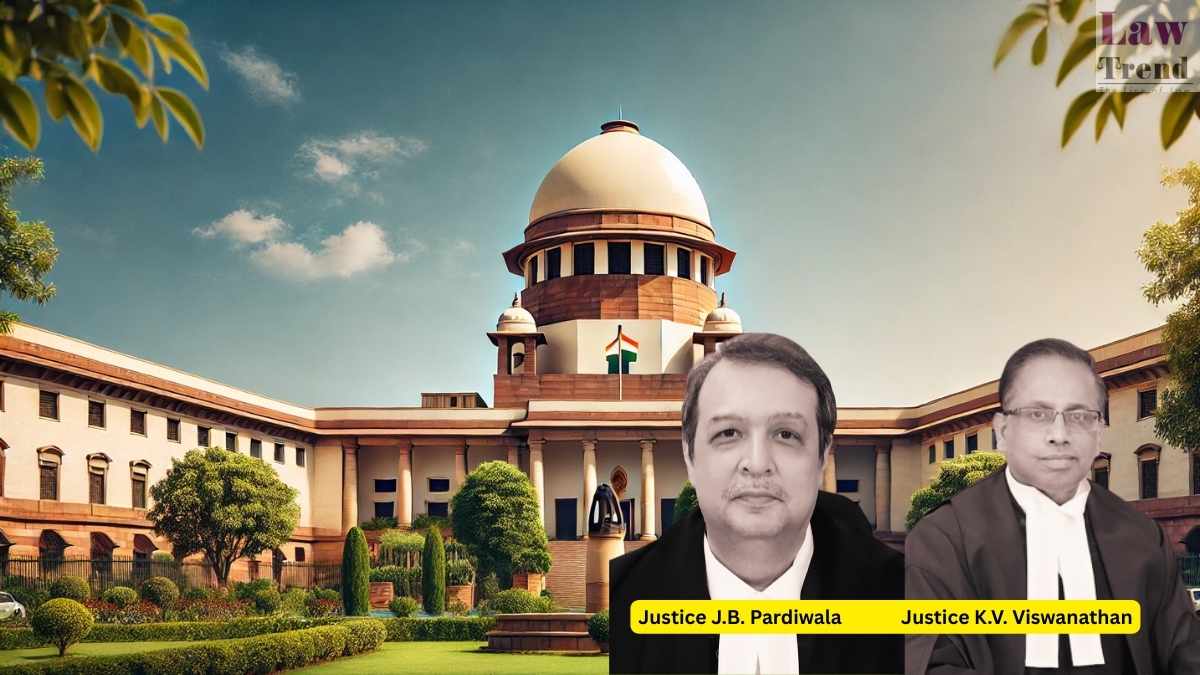
The Supreme Court of India has dismissed the appeals filed by the State of Karnataka, upholding the decision of the Karnataka High Court that the leasing of residential premises to a lessee for the purpose of using them as a hostel for students and working professionals is exempt from Goods and Services Tax (GST).

The Division Bench comprising Justice J.B. Pardiwala and Justice K.V. Viswanathan held that the exemption under Entry 13 of Notification No. 9/2017-Integrated Tax (Rate) dated 28.06.2017 is “activity specific” and not “person specific.” The Court ruled that the benefit of the exemption is available even if the lessee (an aggregator) does not use the premises for their own residence, provided the property is ultimately used as a residence.

The core legal issue was whether the service of leasing residential premises by the Respondent to a company, which in turn sub-leased them as hostel accommodation to students and professionals, falls within the ambit of Entry 13 of Notification No. 9/2017 (prior to its amendment in July 2022). The Supreme Court affirmed the High Court’s view, setting aside the rulings of the Authority for Advance Ruling (AAR) and the Appellate Authority for Advance Ruling (AAAR) which had denied the exemption.

Background of the Case

Respondent No. 1, the co-owner of a residential property in Bangalore consisting of 42 rooms, executed a lease deed on 21.06.2019 in favour of M/s DTwelve Spaces Private Limited (the Lessee). The Lessee used the property to provide long-term hostel accommodation to students and working professionals.

The Respondent sought an advance ruling on whether the rent received from the Lessee was exempt from GST under Entry 13 of Notification No. 9/2017, which exempts “services by way of renting of residential dwelling for use as residence.”

  • AAR & AAAR Ruling: Both authorities held that the exemption was not available because the Lessee (a private limited company) was not using the premises for its own residence, and the hostel accommodation was akin to “sociable accommodation.”
  • High Court Judgment: The Karnataka High Court allowed the Writ Petition filed by the Respondent, holding that the Notification does not require the lessee to use the premises as a residence personally. It held that hostels for students and working professionals constitute a “residential dwelling.”
READ ALSO  College Fee cannot be Enhanced/ Fixed without the Recommendations of AFRC: Supreme Court

Aggrieved by the High Court’s order, the Revenue (State of Karnataka) approached the Supreme Court.

Arguments of the Parties

Submissions on behalf of the Revenue: Mr. V. Chandrashekara Bharathi, counsel for the Revenue, argued that for the exemption to apply, three conditions must be met conjunctively:

  1. Supply of service of renting.
  2. Renting must pertain to a residential dwelling.
  3. Such dwelling must be used as a residence.

The Revenue contended that the transaction between the Lessor and the Lessee (a commercial entity engaged in profit) was purely commercial. It was argued that the Lessee was not using the property as a residence, and the exemption should be tested strictly on the “first transaction” (Lessor to Lessee) without importing facts of the “second transaction” (Lessee to students).

Submissions on behalf of the Respondent: Senior Advocate Mr. Arvind P. Datar, appearing for the Respondent, argued:

  • The Lessee is an aggregator facilitating residential accommodation.
  • Denying exemption because the Lessee is a company would amount to rewriting Entry 13 to read “for use as residence by the lessee.”
  • The ultimate use of the property is for residence by students and working women.
  • The property fulfills all conditions: it is a residential dwelling, it is rented, and it is used for residence.
READ ALSO  Certified Copies Of Sale Deeds Are Admissible As Public Documents Under The Evidence Act:  Patna High Court

Court’s Analysis

1. Definition of “Residential Dwelling” The Court noted that “residential dwelling” is not defined in the GST Act. Relying on the Education Guide issued by CBIC under the Service Tax regime and the Bombay High Court’s decision in Bandu Ravji Nikam v. Acharyaratna Deshbushan Shikshan Prasark Mandal (2003), the Court observed:

“Undoubtedly, ‘hostel’ is nothing but a house of residence or lodging for students… As in the present case, ‘Students hostel’ was also to be used for sleeping, eating, studies etc. temporarily if not permanently day to day, it cannot be described as ‘non-residential’ use…”

The Bench concluded that a property with 42 rooms meant for long-term stay qualifies as a residential dwelling.

2. Interpretation of Entry 13 The Court rejected the Revenue’s argument that the Lessee must use the property as a residence. The Court held:

“Entry 13 of the Exemption Notification does not mandate that the lessee must use the residential dwelling as its own residence. Giving any other interpretation would mean adding an additional condition to Entry 13.”

3. Purposive Interpretation Applying the doctrine of purposive interpretation, the Court emphasized that the legislative intent was to exempt rented properties used as residences from the burden of GST.

“Giving Entry 13 a narrow interpretation by holding that it is available only when the property so rented is used by service recipient themselves would ultimately lead to legislative intent being defeated… In other words, the legislative intent behind this exemption clause is that a rented property that is used as residence should not suffer 18% GST or IGST.”

The Court noted that levying 18% GST on the transaction between the Lessor and the Lessee would ultimately be passed on to students and working professionals, defeating the exemption’s purpose.

READ ALSO  धारा 313 CrPC आरोपी को अपनी बेगुनाही साबित करने का मूल्यवान अधिकार प्रदान करता है और अनुच्छेद 21 के तहत संवैधानिक अधिकार हैः सुप्रीम कोर्ट

4. Activity Specific Exemption The Court clarified the nature of the exemption under the GST regime:

“In addition to above, it is pertinent to note that exemption envisaged under Entry 13 is an activity specific exemption and not person specific exemption.”

The Court distinguished this from other entries (like charitable activities) which are specific to the status of the person/entity.

5. 2022 Amendment Not Retrospective The Court acknowledged that Entry 13 was amended w.e.f. 18.07.2022 to exclude cases where the residential dwelling is rented to a “registered person.” However, the Court held:

“Through these appeals, the revenue is, in effect, trying to give retrospective application to the amendment made in 2022, which is impermissible.”

Decision

The Supreme Court held that for the period in question (2019-2022), the Respondent satisfied all conditions of Entry 13.

“In view of the aforesaid discussion, we have reached the conclusion that we should not interfere with the impugned judgment and order passed by the High Court. As a result, both the appeals fail and are hereby dismissed.”

The Court affirmed that the renting of residential dwellings to an aggregator for use as a hostel/residence by students and working professionals is exempt from GST for the relevant period.

Law Trend
Law Trendhttps://lawtrend.in/
Legal News Website Providing Latest Judgments of Supreme Court and High Court

Related Articles

Latest Articles
