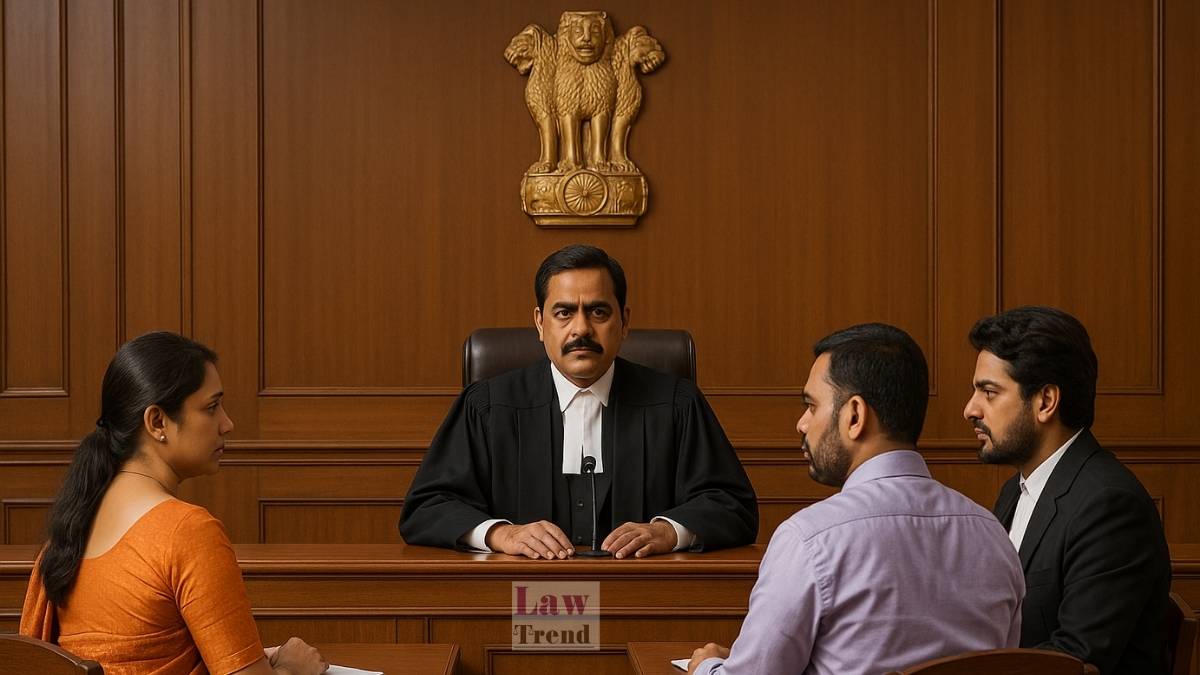
In a significant judgment, the High Court of Delhi has set aside a divorce decree passed by the Family Court, Patiala House Courts, expressing “strong disapproval” of the manner in which the lower court adjudicated the matrimonial dispute. The Division Bench comprising Justice Anil Kshetarpal and Justice Harish Vaidyanathan Shankar observed that the Family Court Judge had relied on a non-existent statutory provision and conflated the provisions of the Hindu Marriage Act, 1955 (HMA) with the Special Marriage Act, 1954 (SMA).
Consequently, the High Court has directed the concerned Judicial Officer, Sh. Harish Kumar, to “undergo an appropriate and comprehensive refresher training program in Matrimonial Laws” under the aegis of the Delhi Judicial Academy before adjudicating further matrimonial matters.
The appeal, filed under Section 19 of the Family Courts Act, 1984, read with Section 28 of the HMA, challenged the judgment dated March 28, 2024, passed by the Family Court. The Court had dissolved the marriage on the grounds of cruelty. However, the High Court found the judgment unsustainable as it invoked “Section 28A” of the Special Marriage Act—a provision that does not exist in the statute book—and closed the parties’ right to lead evidence without affording a fair opportunity.
Background of the Case
The marriage between the Appellant-Husband and the Respondent-Wife was undisputed, though the form was contested. The Appellant claimed the marriage was solemnized on September 26, 2011, under the SMA, followed by a social function. The Respondent asserted the marriage was performed on December 11, 2011, according to Hindu rites.
Marital discord led to multiple legal proceedings, including allegations of cruelty and disputes over the custody of their minor child. Following orders from the Supreme Court in transfer petitions filed by the parties, the divorce petition—originally filed by the wife under Section 13(1)(ia) of the HMA in Siliguri, West Bengal—was transferred to the Family Court, Patiala House Courts, New Delhi.
The proceedings before the Family Court saw a series of procedural steps where the Respondent-Wife’s right to lead evidence was closed on January 18, 2024, the very first date fixed for her cross-examination, due to her absence. Subsequently, the Appellant-Husband’s right to lead evidence was also closed. Without recording oral evidence from either party, the Family Court proceeded to pass the impugned judgment granting divorce.
Arguments of the Parties
Contentions of the Appellant-Husband: The Appellant argued that the impugned judgment was not maintainable because the original petition was filed under the HMA, which he contended was inapplicable as the marriage was registered under Section 13(2) of the SMA. He submitted that the adjudication under HMA provisions was vitiated.
Further, the Appellant contended that the Family Court erroneously relied upon a “proposed amendment which was never gazetted or notified” to dissolve the marriage on the ground of irretrievable breakdown. Specifically, the counsel pointed out that the Family Court referred to “Section 28A of the SMA,” a provision that does not exist in the statute, to support its finding.
Contentions of the Respondent-Wife: Per contra, the counsel for the Respondent-Wife submitted that the Family Court Judge merely took into account the “practical reality of the parties’ marital relationship having effectively ceased to exist.” She argued that the Judge validly exercised jurisdiction to grant a decree of dissolution and that matrimonial laws “should not be permitted to get embroiled in procedural red-tapism.”
Court’s Analysis and Observations
The High Court, after perusing the record, expressed serious concern over the Family Court’s approach. The Bench noted that the Judge had “conflated provisions of distinct and self-contained statutes, each with its own specific procedures and purposes.”
Reliance on Non-Existent Law: The High Court observed that although the petition was filed under the HMA, the Family Court applied provisions of the SMA, specifically “an alleged Section 28A thereof.” The Bench remarked:
“We were, in fact, taken aback to find that the learned Judge relied upon, in the Impugned Judgement, a provision, Section 28A of the SMA, that does not exist on the statute book… It is incomprehensible how a Judicial Officer of the rank of a Family Court Judge could rely upon a non-existent statutory provision to grant a decree of divorce.”
Sanctity of Marriage under SMA: The High Court took strong exception to the Family Court’s observation that marriages under the SMA “cannot be termed as holy union.” The Division Bench held:
“The conclusion drawn by the learned Judge, that marriages solemnised under the SMA ‘cannot be regarded as a holy union’, is an unwarranted extrapolation… The SMA is a secular code… and it in no manner diminishes the dignity, solemnity, or seriousness of such marriages.”
Procedural Irregularity: The Court found that the Family Court acted “unreasonably” by closing the Wife’s right to lead evidence on the very first date fixed for that purpose. The Bench stated:
“Closing the Wife’s right to adduce oral testimony at that first opportunity, without granting any further effective chance, is, ex facie, unfair and unreasonable and runs counter to settled procedural norms and Principles of Natural Justice.”
The Court also noted that the Family Court Judge had followed a similar pattern in other cases (Upinder Kaur Malhotra, Lovely Sharma, etc.), invoking procedural flexibility to bypass mandatory statutory requirements.
Decision
The High Court held that the impugned judgment was “unsustainable in law” as it was rendered based on non-existent provisions and without proper evidentiary foundation.
- Appeal Allowed: The judgment dated March 28, 2024, was set aside.
- Remand: The matter was remanded to the Principal Judge, Family Court, Patiala House Courts, for de novo adjudication.
- Direction for Evidence: The Family Court was directed to permit both sides to adduce oral and documentary evidence.
- Training Direction: The Court directed that the concerned Judicial Officer “shall undergo an appropriate and comprehensive refresher training program in Matrimonial Laws… before he adjudicates any further matrimonial matters.”
The parties have been directed to appear before the Principal Judge, Family Court, Patiala House Courts, on December 5, 2025.